Recourse After Botched Microblading: Refunds, Complaints, and Reporting a Studio
Published on September 15, 2026

Almost everything written about bad microblading is about the brows: laser, saline, colour correction, how many sessions and how long. We have covered that in detail in our guide to removing bad microblading, and this article is deliberately not about it. This one is about the studio.
There is a second problem sitting underneath the first, and nobody writes about it. You paid someone to cut pigment into your face, the result is wrong, and you have no idea whether you are owed anything, who you would complain to, or whether the form you signed on the way in ended the conversation before it started. Those questions have answers. They are just scattered across agencies that do not talk to each other, and the honest version comes with hard limits. (General consumer information, not legal advice, and the rules really do change at state and county lines.)
Document Everything Before You Say a Word
Every route below asks you for the same thing: evidence gathered at the time. The state board wants it, your card issuer wants it, a judge wants it, your doctor wants it. And the window closes from the day you walk out, because brows heal, colour shifts, and studios stop answering messages.
Start photographs immediately and keep them daily for at least three weeks. Same spot, same time of day, same light, no filter, no makeup, one straight-on shot and one from each side, since asymmetry is far easier to see at an angle. Phone photos carry timestamps in their metadata, which is exactly the dull corroboration that makes a complaint credible later.
Then collect the paperwork while it still exists: the signed consent form, the receipt, the aftercare sheet, and every text, DM, and email with the studio. Screenshot the booking page and the portfolio post that sold you on it, because both can be edited or deleted. If you can find out the pigment brand and batch, write it down. That is close to useless for a refund argument and close to essential if you end up with a reaction and a health department asks what went into your skin. Finally, write a dated account of the appointment while it is fresh: who worked on you, whether they were the person you booked, what was said about the shape, whether the tools came out of sealed packaging. You will not remember any of it accurately in six weeks, and those specifics are what agencies act on.
Is It Botched, or Is It Week Three?
This is the uncomfortable gate, and skipping it is how people burn their leverage.
Freshly microbladed brows look wrong. They are too dark and too sharp for the first week, they scab, and around week two or three the colour appears to vanish almost entirely. That ghosting phase is normal and the pigment usually resurfaces. Our day by day healing timeline walks through what each stage should look like. A furious email sent on day five about a brow that will look fine on day forty costs you the one thing you want later: the appearance of a reasonable person who gave the studio a fair chance.
Real problems are usually still real at six weeks, and most are structural rather than tonal. Brows mapped too low, tails dropping in different places, strokes blurred into a solid block, a shape you specifically said you did not want, or work done by someone other than the artist you booked and paid for. None of that resolves with patience.
Infection is the exception and waits for nothing. Spreading redness, heat, swelling that increases rather than decreases after day three, pus, red streaking, or fever means a doctor now, not a six week review. Our risks and contraindications guide covers the warning signs. Getting treated promptly also preserves your options, since a documented, cultured infection is far stronger evidence than a remembered one.
What the Consent Form Does and Does Not Sign Away
Clients tend to assume the form they scribbled on is a full surrender. It is not.
A consent form documents informed consent to known risks. It says you were told results vary, that pigment can heal unevenly, that colour can shift, that a touch-up is part of the process rather than a bonus, and that scarring and allergic reaction are possible. If your complaint is essentially that microblading carries the risks microblading carries, the form is a good answer to it.
What a form generally cannot do is convert negligence into an agreed outcome. Signing a paper does not authorise unsanitary practice, does not license an unlicensed operator, and does not make legal a procedure the practitioner was never permitted to perform. Nor does a “no refunds under any circumstances” line erase the statutory rights you hold through your card issuer, or the jurisdiction a regulator holds over that business. A studio can set its own refund policy. It cannot write itself out of the law.
The scope of practice point is where the most serious cases live. When the California Board of Barbering and Cosmetology disciplined celebrity aesthetician Sonya Dakar in 2026, the conduct at issue was that procedures had been performed which an esthetician licence did not permit at all. The client in that case, Victoria Nelson, put it better than any regulator has: “It shouldn’t be on the consumer to know what is within and without someone’s license.” She is right that it should not be. Practically, knowing roughly where that line sits in your state is what tells you whether you have a complaint or a disappointment.
Asking the Studio: Correction First, or Refund First
Decide which you actually want before you open your mouth, because you rarely get both, and asking for money usually ends any prospect of that studio touching your face again.
For genuinely fixable problems, a correction at the included touch-up is the better ask and the likelier yes. It costs the studio time rather than cash, and a reputable artist would generally rather adjust the work than have it walking around town. Name the change you want, in writing, with your photographs attached.

A refund is the right ask when you have lost confidence in the artist, when the work needs removal rather than adjustment, or when something happened you would not let happen twice. Ask in writing even if you have already phoned, and keep the tone flat: the date, what was agreed, what the result is, what you want, and a reasonable deadline. Federal consumer guidance is consistent that this is not a formality. A written, dated, unemotional request is the document every later step gets built on. Escalate to the owner or head office if the artist is not the decision maker, which at a multi-location studio is often the case. Partial refunds are common: the touch-up fee and part of the session back, with no obligation to return, is frequently the most realistic good outcome on the table.
The Card Chargeback: What It Actually Covers
This is where most internet advice is simply wrong, so it is worth being precise. United States credit card protections under the Fair Credit Billing Act split into two categories, and a bad brow sits in the harder one.
Billing errors are the straightforward group: charged for a touch-up you never received, double charged, charged after cancelling, wrong amount, unauthorised charge. Dispute these in writing so the letter reaches the issuer within 60 days of the first statement showing the error, at the billing inquiries address rather than the payments address. The issuer must acknowledge within 30 days and resolve within 90.
Quality disputes are the other group, and “my brows are wrong” is one of them. You were charged the agreed amount for a service that was in fact performed, so it is not a billing error at all. The Act does let you dispute charges for unsatisfactory goods and services, but it attaches conditions: a good faith attempt to resolve it with the seller first, a purchase over a small dollar threshold, and a purchase made in your home state or within 100 miles of your billing address. Card networks often apply their own more generous rules, but the statutory floor is that narrow and you should not plan around a waiver nobody has promised you.
Two things follow. The “try the seller first” condition is not box-ticking, which is why the written request in the previous section matters so much. And that 100 mile radius is exactly why a session bought overseas is the hardest kind to dispute, a problem our guide to getting microblading abroad covers alongside the rest of the cross-border question. Debit card protections are weaker again. Assume, either way, that a chargeback ends the relationship.
Reporting a Studio: Finding Who Actually Has Jurisdiction
The reason this feels confusing is that it genuinely is split, and not intuitively.
The FDA treats tattoo and permanent makeup inks as cosmetics and acts on the ink. The agency is explicit, though, that “the actual practice of tattooing is regulated by local jurisdictions.” The needle, the room, the sharps bin, and the person holding the blade are a state and county matter, not a federal one.
Which body depends on where you are. In some states permanent cosmetics sits with the cosmetology or barbering board. In others it is body art licensing through the health department, and the permit frequently attaches to the premises rather than to the individual artist, a distinction we unpack in our comparison of chain studios and independent artists. The Society of Permanent Cosmetic Professionals maintains a state-by-state reference for exactly this reason, while advising people to check the current statute and contact county or city health officials about local ordinances.
Know what a board will act on. Sanitation failures, reused or unsterile equipment, unlicensed practice, working outside a licence, misrepresented credentials, and injury are all within reach. “I don’t like the arch” is not. File in writing, attach the photographs and the dated account, and name the individual as well as the business.
When it works, it works substantially. The Dakar outcome was surrender of both the esthetician and establishment licences, a three year bar on applying for reinstatement, and a condition that reinstatement would require paying $70,972.27 in restitution to the complainant plus $17,731.25 in state investigative costs, with the allegations treated as admitted on the disciplinary record. Note the shape of that carefully, though. The restitution is conditional on the practitioner choosing to come back. A board order is a sanction on a licence, not a cheque in the post.
Sometimes there is no door to knock on at all. A 2019 investigation by KUTV in Salt Lake City found Utah was then one of only six states requiring no training or licensing whatsoever for permanent cosmetics, leaving a local practitioner with a complaint about her own training provider and no licensing body with authority to hear it. Where there is no licence, there is no board, and your remaining routes are the health department on sanitation grounds, the state attorney general or consumer protection office, and the courts.
When It Becomes a Medical and Public Health Matter
An infection changes the category, and the sequence matters. See a doctor first, and ask specifically whether the site can be cultured. Naming the organism is what turns “my brow got infected” into something a health department can investigate, and it changes your treatment too, since the atypical bacteria implicated in tattoo infections do not respond to the antibiotics prescribed for an ordinary skin infection.
Then report it to your county or city health department. This is the step people skip, and the one with consequences beyond your own face. When the CDC investigated tattoo-associated nontuberculous mycobacterial infections across multiple states in 2011 and 2012, the New York cluster alone ran to 14 confirmed cases traced to a single nationally distributed pre-diluted grey ink. Clusters like that are only ever visible because individuals reported to local officials, who then connected cases nobody could see one at a time.
Reactions to the pigment itself do have a federal channel, because the ink is the part the FDA regulates. Consumers can file through the MedWatch online voluntary reporting form, submit Form FDA 3500B by mail or fax, or call the Food and Cosmetics Information Center on 1-888-SAFEFOOD and select option 4. Rashes, infection, scarring, and hair loss are all explicitly within what the agency asks to hear about, whether or not you needed treatment. It was a run of more than 150 adverse reaction reports to particular permanent makeup shades that produced a recall in 2004.
The Realistic Limits of Small Claims
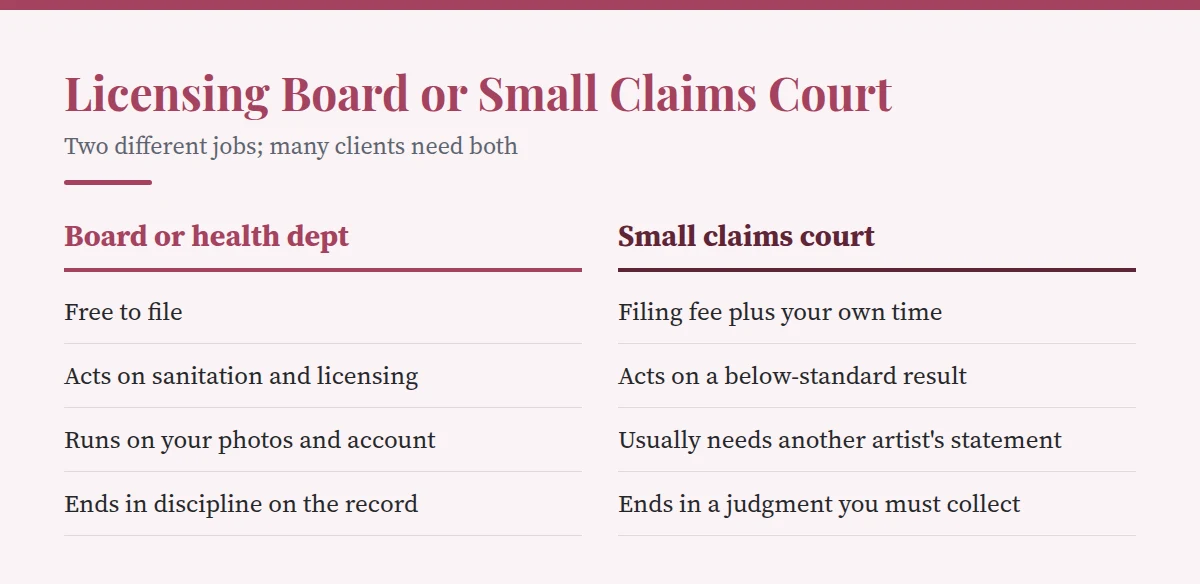
Small claims court is built for a dispute this size. It is cheap to file, you do not need a lawyer, and the amounts are usually in range: California allows individuals to sue for up to $12,500, New York City’s limit is $10,000, and other states run from a few thousand dollars up to around $25,000.
The limits worth knowing are not about the ceiling. You have to prove more than dissatisfaction, which generally means showing the work fell below a competent standard, and that ordinarily requires another artist or a dermatologist willing to say so in writing. An artist who agrees with you warmly in the chair may be much less willing to put their name to a statement about a local colleague.
A judgment is also not money, it is permission to collect money, and collecting from a dissolved single-person LLC or a studio that has reopened under a new name is its own project. Check the business is still registered before you spend the filing fee. Pitch the claim at what you actually lost, which is the session cost plus documented corrective treatment rather than distress, so keep every removal and correction receipt. And watch the clock: statutes of limitation vary by state and by whether the claim is framed as contract or personal injury, so check yours early rather than discovering it at month eleven.
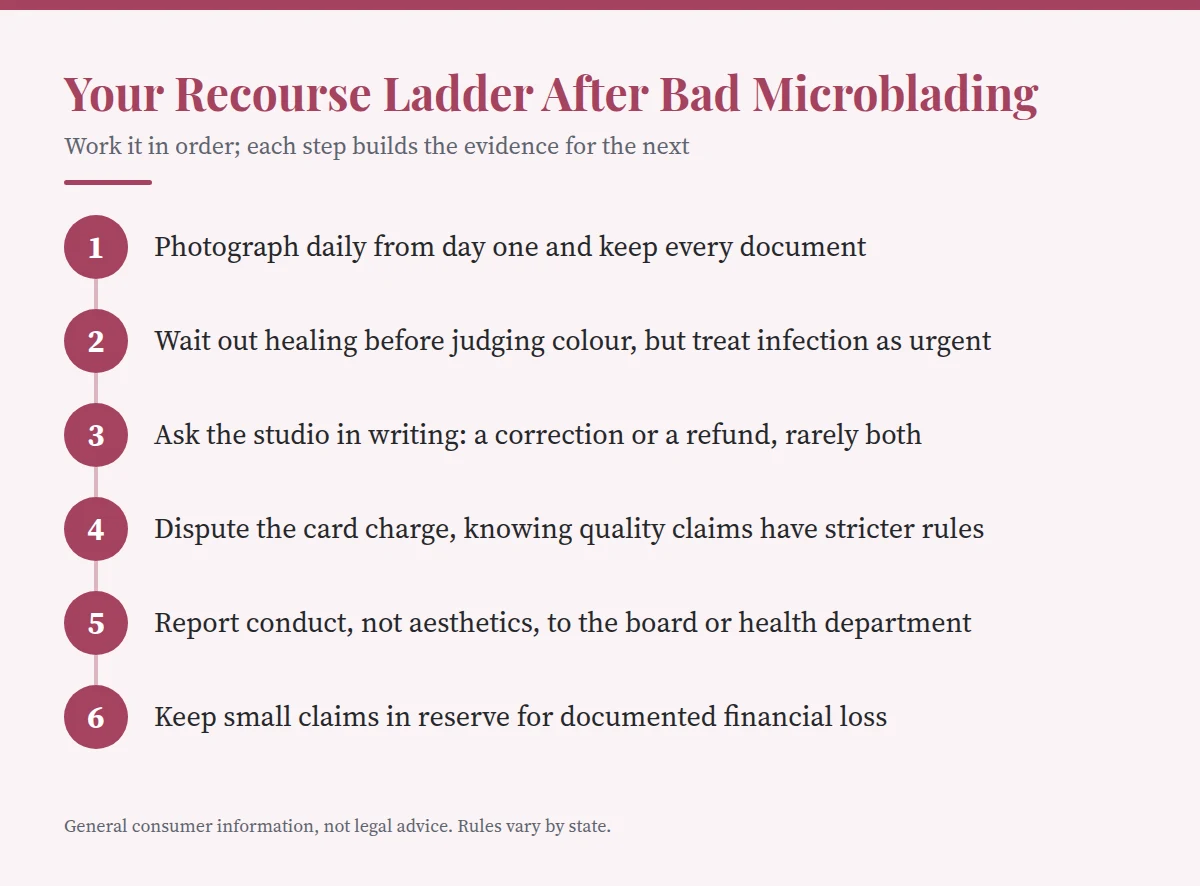
Working the Ladder in Order
None of this repairs the brows. That is a separate and slower project, and our removal and correction guide is the place to start on it. What the ladder does is stop the loss compounding: it keeps your evidence intact, keeps the deadlines from expiring quietly, and puts the conduct on a record somewhere it can be seen again.
That last part is the argument for bothering at all on a day when you would rather let it go. Microblading being semi-permanent rather than permanent cuts both ways. The work will fade long before the record of a complaint does, and the complaint is the part that protects whoever books that chair after you.
Sources
- FDA on why the practice of tattooing is left to local jurisdictions while the ink is federal
- FDA for the MedWatch and Form 3500B routes consumers use to report a pigment reaction
- Federal Trade Commission with the line between a billing error and a quality dispute on a credit card
- Federal Trade Commission covering how to put a complaint to a business in writing and escalate it
- CDC Morbidity and Mortality Weekly Report on the multi-state tattoo ink infection clusters found through local reporting
- Society of Permanent Cosmetic Professionals for the state-by-state regulatory reference and who to contact locally
- NewBeauty reporting the licence surrender and restitution order that followed one client complaint
- KUTV on what happens when a state requires no permanent cosmetics licence at all
- California Courts with the dollar limits that define what fits in small claims