Contaminated Microblading Pigment: Bacteria in Sealed Bottles, FDA Recalls, and Infections a Clean Studio Cannot Stop
Published on September 17, 2026
Most infection advice about microblading is really advice about the studio: a fresh blade, new gloves, a wiped-down chair, a licensed artist. All of it matters. But in December 2018, FDA staff collected an unopened bottle of tattoo ink from one of a Florida manufacturer’s customers in Texas, tested it, and found two species of Clostridium, bacteria that thrive where oxygen is scarce. The bottle was labeled sterile.
No artist could have seen that problem, smelled it, or wiped it away. And this is not only a body art story: when FDA microbiologists tested sealed permanent makeup (PMU) inks, bottles sold for microblading were among the contaminated ones. This guide covers what the testing found, how bacteria get into a bottle, what a sterility claim is worth, how to check a pigment against recall notices, and what an ink-borne infection looks like, which is often not what people expect and not when they expect it.
What FDA Labs Found Inside Sealed Bottles
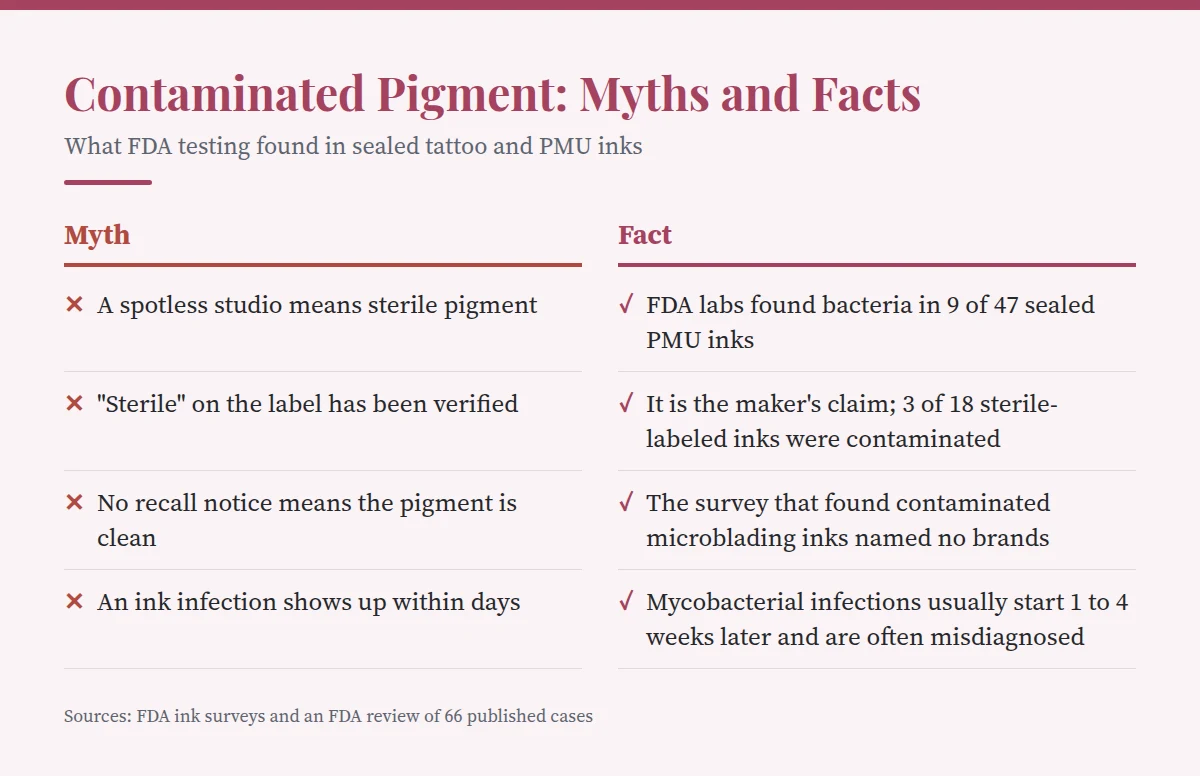
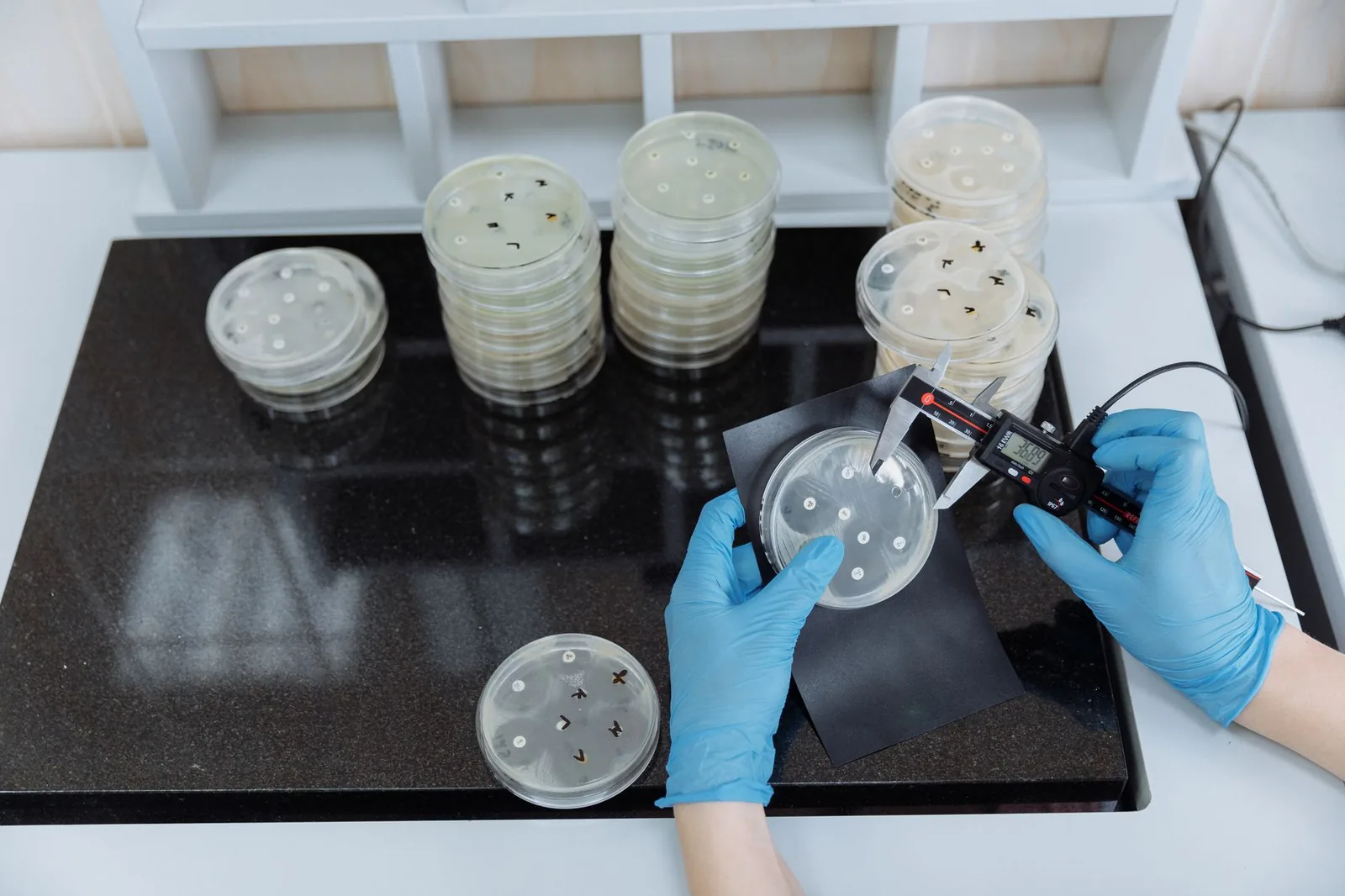
The FDA has been buying inks on the open market and culturing them for years, and it keeps finding the same problem. Its 2018 survey of 85 unopened tattoo and permanent makeup inks from 13 companies found microorganisms in 42 of them, nearly half, including species previously linked to human skin infections.
A follow-up focused on permanent makeup alone. The team bought 47 sealed PMU inks from nine manufacturers, 28 of them sold for microblading, and found contamination in nine. Five of those nine were microblading inks. Most counts were low, under 250 colony-forming units per gram, but the most contaminated bottle in the study, at 980 per gram, was a microblading ink whose label claimed it was sterile.
A 2024 study added a new worry. Using methods designed to also catch bacteria that grow without oxygen, FDA scientists tested 75 tattoo and PMU inks and found 26 contaminated, with 19 of the 34 bacterial isolates classed as possibly pathogenic. Two species, Cutibacterium acnes and Staphylococcus epidermidis, were recovered under anaerobic conditions. That matters because pigment is placed in the dermis, a low-oxygen layer of skin where such bacteria can thrive.
The same testing has pulled products off the market. In 2019 alone, three tattoo ink makers recalled products after FDA sampling: a black ink carrying Bacillus cereus, a basic black with Pseudomonas aeruginosa and Clostridium species, and the ink from the opening of this article.
None of this means a booked appointment will make you ill. Contamination is not the same as infection, and reported infection rates after brow work are low: when a Tokyo clinic surveyed 1,352 eyebrow and eyeliner clients, three reported an infection, about 0.2 percent. That survey ran a median of 15 days after treatment, though, and some ink-borne infections take weeks or months to show.
How Bacteria Get Into a Bottle
At the factory. Inspection records show how ordinary the failures can be. At the Florida plant behind the Clostridium bottle, the FDA documented bulk containers for base color ink that, by the company’s own account, had not been cleaned in years, with new lots poured in on top. The firm did not test incoming raw materials, had no written procedure for testing finished ink before release, and had not tested whether its alcohol preservative actually worked.
Retesting shows the problem can persist. When FDA researchers bought and tested new batches from seven manufacturers with a recall history, six of 28 inks, from two of those companies, were still contaminated. Across 2003 to 2021, the same team counted 15 voluntary ink recalls covering more than 200 inks. Fourteen were for microbial contamination, and eight, all between 2017 and 2021, were prompted by the FDA’s own sampling.
In the studio. The factory is not the only way in. An FDA review of 66 published cases of tattoo and permanent makeup infections caused by nontuberculous mycobacteria, slow-growing relatives of the tuberculosis bacterium, found that contaminated ink was the main source, whether it was diluted with non-sterile water during the procedure or contaminated during manufacturing. A separate review of tattoo infections reaching back to 1820 concluded that poor hygiene causes more infections overall, with contaminated inks contributing substantially and linked to 11 outbreaks that ended in recalls.
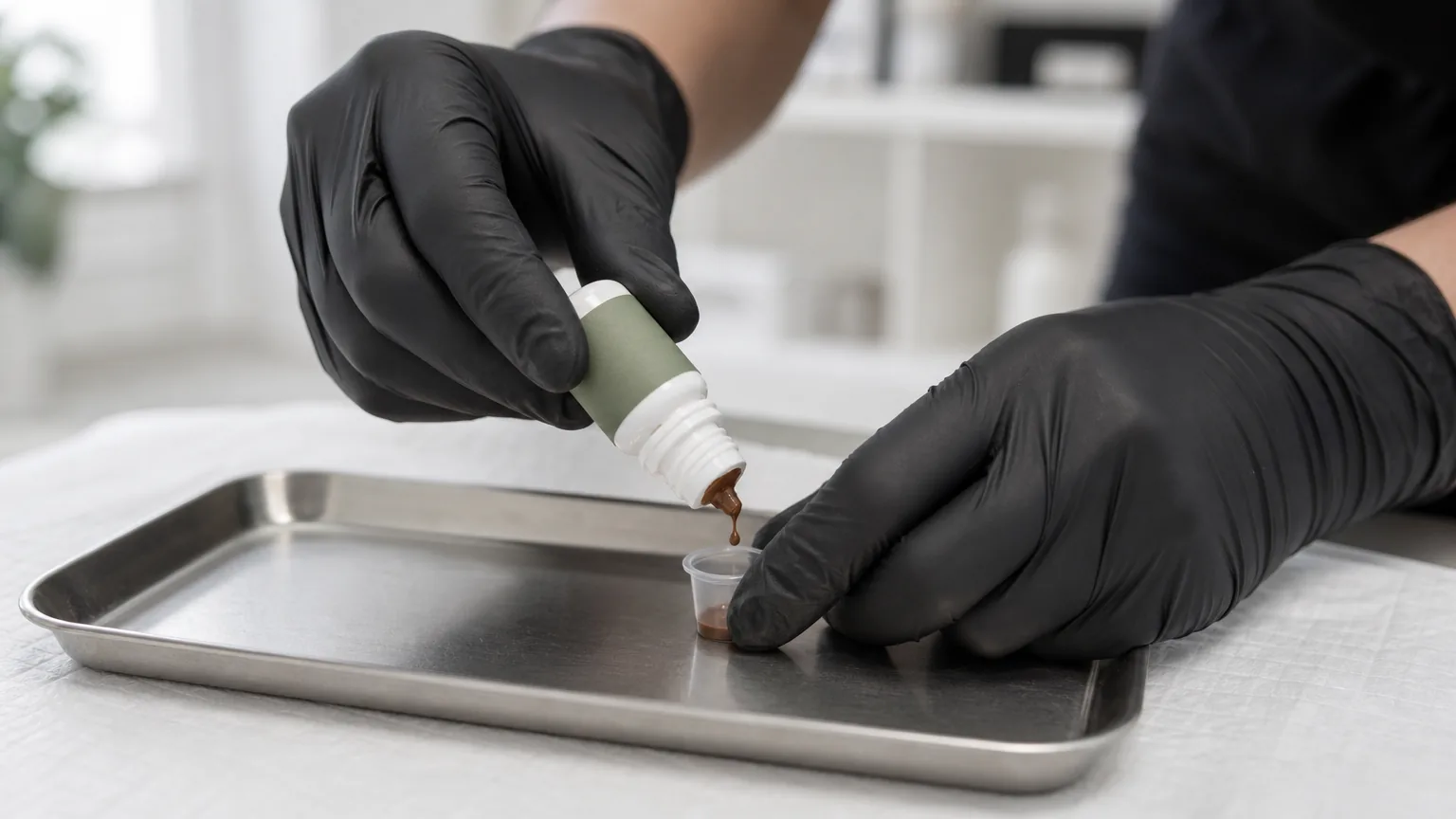
So the responsibility splits. Your artist controls what happens once the seal is broken: sterile diluent only and never tap water, pigment dispensed into a single-use cup and never poured back, a lot number recorded for every client, and supplies bought from a traceable distributor rather than an anonymous marketplace listing. No one in the studio can test what was sealed inside the bottle before it arrived.
What “Sterile” on the Label Does and Does Not Promise
The word has legal weight. When the FDA found microorganisms in inks labeled sterile, it told the Florida manufacturer that products labeled that way “are expected to be free of viable microorganisms,” and that its use of the term was false and misleading. That finding came only after the agency sampled and tested the product. Tattoo and permanent makeup inks are regulated as cosmetics, which need no FDA approval before they go on sale, so a sterility claim is the manufacturer’s own statement. That applies to brow pigment exactly as it does to body ink, because microblading is a tattoo in law and in mechanism.
The studies show how much weight the claim can bear. In the permanent makeup survey, 18 of the 47 inks claimed sterility, and three of those were contaminated, all three sold for microblading. The 2024 study found no significant association between a sterility claim on the label and the absence of bacteria.
A sterility claim also describes a sealed bottle. Once a bottle has been opened and dispensed from across weeks of clients, the label no longer vouches for what is inside, which is why the handling described above matters as much as the brand.
That does not make the label useless. It is where your checks begin. Look for a brand, a shade name, a lot or batch number, an expiration date, and the name of the company responsible for the product. A bottle without a lot number can never be matched to a recall notice.
How to Check a Pigment Against Recall Notices
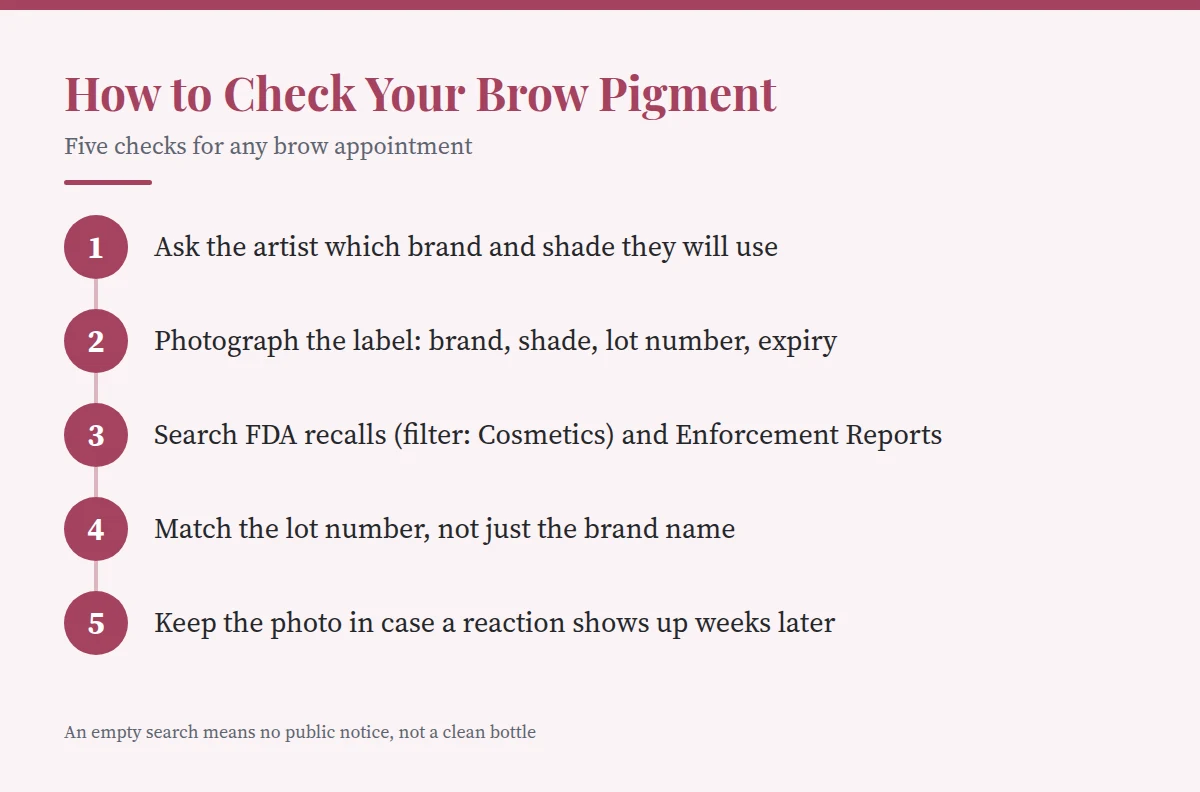
Ask before you book. Ask the artist which brand and shade they plan to use and whether you can see the bottle. A careful artist will not mind, and one who cannot tell you what goes into your skin has answered a more important question.

Photograph the label. Brand, shade, lot number, and expiration date fit in one photo. If you react later, those are the details your doctor, the artist, and the FDA will all need.
Search the FDA’s recall records. The Recalls, Market Withdrawals, and Safety Alerts page on fda.gov has a search box and a product type filter; choose Cosmetics. Then search the FDA Enforcement Reports, which hold the classified recall records themselves and are what FDA researchers used to compile two decades of ink recalls.
Match the lot, not just the brand. Recalls are often limited to specific lots, so compare the number on the bottle rather than the name on the front. A brand that appears in an old notice is not condemned in every bottle it makes, and a brand missing from every list is not proof that yours is clean.
Know what an empty search means. A search for your brow pigment will very likely come back empty. Between 2003 and 2021, the only permanent makeup inks recalled in the United States were pulled over allergic reactions, not bacteria, and the survey that found contaminated microblading inks did not name the brands. An empty result means there is no public notice, nothing more.
What an Ink-Borne Infection Looks Like
Normal healing has a direction. Brows are darkest and most tender in the first few days, scab and flake through the first week or so, then settle, as our day-by-day healing timeline walks through. A fast bacterial infection runs the other way: redness spreading past the strokes, heat, yellow-green pus, fever, a brow that is worse on day six than on day four. That needs a doctor the same day, and our guide to whiteheads, milia, and pimples during healing explains how to tell it from harmless bumps.
Mycobacterial infections are slower and far easier to miss. In the FDA review of 66 cases, symptoms usually began one to four weeks after the procedure, with a range from three days to more than a year, so they can surface after a brow looks healed. The typical signs were red papules, pustules, and nodules within the inked skin, sometimes progressing to plaques or open sores.
The trap is diagnosis. About 70 percent of those cases were misdiagnosed or undiagnosed at first, and nearly half were initially treated with corticosteroids, which do not work against these bacteria and may make the infection worse. The organisms are slow to grow in the lab, too. Mycobacterium haemophilum, the species in the brow cases below, needs added iron and a cooler incubation temperature, which makes it hard to detect with standard lab methods; in one case it took 70 days to grow and identify. Treatment in the review typically meant a combination of antibiotics for three to six months.
Two brow reports show why that matters. A German dermatologist described two women who developed nodules in their eyebrows some time after permanent makeup. In one, testing showed a noninfectious granulomatous reaction, which responded to corticosteroids. In the other, the cause was M. haemophilum, and it took a combination of three antibiotics to clear. Both women had nodules, but the treatment that helped the first is the kind the FDA review warns can worsen the second. In Switzerland, 12 clients of one freelance artist developed an eyebrow lesion and swollen lymph nodes in the neck after having their brows done. All needed antibiotics, 10 needed surgery, and the bacterium’s DNA was found in the makeup ink.
What to do. If bumps or a rash appear along your strokes in the weeks after microblading, or a “reaction” is not improving with treatment, see a doctor, ideally a dermatologist. Lead with the procedure: when it was done, that pigment went into the skin, and the brand and lot from your photo. Ask whether a biopsy with cultures, including for mycobacteria, makes sense before any steroid is started, and do not self-treat with a leftover steroid cream. Late lumps that turn out to be granulomas are a separate problem with a separate treatment path, covered in our guide to bumps, lumps, and granulomas after microblading.
Reporting a Reaction You Suspect Came From the Pigment
Tell your doctor first. Then tell the artist, who can pull that lot from use and give you the brand, shade, and lot number if you do not already have them.
Then tell the FDA. Consumers can use the MedWatch online voluntary reporting form, mail or fax Form FDA 3500B, or call the Food and Cosmetics Information Center at 1-888-SAFEFOOD and choose option 4. The agency explicitly asks to hear about infections and other unexpected reactions whether or not they needed medical treatment, and about signs of contamination in the product itself.
It is also worth contacting the company named on the bottle. Under the Modernization of Cosmetics Regulation Act of 2022, that company must report serious adverse events to the FDA within 15 business days, and the law’s definition of serious explicitly includes an infection. That duty is triggered by the reports a company receives, which is one more reason to send one.
If your concern is the studio itself rather than the pigment, our guide to recourse after botched microblading covers health department complaints and what to document.
The Bottom Line
None of this is a reason to cancel a booked appointment in a panic. Most sealed bottles in the FDA’s permanent makeup survey were clean, and reported infection rates after brow procedures are low. It is a reason to treat the pigment as part of your safety checks rather than an afterthought. Choose a licensed artist working under your state’s rules, since unlicensed practitioners are a genuine infection risk and a license is what makes a studio answerable to a health department. Ask what pigment they use and photograph the label. Patch test with that exact pigment, bearing in mind that a patch test screens for allergy, not bacteria. If you have eczema, rosacea, or a condition or medication that weakens your immune defenses, see a dermatologist before booking. And if something appears along your strokes in the weeks afterward, get it examined and mention the microblading first.
Sources
- FDA on the warning letter over anaerobic bacteria in a sealed ink labeled sterile
- FDA for the consumer routes for reporting a cosmetic reaction and the maker’s duty to report serious ones
- Nho and colleagues with the survey that found microbes in 42 of 85 unopened tattoo and PMU inks
- Yoon and colleagues surveying 47 sealed permanent makeup inks, microblading inks included
- Yoon, Kondakala, Foley, and colleagues on anaerobic and aerobic bacteria in commercial tattoo and PMU inks
- Yoon, Kondakala, Moon, and colleagues compiling two decades of US ink recalls and a retest of new batches
- Daddy-Gaoh and colleagues reviewing 66 published mycobacterial infections after tattoos and permanent makeup
- The Lancet Microbe for the causes and patterns of tattoo-associated infections
- U. Wollina describing two cases of eyebrow nodules after permanent makeup, one mycobacterial
- Giulieri and colleagues on a Mycobacterium haemophilum outbreak after eyebrow permanent makeup
- Tomita and colleagues tallying complications reported by 1,352 eyebrow and eyeliner clients in Tokyo