Chain Brow Studios vs Independent Artists: How to Judge Either Before You Book
Published on September 11, 2026

For most of microblading’s first decade, choosing an artist meant choosing a person. You found her on Instagram, you studied her healed work, you booked her, and the room she rented was incidental. That is no longer the only shape the industry comes in. Franchised cosmetic tattoo brands and multi-location studios now sell the studio rather than the individual: a house style, standardized pricing, an online booking system that quietly assigns you whoever has a gap, and frequently a training academy running out of the same suite of rooms.
Neither model is better than the other. But the vetting method almost every guide teaches, ours included, assumes you are choosing a person, and it stops working the moment the brand is the thing being marketed. Here is what actually changes between the two, and what to check in each case.
Whose License Is Actually on the Wall
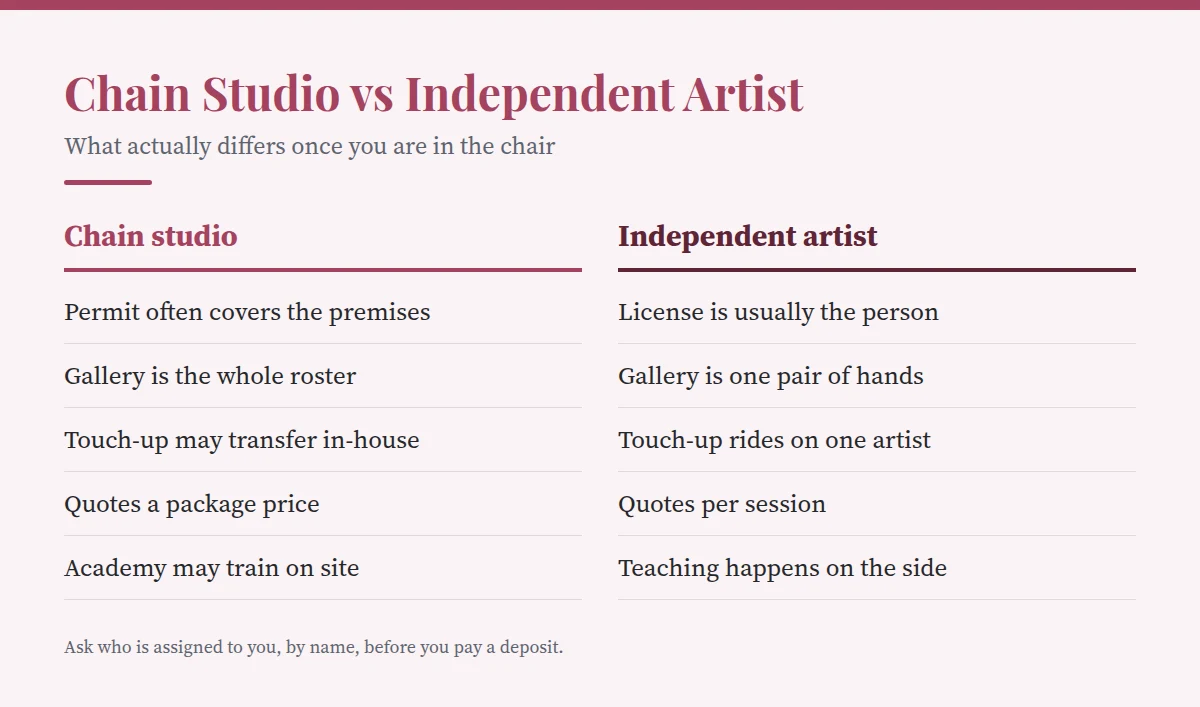
Two separate things get regulated in this trade, and people conflate them constantly: the premises, and the pair of hands.
In Illinois, the Department of Public Health is explicit that “the location holds the Body Art permit with IDPH, not the individual.” The establishment owner is the one who decides whether a given artist is qualified to work under that registration, and the state’s floor for those artists is proof of bloodborne pathogen training that meets OSHA standards. A framed certificate in a chain lobby can therefore be certifying the room, the sharps handling, and the sink, while saying nothing at all about the person who is about to map your face.
Now look at New Hampshire, where practitioners are licensed individually and an initial body art license requires an apprenticeship of at least 1,500 hours under a qualified supervising licensee, completed over no less than twelve months. Same procedure, same country, wildly different meanings behind the phrase “licensed studio.”
So ask for the individual credential of the person assigned to you, by name. At an independent this is usually the same paperwork as the business, handed over in one breath. At a chain these are two different documents, and you want to see both. If you want a sense of what that individual credential costs in time and money to earn, our guide to what it takes to become a microblading artist walks through the real training path.
The Portfolio Problem When the Brand Owns the Gallery
A brand gallery is a composite. It is the strongest work of the strongest artist on the roster, curated by a marketing team, and it is not a promise about your appointment. If the booking flow never names a technician, you are being sold an average you cannot inspect.
The fix is a single question, asked before the deposit: who specifically is performing my procedure, and can I see their healed work at six weeks and at a year? Fresh photos taken minutes after a session are close to worthless, because the strokes are still bold and the skin is still pink. Healed photos are the only honest evidence, and they need to belong to the individual, not the logo. Ask to see them on skin like yours and on brows as sparse as yours.
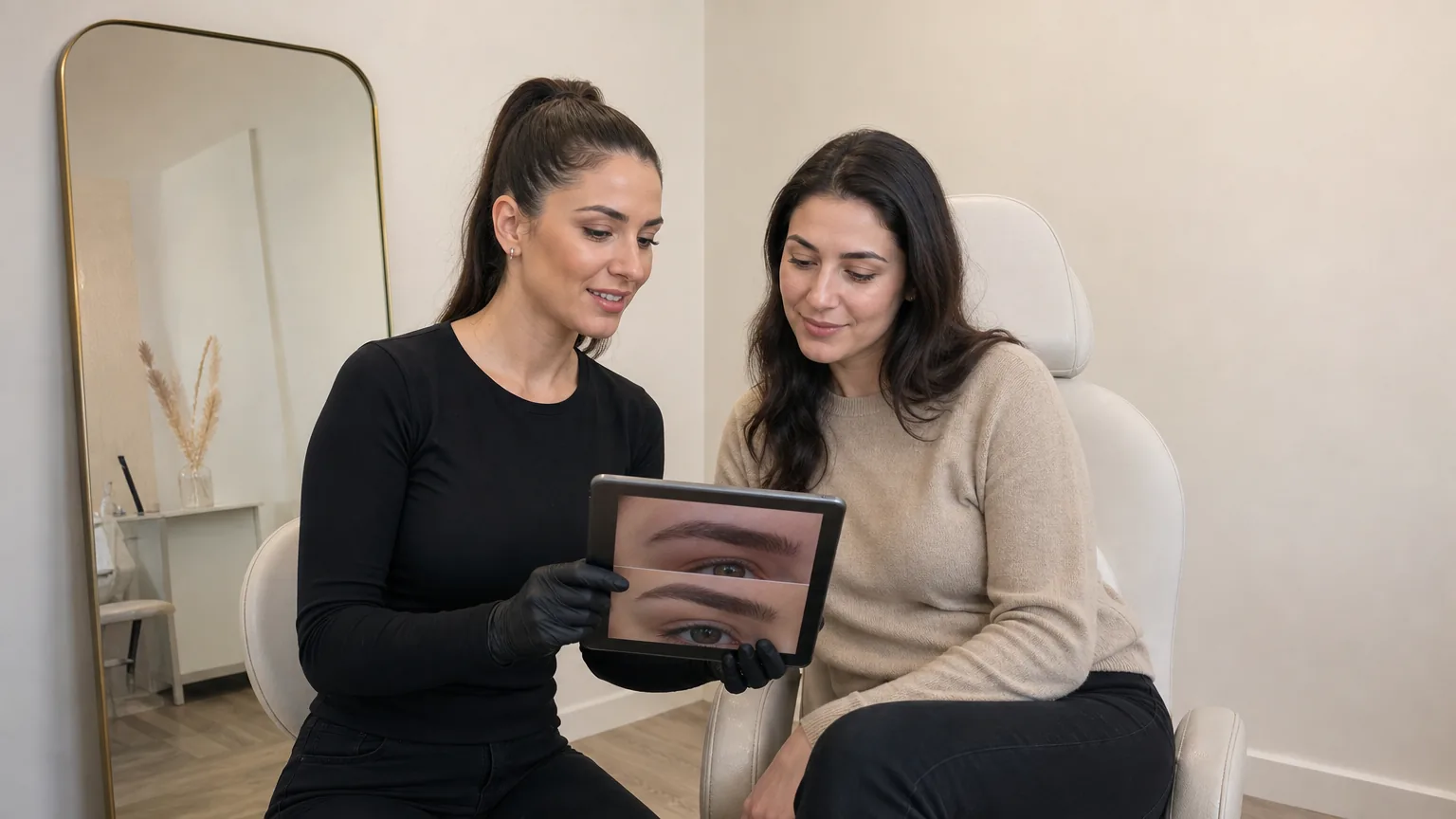
With an independent the gallery is one hand, so the sample is honest but small. What you are reading for there is consistency and range: does the same shaping logic show up across different faces, and has she worked on skin types other than the easy ones? Either way, the questions worth asking before you book do not change. What changes is who you have to insist on asking them about.
Treat “all our artists are trained to the same standard” as a non-answer. It is true of the sterilization protocol and almost never true of the artistry.
What Happens to Your Touch-Up If That Artist Leaves
This is where the two models genuinely diverge, and it is the part clients discover too late.
The perfecting session is not a courtesy add-on, it is the second half of the procedure. Pigment heals differently than it looks on the day, and the follow-up is where the result gets corrected. Studios schedule it tightly. Lasting Touch NYC, for one, books the touch-up 4 to 8 weeks after the first session and charges more outside that window, and asks clients whose original work was done elsewhere to email photos for approval first, noting plainly that “not every old tattoo can be covered, and removal may be needed.”
That last policy is the industry norm, and it is the thing to hold in your head. Artists are reluctant to put their name on someone else’s strokes, because they inherit the blame for a shape and a pigment choice they did not make. So if your artist leaves the chain in week five, the brand persists but the hand does not, and the question becomes whether the studio treats your outstanding touch-up as a company obligation or as a personal one that walked out the door.
Ask it directly, before you pay: if my artist becomes unavailable, is the perfecting session transferred to another artist in-house at no extra charge? Get the answer in writing. A well-run chain should say yes without hesitating, and that redundancy is a real advantage of the model.
The independent has the mirror-image problem. The hand stays consistent for as long as the business exists, but there is no cover. Maternity leave, a relocation, an injury, or a studio closure leaves you holding a half-finished brow with nobody contractually on the hook. It is a fair question to ask a solo artist too, and a good one will have a colleague she refers to.
Package Pricing, Deposits, and What the Number Includes
Chains tend to quote a package. Independents tend to quote per session. Neither is reliably cheaper, and the sticker figure is not the comparison that matters.
Work through the same four points with both:
Is the perfecting visit inside the quoted number, or billed separately? This single answer swings the total by hundreds of dollars. Does the package expire, and on what date? Some bundle an annual color boost that is only redeemable within twelve months, which is a discount only if your skin actually needs it on that schedule. Is the deposit refundable, and is it transferable to a different artist or a different location? Lasting Touch’s terms are typical of the trade: a $50 deposit applied to the session, forfeited without 48 hours notice, with arrival more than 15 minutes late counted as a no-show. And what happens if you are declined at the consultation on medical grounds? A studio that keeps the deposit after telling you that you are not a candidate has an incentive problem worth noticing.
The honest budgeting question is whether you are comfortable with the two-year figure rather than the deposit, and we run those numbers in the true two-year cost of microblading.
Apprentices, Academies, and Volume
A lot of the expanding brands are built on two revenue streams rather than one. Brows & Co pitches franchisees “a dual profit streaming business model, providing services to client as well as an academy for aspiring permanent makeup artists.” DAELA Cosmetic Tattoo runs DAELA Academy alongside its studios and requires each franchise location to have a Master Artist Manager working in it.
None of this is a scandal. Trained artists have to come from somewhere, and supervised live-model work is how they are made. Programs like MicroBladers’ six and twelve month apprenticeships exist precisely so that trainees practice on real skin in a real setting under an instructor rather than on latex forever.
The only thing that makes it a problem is disclosure and price. A model rate for a supervised apprentice is a fair, transparent trade: you accept a less experienced hand and pay a fraction of the fee. A full-price booking that turns out to be a trainee’s twentieth set of brows is not. So ask whether an apprentice or student will perform any part of your procedure, who is supervising, and what the pricing difference is. Independents who teach on the side are subject to exactly the same question.
What Each Model Is Genuinely Good At
Chains buy you redundancy. Written protocols, someone to escalate a complaint to who is not the person who made the mistake, a business likely to still exist in three years, consistent sterilization and record keeping, evening and weekend availability, and often a second location if you move. Those are real goods, and a solo artist working out of a rented suite cannot match most of them.
Independents buy you continuity and accountability. One pair of hands from the mapping pencil to the final touch-up, the specific style you actually chose rather than a house template, and an artist whose entire reputation rides on your result rather than a quarterly location target. The independent clinic model at its best looks like the New Hampshire studio whose owner hand-maps every design to the client’s own features instead of working from a stencil, and includes the follow-up visit as part of the service rather than as an upsell.
The risks mirror each other. A chain’s exposure is variable hands, throughput pressure, and artist churn. An independent’s is no cover, no escalation path, and a hard ceiling on how many complicated cases she has seen. Watch, too, for a studio with a single house technique, because a business built to sell blade work will tend to recommend blade work to oily skin that will not hold it. Our skin type pairing guide covers which technique actually suits which skin, and it is worth reading before anyone tells you what you need.
The Same Four Things, Either Way
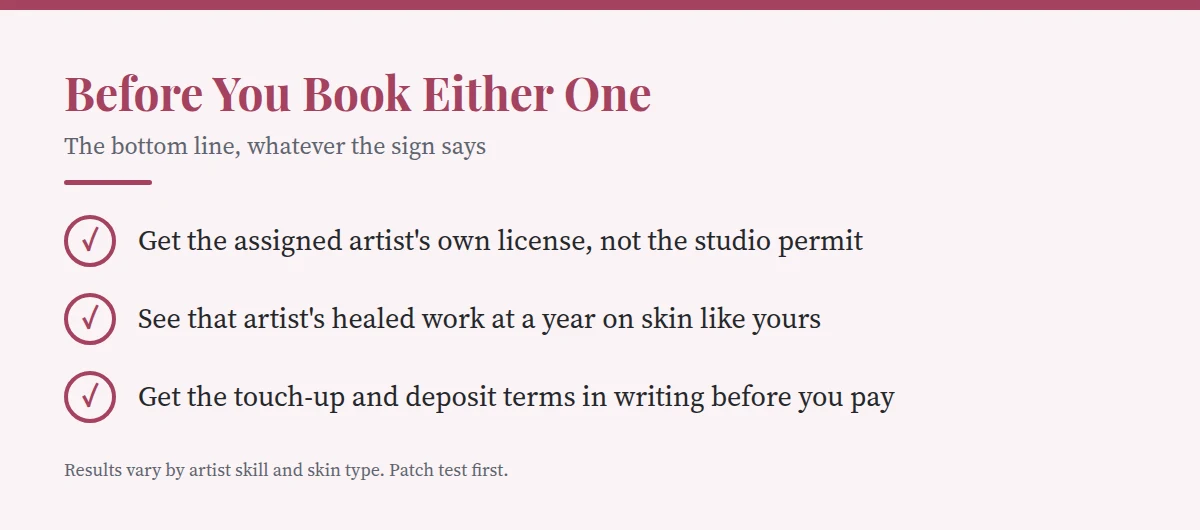
Whatever the sign above the door says, the checklist collapses to this: a named individual, that individual’s own credential, their healed work at a year on skin like yours, and written terms covering the touch-up and the deposit. Add a patch test before any pigment goes into your face, and a consultation long enough to cover medical history and mapping properly.
Results vary substantially by artist skill and by skin type, and no business model changes that. Microblading is a regulated tattoo procedure, so an unlicensed practitioner is a safety risk regardless of how polished the branding is, and anyone with eczema, rosacea, psoriasis, or another active skin condition near the brow should see a dermatologist before seeing an artist at all.
Sources
- Illinois Department of Public Health on why a body art permit belongs to the premises and not the artist
- NH Office of Professional Licensure and Certification for the apprenticeship hours behind an individual practitioner license
- Lasting Touch NYC with typical deposit, touch-up window, and previous-work terms
- DAELA Cosmetic Tattoo covering how a cosmetic tattoo franchise pairs studios with its own academy
- Brows & Co on the dual service and training revenue model sold to franchisees
- MicroBladers for what a supervised live-model apprenticeship involves