Microblading for Medical Brow Loss: Alopecia Areata, Thyroid Disease, Frontal Fibrosing Alopecia, and Trichotillomania
Published on September 3, 2026

When brows disappear for a medical reason, the consultation is a different conversation from the one a client has when their brows are simply thin. There is a diagnosis in the room, often a dermatologist, sometimes a drug regimen, and almost always a question the client has been carrying for months: is this coming back? We have already covered the oncology version of this in microblading after chemo. This guide is for the much larger group whose brows went for another reason, and it is organised around the two things that actually decide the answer.
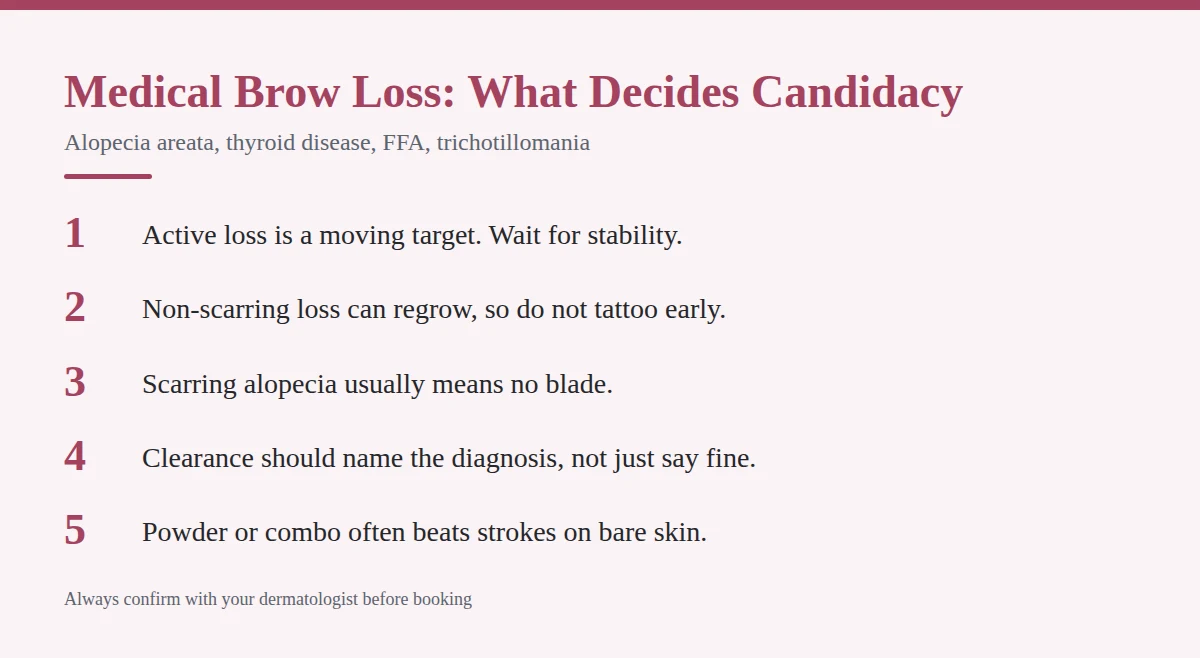
The Two Questions That Decide Everything
Forget the diagnosis label for a moment. Almost every judgement an artist makes about medical brow loss comes down to two questions, and the condition name matters mainly because of how it answers them.
Is the loss active or stable? Hair loss that is still progressing is a moving target. Pigment lasts years. If the brow you design today keeps shrinking, or if hair comes back in a shape that fights the strokes you drew, you have built a permanent decoration around a temporary state of affairs. Stability is not a formality. It is the thing that makes the work age well.
Is the brow skin intact or scarred? Dermatology splits hair loss into non-scarring and scarring (cicatricial) types, and the split matters enormously here. In non-scarring loss the follicular structures survive, the skin underneath is essentially normal, and regrowth remains possible. In scarring loss, deeper inflammation replaces follicles with fibrous tissue. That tissue is permanent, and it does not take pigment the way healthy dermis does.
Alopecia areata, thyroid-related loss, and most trichotillomania sit on the non-scarring side. Frontal fibrosing alopecia sits firmly on the scarring side, and that single fact changes almost everything about how it is handled.
Alopecia Areata: Wait for the Disease to Settle
Alopecia areata is autoimmune. The immune system attacks the hair follicle, hair falls out in defined patches, and the follicle itself survives underneath. That last part is the good news and the complication at the same time.
Because follicles survive, brows can come back, sometimes on their own and sometimes with treatment. The newer JAK inhibitors have made this considerably more likely than it was five years ago. Trial data on ritlecitinib measured eyebrow and eyelash response as their own endpoints, and regrowth at those sites broadly tracked what happened on the scalp. A client who starts systemic treatment has a genuine chance of growing brows back, which is an excellent reason not to tattoo a permanent shape onto the space where they used to be.
The practical position most artists take is a period of documented stability, typically six to twelve months without new patches or fresh loss, before anything permanent happens. It is also worth asking what treatment is planned rather than only what has happened, because a client about to start a drug that may regrow the brow is in a different situation from one who has exhausted the options.
Skin quality is usually normal in alopecia areata, so retention tends to be unremarkable once the disease is quiet. The wider immune picture still applies, and our guide to microblading with an autoimmune condition covers the medication questions in detail, particularly for clients on immunosuppressants or biologics.
Thyroid Disease: Treat the Thyroid, Then Reassess
The classic presentation is thinning at the outer third of both brows, symmetrical, gradual, often noticed by a hairdresser before the client notices it themselves. It has a couple of old eponyms attached to it and it is a recognised sign of hypothyroidism, though it is not universal and plenty of hypothyroid people keep full brows.

The important thing for our purposes is that this is non-scarring loss driven by a metabolic problem, and metabolic problems get corrected. Once thyroid function is properly managed and levels have been stable for a while, brow hair frequently improves. Not always, and rarely to the density of twenty years earlier, but enough that tattooing a full brow at the six-week mark of a new levothyroxine prescription is a decision made too early.
Give it two things: stable labs for several months, and an honest look at what the brow is doing. If the outer third has genuinely repopulated, the client may want nothing more than a light tail extension. If it has not moved in a year, that is real information and worth acting on.
Two side notes matter in the chair. Autoimmune thyroid disease travels with other autoimmune conditions, so a client with Hashimoto’s has a meaningfully higher chance of also having alopecia areata or vitiligo, which is worth asking about rather than assuming. And hypothyroid skin is often dry, sometimes flaky, which affects healing and pigment settling. The skin type pairing guide is the right cross-check on technique for that.
Frontal Fibrosing Alopecia: This Is Usually Where the Blade Stops
Frontal fibrosing alopecia is a scarring alopecia, understood as a variant of lichen planopilaris. It mostly affects postmenopausal women, it recedes the frontal and temporal hairline in a characteristic band, and eyebrow loss is one of its most common features. For a substantial number of people the brows go first, sometimes years before anything visible happens at the hairline, which means an artist occasionally meets undiagnosed FFA before a dermatologist does.
Three things make it different from everything else on this list.
The first is that the follicles are destroyed, not suppressed. Once fibrosis has replaced them, there is nothing to regrow and nothing to blend into. The skin over a scarred brow behaves differently under a blade: it can be firm and resistant in some spots, thin and fragile in others, and pigment placed in it often heals patchy, blurred, or simply gone.
The second is the Koebner phenomenon, and this is the one that should give any artist pause. Lichen planus and lichen planopilaris are known to appear at sites of trauma, and FFA has been reported to follow facelift procedures and hair restoration surgery. There is a published case of lichen planopilaris developing exactly where a wig attachment repeatedly stressed the scalp. Microblading is hundreds of deliberate incisions across the brow. In a condition documented to localise to injured skin, that is a poor bet.
The third is that FFA progresses, often slowly, sometimes for years. A brow designed around today’s remaining hair may sit oddly against tomorrow’s hairline.
None of this makes cosmetic work impossible, and many women with FFA do end up with tattooed brows they are happy with. It does mean the sensible route is dermatologist-led: disease quiet on treatment, no blade, and soft machine shading rather than crisp hairstrokes. There is one more wrinkle worth knowing. Brow skin in FFA can be noticeably hypopigmented, and biopsy work has found reduced melanocyte counts in affected FFA skin compared with lichen planopilaris and controls. Pale, altered skin under the pigment changes how a colour heals, so conservative shade choices and a patch test read at two weeks are not optional here.
Trichotillomania: The Skin Is Only Half the Question
Trichotillomania is a body-focused repetitive behaviour, and dermatologically it is a traumatic alopecia: the damage comes from repeated mechanical pulling. Brows and lashes are among the most commonly targeted sites, and years of pulling can leave follicles damaged and the skin subtly scarred, textured, or fibrotic in patches. Scarred brow skin does not hold colour evenly, which is the mechanical half of the problem.
The other half is behavioural, and it is the half that gets skipped. Tattooing a brow does not treat the urge to pull. Some clients report that having a visible brow again reduces the distress that fuels the cycle, and artists who work with this population often describe good outcomes, but this is experience rather than evidence, and pulling can continue over tattooed skin. The right sequence is behavioural treatment first, habit reversal training or whatever the client’s clinician recommends, with cosmetic work as something that supports a stable period rather than something that starts one.
Be candid about the result too. Skin that has been pulled for a decade may need a third session where most clients need two, and retention across scarred patches will be uneven. A client who understands that in advance is disappointed far less often than one who was promised a clean result.
What Dermatologist Clearance Should Actually Cover
“My dermatologist says it’s fine” is not clearance. A useful letter, in writing, answers five specific things:
- The named diagnosis, not a general reassurance.
- Whether the loss is scarring or non-scarring, which decides whether a blade is on the table at all.
- Whether the disease is currently active or stable, and for how long it has been stable.
- Current medications, including immunosuppressants, biologics, JAK inhibitors, anticoagulants, and isotretinoin.
- An explicit view on trauma to the brow area, which is the question that matters most for anything in the lichen planus family.

Ask for it before booking rather than on the day, and keep it on file. An artist who takes a medical history seriously will also read the risks and contraindications guide territory as their baseline, not as an extra.
Designing a Brow With Nothing to Blend Into
Microblading strokes were designed to sit among existing hairs and disappear into them. Take the surrounding hair away and the same strokes can read as drawn on, because there is nothing to break up the pattern. This is why so many artists working with medical brow loss reach for powder, ombre, or combo brows instead, letting a soft shaded base carry the shape while strokes are used sparingly at the front. Machine-based methods, covered in our hairstroke brows guide, are also gentler on compromised skin than a manual blade.
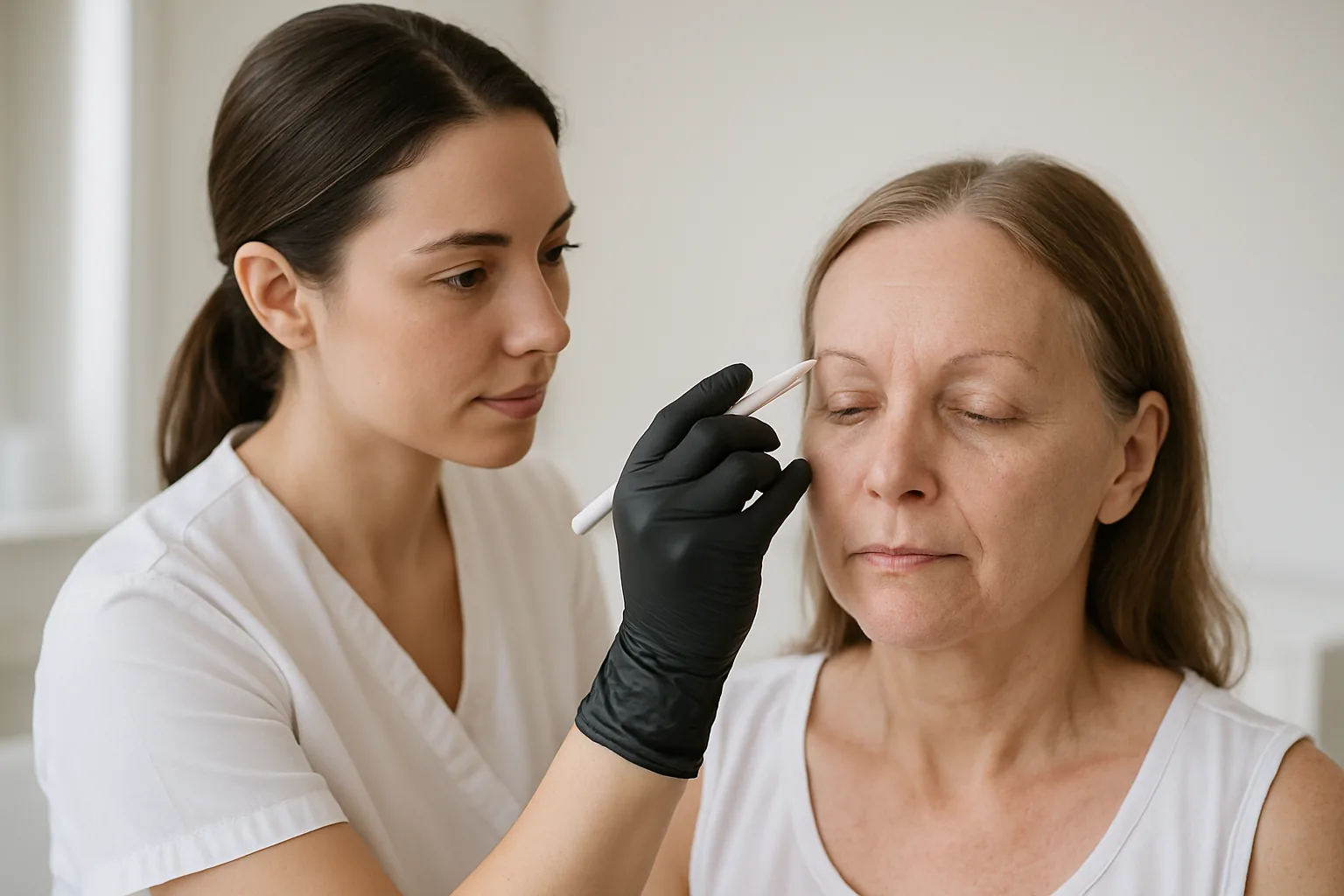
Bring photographs. Old passport pictures and casual snapshots from before the loss are far more useful for shape than any mapping formula, and clients consistently underestimate this.
Design conservatively. A slightly softer, slightly shorter brow accommodates regrowth if it comes and looks less stark if it does not. Expect healing to be less tidy than the textbook version, and read the day-by-day healing timeline so the ghosting phase does not get mistaken for failure. For older clients, particularly the FFA group, microblading after 50 covers the overlapping ground on mature skin.
Medical brow loss is one of the best reasons there is to have this work done. It just has a queue in front of it, and most of that queue exists so the brow you commit to is the one your face is actually going to keep.

Sources
- Journal of Drugs in Dermatology on the current review of non-scarring eyebrow madarosis and how it is managed
- American Journal of Clinical Dermatology for a clinical review of eyebrow and eyelash alopecia across causes
- Journal of the American Academy of Dermatology with the multicentre review of 355 frontal fibrosing alopecia patients
- International Journal of Trichology covering why eyebrow loss is a marker for so many different conditions
- International Journal of Trichology again for the case of lichen planopilaris appearing where a wig attachment injured the scalp
- Skin Appendage Disorders for the hypopigmented eyebrow skin seen in frontal fibrosing alopecia
- CPT: Pharmacometrics and Systems Pharmacology examining how eyebrow and eyelash regrowth responded to ritlecitinib
- DermNet with the plain-language explanation of madarosis