The Microblading Healing Timeline: What Your Brows Do Day by Day Through Week Six
Published on September 1, 2026

Almost every message a brow artist receives in the first month is a photograph with the same caption attached: is this normal? Day two, the brows look drawn on with a marker. Day eight, half a stroke has flaked into the bathroom sink. Day seventeen, the left tail has vanished and the client is quietly drafting an email about a refund.
Nearly all of it is normal. Microblading does not heal in a straight line from fresh to finished. It heals in a loop that goes too dark, then patchy, then almost invisible, then back again, and the low point sits right in the middle where most people are looking hardest. Knowing where you are on that loop is the difference between six anxious weeks and six uneventful ones. This is the chronology of what you will actually see. For the rules about what to put on your brows and what to avoid, our microblading aftercare guide covers the protocol.
Days 1 to 3: Bolder Than You Ordered
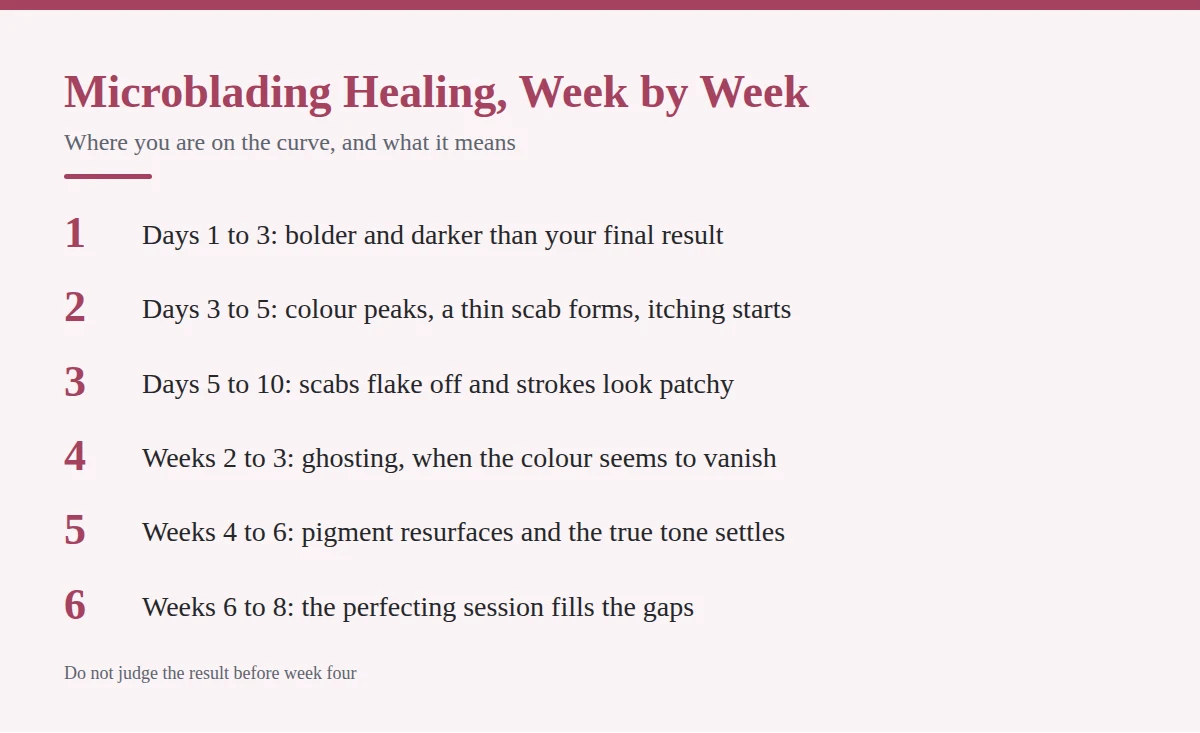
You walk out of the studio with the boldest brows you will ever have, and they get bolder overnight. Expect roughly 30 to 50 percent more intensity than your healed result: darker, sharper-edged, and thicker than the strokes your artist actually cut.
Three things are happening at once. Pigment sits in both the upper dermis where it belongs and the epidermis where it does not, and the epidermal share is still fully visible. Lymph fluid and a trace of plasma are rising into the strokes and drying on the surface, deepening the colour. And the skin around each incision is inflamed, which reads as a faint pink or red halo along the brow.
Mild swelling on day one is ordinary, as is tenderness when you press the area and a sensation like light sunburn. The colour often looks cooler or greyer than you expected during this window, particularly with darker pigments, which is oxidation and not a mistake.
Red flags here: swelling that spreads into the eyelid or closes the eye, redness pushing well beyond the tattooed area, a fever, or pain that is throbbing rather than tender. These are hours-matter problems, not wait-and-see ones.
Days 3 to 5: Darkest Point and the Scab
The colour peaks somewhere around day three, and on many people it looks close to black-brown regardless of the shade chosen. A thin scab now forms across the strokes. It can be almost invisible on dry skin or a distinct crust on skin that produced a lot of lymph.
The itch usually arrives at day four, and it is the single most dangerous moment in the whole timeline. The urge to scratch peaks exactly when the scab is loose enough to come away and the pigment underneath is not yet anchored.
Small bumps often appear in the same window, most commonly pinpoint whiteheads from too much ointment sitting on follicles that have just been punctured. Our guide to whiteheads, milia, and pimples during healing sorts the harmless ones from the ones worth a phone call.
Days 5 to 10: Flaking and the Patchy Middle
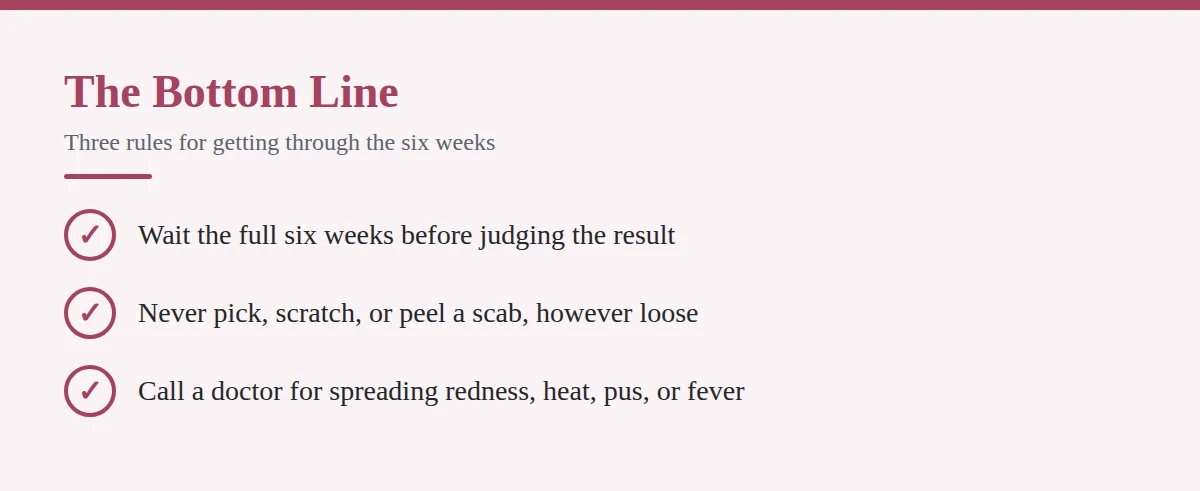
The scabs lift and shed, rarely politely. Flaking is uneven by nature, so you will have a fully shed section next to a section still crusted, and it is completely normal for one brow to run two or three days ahead of the other. Do not help it along. A scab pulled early takes the pigment beneath it with it, and that gap has to be re-tattooed rather than simply reinforced.
What emerges underneath is the source of most week-two panic. The strokes look thin, broken, or missing in patches, and the colour is noticeably weaker than anything you have seen so far. Some of that is genuine pigment loss (entirely expected, and the reason a second session is built into the process), but most of it is the next stage arriving early.
Red flags here: yellow-green discharge, heat you can feel with the back of a finger, redness that is worse on day eight than day five, or clustered small blisters with burning rather than itching, which can be a herpes simplex reactivation and needs an antiviral rather than an aftercare tweak.
Weeks 2 to 3: The Ghosting Phase
This is the one nobody warns clients about properly, and it is when the refund emails get written.
Somewhere between day ten and day twenty-one, the brows appear to fade dramatically. People routinely describe losing a third to a half of their colour, and some report tails or sparse areas that look like they have vanished completely. Under bathroom lighting the brows can read as a faint, cloudy shadow of the shape you were shown at the end of the appointment.
The pigment has not gone anywhere. What has happened is that your skin rebuilt its top layer over the treated area, and brand new epidermis is thicker and far more opaque than mature skin. It is sitting between your eyes and the pigment like frosted glass. The industry nickname for this is ghosting, and it is a stage, not an outcome.
Two practical rules follow. Do not book a colour correction, and do not go back to the artist demanding a fix. And do not judge the shape either, because ghosting is rarely symmetrical and a tail that looks lost at day sixteen is usually the last part to resurface.
Weeks 4 to 6: The Colour Blooms Back
New skin matures and thins, becomes more translucent, and the pigment underneath resurfaces. Most people see meaningful return during week four, with the true healed result readable somewhere between weeks four and six.
What comes back is not what you had on day one. Expect a result roughly 20 to 40 percent softer than the fresh appearance, with blurrier stroke edges and a warmer, more natural tone. That softness is the point. The healed brow is meant to look like hair, and hair does not have hard black edges.
This is also the first honest assessment window. Karen Betts, one of the UK’s better known permanent makeup artists, puts it plainly: true results are not visible for at least a month. Anything you conclude before week four is a conclusion about a scab.
The Perfecting Session Is Part of the Plan
The second appointment, usually booked six to eight weeks out, is not a repair for something that went wrong. No first pass retains evenly, because retention depends on how your individual skin holds pigment, and nobody can predict that before they have watched you heal once.
Earlier than four weeks risks working on tissue that is still remodelling, which invites scarring, and scarred skin takes pigment badly for a long time afterwards. Much later than eight weeks and additional fading means more work. Your artist uses this visit to fill gaps, adjust the colour now that the healed tone is visible, sharpen the shape, and add density where your skin pushed pigment out. Budget for it as part of the price rather than an extra, which our two-year cost breakdown sets out in full.
Why Your Timeline May Run Differently
The stages are consistent. Their depth and speed are not.
Oily skin is the biggest variable. More sebum means more pigment migration and softer strokes, deeper ghosting, and typically less retained at week six, which is why some artists recommend a shaded technique instead of crisp hairstrokes for oily clients. Our skin type pairing guide covers the matching in detail. Mature skin heals more slowly and can run a week behind these markers. Heavy sweating, sun, exfoliating actives, and any facial treatment during the healing window all pull pigment out early, and treatments booked either side of your appointment need their own calendar, which our treatment sequencing guide maps out.
One last boundary worth knowing. This timeline ends. Firm lumps that appear at week six, month three, or years later and never flake or drain on any schedule have broken the healing sequence entirely and belong in the territory of delayed pigment reactions and granulomas.
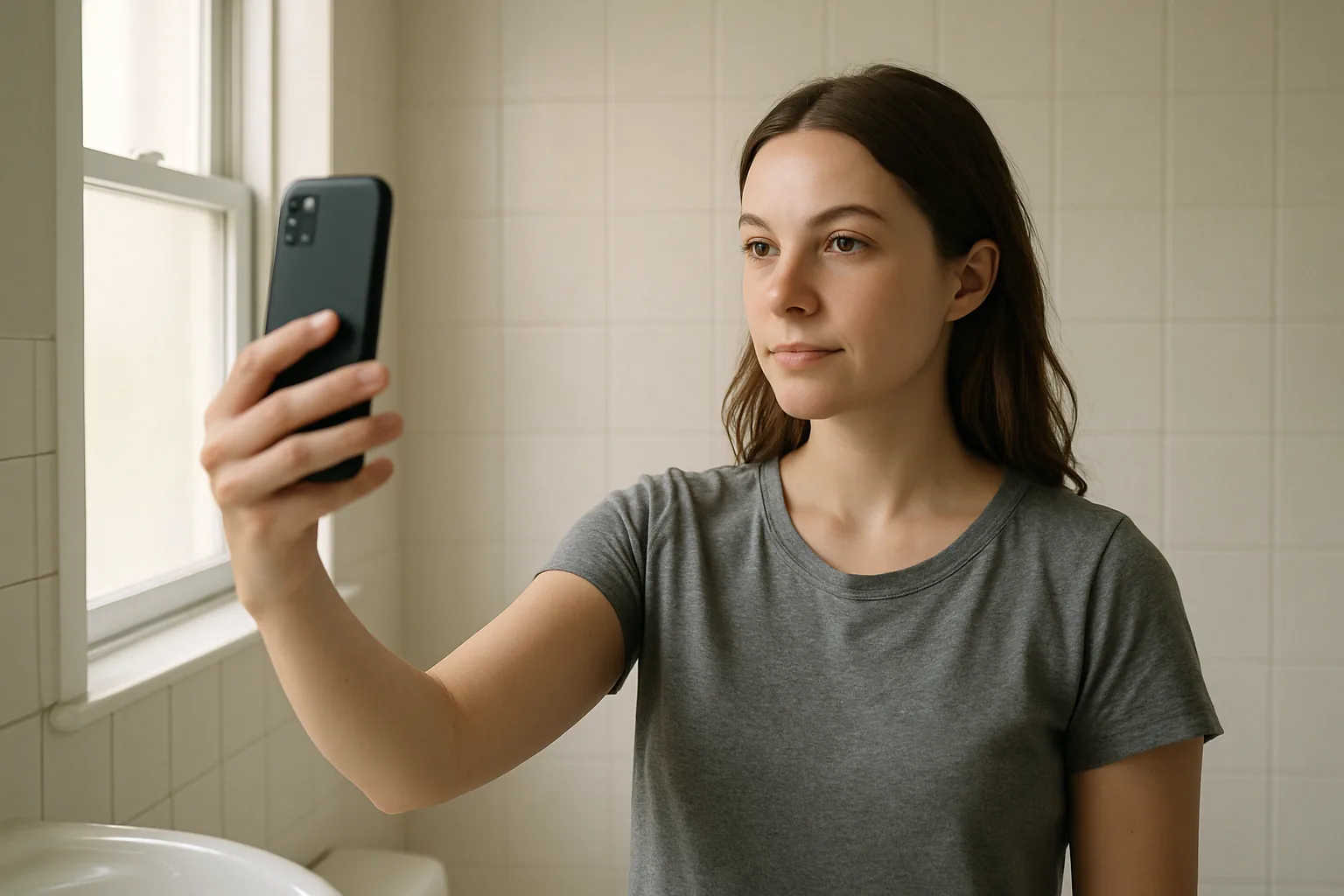
Everything else is a stage. Patch test before any pigment goes in, take a photo in the same light every few days so you are comparing like with like, and give it the full six weeks before you decide anything. Results vary enormously with artist skill and skin type, but almost nobody who panicked at week three still thought there was a problem at week six.
Sources
- Women’s Health on why true microblading results are not visible for at least a month
- Woman’s Day for why artists ask clients back roughly a month after the first session
- Chatelaine with a walk-through of what the procedure and recovery involve
- Current Problems in Dermatology covering the early and late complications of cosmetic tattooing
- Medicine on a 1,352-client survey of permanent makeup complication rates