Reactive Skin in the Microblading Chair: Contact Reactions to Numbing Cream, Ointment, and Tape
Published on September 12, 2026
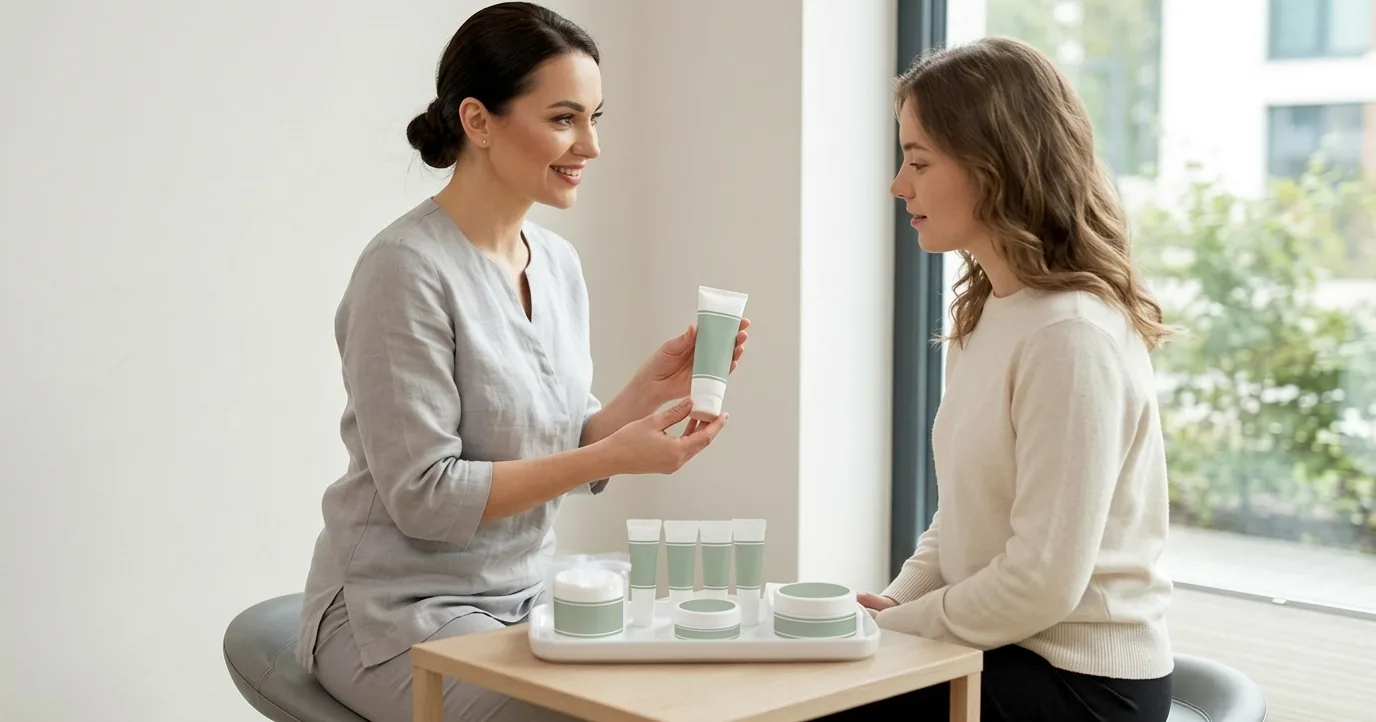
The client who books a consultation and opens with “I have really sensitive skin” almost always follows it with a question about the pigment. Is it hypoallergenic. What is actually in it. Can I be tested first. Those are fair questions and they deserve real answers, but they are aimed at the wrong end of the appointment.
Federal health data has made this a larger conversation than it used to be. The CDC’s National Center for Health Statistics puts allergic and irritant contact dermatitis at roughly one in three American women at some point in their lives, with facial cosmetics among the most commonly cited triggers, and permanent makeup clinics now report a shift in why women walk through the door. For a growing share it is not convenience. It is that they cannot wear conventional brow products at all. Those clients arrive braced for a pigment problem, when the pigment is one of maybe eight substances that will touch their face over the next two hours, and several of the other seven sit on published lists of the most common contact allergens in medicine.
Everything Else That Touches Your Face
Walk through a single appointment and count the products. A cleanser or degreaser preps the skin, usually isopropyl alcohol, chlorhexidine, benzalkonium chloride, or a green soap carrying fragrance or an essential oil. A primary topical anesthetic goes on next, typically a lidocaine cream, sitting under occlusion for twenty to forty minutes and often held down with plastic wrap and tape. Mapping follows: pencil, white paste or pomade, sometimes tape as a straight edge. Gloves rest against your face for the better part of an hour. Once the skin is open, a secondary anesthetic goes on, usually a stronger blend adding prilocaine, tetracaine, or epinephrine. Then you go home with an ointment you will apply twice a day for two weeks onto skin with no functioning barrier. And on about day four, when the itching starts, a good number of people quietly reach for something else in the bathroom cabinet.
One of those is pigment, and pigment is the only one the “patch test” most studios offer actually tests. Everything else goes on your face untested, which is a strange way to run a risk assessment for someone who reacts to things.
Irritant or Allergic: The Distinction That Changes the Plan
These two get used interchangeably in studio conversation and they are not the same event, which matters because they lead to different decisions.
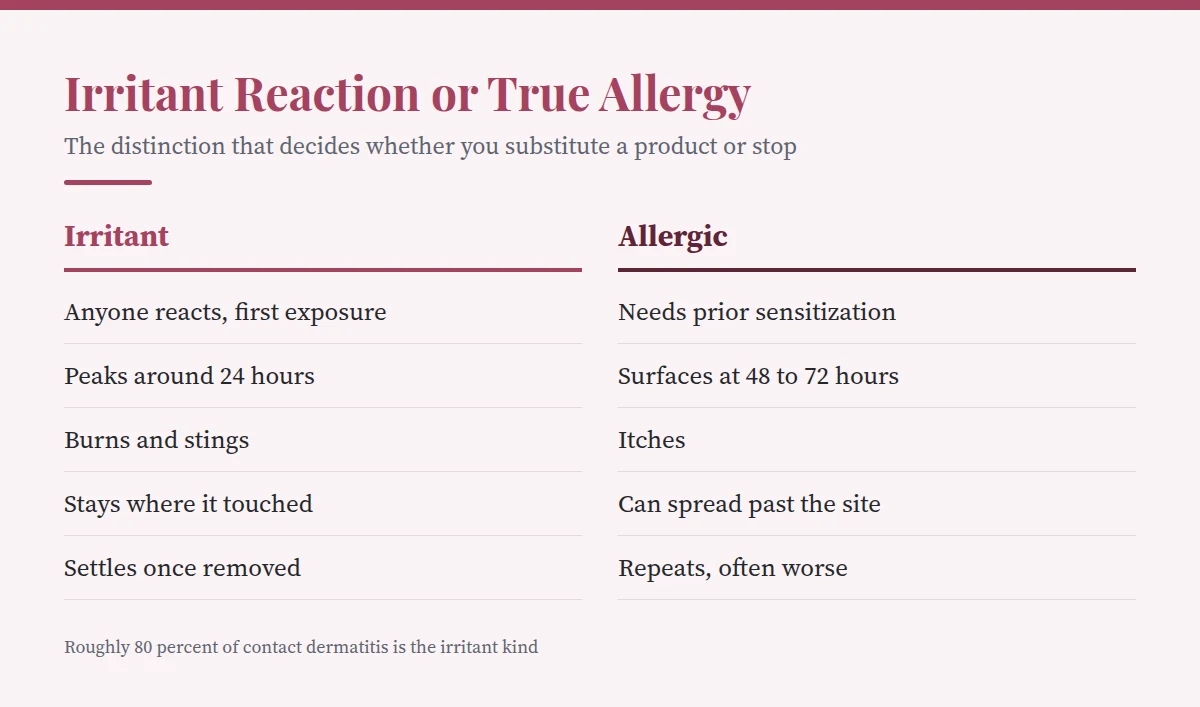
Irritant contact dermatitis is direct chemical injury to the outer skin cells. No prior exposure is needed, anyone will react given enough concentration or contact time, and the response is fast, typically peaking around twenty-four hours. It burns and stings more than it itches, stays sharply confined to wherever the substance sat, and settles once the substance is gone. It is also the large majority of contact dermatitis, roughly eighty percent of cases.
Allergic contact dermatitis is an immune event, a type IV delayed hypersensitivity reaction. It requires that your immune system already met the substance and learned to recognise it, which is why a product you used happily for years can turn on you. The response lags, usually surfacing forty-eight to seventy-two hours after exposure, itch dominates over sting, and it can spread past the contact area into skin the product never touched. It also repeats every single time, often worse.
For microblading the practical difference is this. An irritant reaction to a degreaser means use a gentler one and carry on. A true allergy to an ingredient that also appears in your aftercare balm means a two-week problem you cannot rinse off, on an open wound, at the exact moment pigment retention is being decided. One honest caveat sharpens the point: for the first seventy-two hours a freshly tattooed brow is red, swollen, and tender no matter what, both reaction types hide inside that noise, and even dermatologists frequently cannot separate them by eye. That is an argument for testing in advance, not for watching and waiting.
The Numbing Cream: Esters, Amides, and the Second Application
Topical anesthetics split into two chemical families, and the split predicts a lot. Esters (benzocaine, procaine, tetracaine, chloroprocaine) are the more allergenic group by a wide margin. Benzocaine produces the largest number of positive results of any anesthetic on patch testing, and an estimated five percent of people who use topical benzocaine preparations become sensitized to it. Amides (lidocaine, prilocaine, mepivacaine, bupivacaine) are considerably better tolerated, which is why lidocaine is the default in most brow studios.
Better tolerated is not the same as inert. Allergic contact dermatitis to lidocaine is documented in case series, so “it is only lidocaine” is not a reassurance to accept unexamined. Two numbers put it in proportion: across large patch-test populations, about 3.4 percent of patients react to at least one topical anesthetic, and of those, roughly 93 percent react to only one. Reacting to a numbing agent almost never means reacting to all of them. Patients allergic to an ester generally tolerate an amide and vice versa, and the rare cases positive to both look more like separate sensitizations than true cross-reaction.
The second application deserves its own note. Primary numbing goes onto intact skin, where the barrier limits absorption. Secondary numbing goes on after the blade has opened channels, and absorption through broken skin is a different proposition entirely, both for allergy and for dose. The FDA has warned about topical anesthetics used before cosmetic procedures after deaths linked to heavy occluded application, and cautions consumers against over-the-counter lidocaine above four percent on skin. Prilocaine and benzocaine carry a separate methemoglobinemia risk. None of this makes numbing unsafe in trained hands. It does mean the ingredient list of the second cream is a reasonable thing to ask about, not an imposition.
Aftercare Ointment: The Longest Exposure of the Whole Process
If you rank the products by total contact time, the aftercare balm wins outright. Twice daily for two weeks, onto skin that is by definition compromised. That is the exposure most likely to sensitize someone and most likely to be blamed on the pigment when it goes wrong.
Lanolin is the headline. The American Contact Dermatitis Society named it the 2023 Allergen of the Year, and the reasoning is directly relevant here: lanolin is a genuinely rare sensitizer on healthy intact skin, but people with a damaged barrier or chronic inflammatory skin disease react far more often, with reported prevalence in dermatitis patients running from about 1.2 to 6.9 percent. The allergenic fraction is the free lanolin alcohols. A healing microbladed brow is, for a fortnight, precisely the compromised-barrier scenario that moves lanolin from low risk to worth checking. It appears in several of the balms most commonly handed out after brow work.
The rest of the ingredient deck is more ordinary. Fragrance and botanical extracts are among the top sensitizers in facial products generally, propylene glycol was the 2018 Allergen of the Year, and tocopherol (vitamin E), tea tree oil, and aloe all sound gentle while carrying contact allergy case literature behind them. Plain white petrolatum, by contrast, is one of the least allergenic substances in dermatology, which is why it is the usual fallback when someone reacts to everything else. Its problem is occlusion rather than allergy: applied too thickly it traps sebum and keratin and produces the crop of pinpoint whiteheads covered in our guide to early bumps during microblading healing.
Then there is the tube nobody prescribed. Triple antibiotic ointment is the most common uninvited addition to brow aftercare and a poor idea on two counts. Bacitracin was the ACDS Allergen of the Year in 2003 and neomycin in 2010, co-sensitization to both is common, and a reaction to either looks exactly like the infection people are trying to prevent. Your artist’s written protocol, and our microblading aftercare guide, should be the whole of what goes on those brows unless a doctor has looked at them and said otherwise.
Tape, Wrap, and Gloves
Adhesives are the category clients never think to mention and clinicians see constantly. The tackifiers that make medical tape stick are the allergens: colophonium (rosin) and its derivatives, acrylates, and isocyanates. In a study of soldiers using adhesive tape preventively, contact allergy to the tapes was found in 77 percent of the affected subjects and to colophonium specifically in 61 percent, with the chemistry confirmed in the tapes themselves.
Scale matters, and brow tape is a far lighter exposure than a surgical dressing. Still, the dressing numbers show the mechanism is not exotic. In a prospective study of spinal surgery patients, 45 percent developed some form of medical adhesive-related skin injury within ten days, and contact dermatitis was the most common type at 41.4 percent. Acrylate-based dressings caused it substantially more often than silicone-based ones, and several days sooner.
Two separate problems hide in that category, and mixing them up leads to the wrong fix. One is allergy to the adhesive chemistry: a rash where the tape was and nowhere else, two days later, itching. The other is purely mechanical: stripping tape off the thin, mobile skin around the eye can tear the surface outright, a documented and preventable injury in older and post-menopausal patients, and it shows up as a red, sore, slightly peeled rectangle the moment the tape comes off. If you have ever reacted to plasters, surgical tape, or an ECG electrode, say so and ask for silicone tape or for the wrap to be held some other way. It is among the easiest substitutions in the whole appointment. Gloves deserve the same question. Nitrile is standard in professional studios now, but latex has not vanished everywhere, and an hour of gloved hands on the face is meaningful contact for anyone with a latex allergy.
What to Actually Do Before You Book
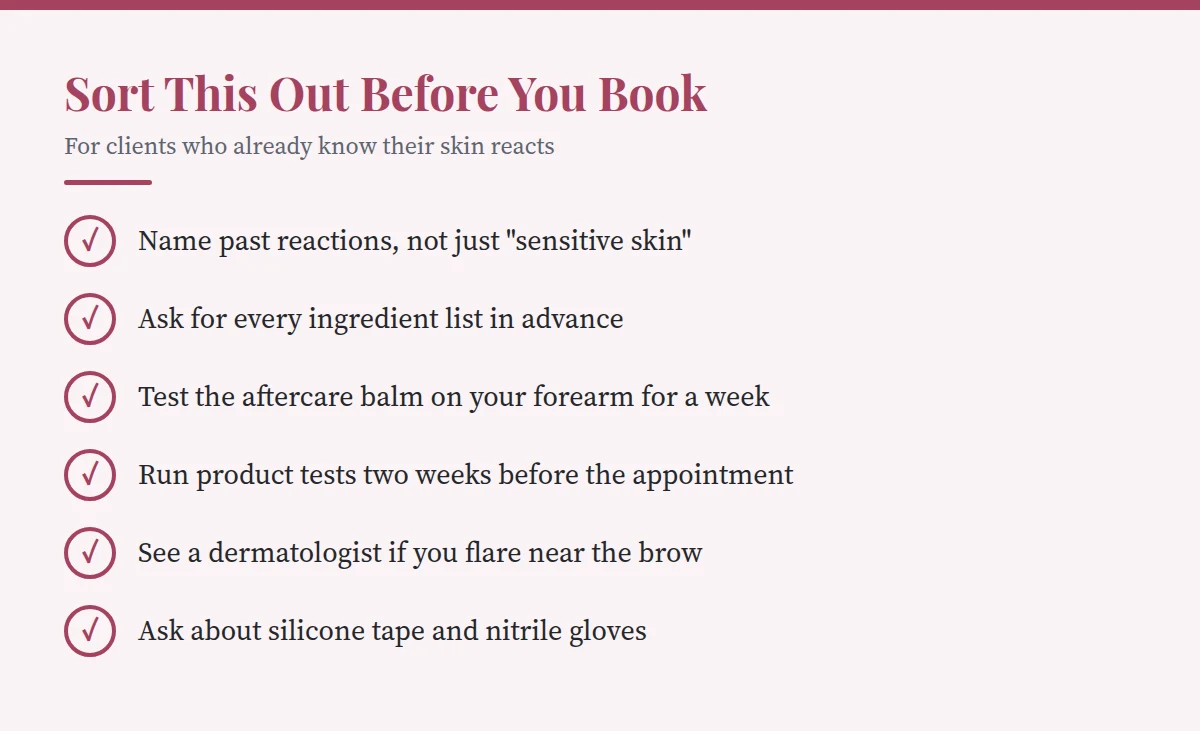
Disclose specifically, not vaguely. “I have sensitive skin” tells your artist almost nothing. What helps is a list of actual events: the dental numbing that made your lip swell, the sunscreen that stung, the plasters that leave a red square, the hair dye, the earrings, the antibiotic ointment that made the cut worse. If you have ever been patch tested, bring the report. That single sheet of paper is worth more than any amount of describing.
Ask for the ingredient lists in advance. All of them: primary anesthetic, secondary anesthetic, cleanser, aftercare balm, tape. An artist who cannot produce these is telling you something about how they document their own practice. This applies whichever way you booked, and whether the name on the door belongs to a franchise or to one person, as our comparison of chain studios and independent artists goes into.
Test the ancillary products separately from the pigment. They are different questions on different schedules. For a leave-on product like an aftercare balm, the standard approach is an open application test: apply it twice a day to a patch of clear skin about five centimetres square on the inner forearm, for a week, and watch. A positive is redness, dryness, itching, or frank dermatitis at the site, and it often does not appear until several days in, which is exactly why a single dab and a glance twenty minutes later proves nothing. Run product tests at least two weeks before your appointment so a positive still leaves time to substitute.
See a dermatologist first if any of these apply. Eczema, rosacea, or psoriasis anywhere near the brow. A past reaction that needed oral steroids or a hospital visit. Reacting to multiple unrelated products without ever finding out why. In that last case ask specifically about patch testing to a standard panel rather than guessing product by product. Knowing you react to colophonium or to fragrance mix is portable information you will use for the rest of your life, not just for your brows.
Know that substitutes exist for nearly everything. Amide instead of ester numbing, or a protocol with no secondary numbing at all. Plain petrolatum or a dry-healing approach instead of a compounded balm. Silicone tape or none. Nitrile gloves. A different degreaser. A good artist would rather reroute around your allergen than find out about it on day three.
When Sensitive Skin Is Still a Yes
Most self-described sensitive-skin clients are perfectly good candidates, and the CDC framing cuts in their favour as often as against it. If conventional brow makeup is the thing you react to, removing a daily product from your face permanently is a real benefit rather than a cosmetic indulgence. Reactive skin is a reason to plan carefully, not an automatic disqualification. Where it does interact with technique and retention, our microblading by skin type pairing guide covers the sensitive-skin case in more detail.
The genuine red lines are narrower. Active dermatitis at the brow on the day is one, because nobody should tattoo inflamed skin, and that appointment gets moved. A documented severe reaction to something that cannot be worked around, such as anaphylaxis to chlorhexidine, is another, and belongs with your doctor rather than your artist. A history of reacting to many things with no idea which things is a reason to get tested before booking, not a reason to find out the hard way.
One last boundary. Nothing here screens for pigment allergy. That is a separate question with its own test and a long tail, since pigment reactions can surface weeks, months, or years after a clean start, which is what our guide to bumps, lumps, and granulomas after microblading is for. Clearing the numbing cream, the ointment, and the tape simply removes the noise, so that if something does react, you and your artist know what it was.
Microblading is a regulated tattoo procedure, and an unlicensed practitioner is a safety risk regardless of how careful their ingredient list looks. Results vary substantially with artist skill and skin type, and this is semi-permanent work needing touch-ups rather than a one-time permanent fix. Insist on a patch test before pigment goes into your face, and if you have a chronic skin condition, see a dermatologist before you see anyone else.
Sources
- Actas Dermo-Sifiliográficas on why ester anesthetics sensitize far more often than amides
- StatPearls for how irritant and allergic contact dermatitis differ in mechanism and timing
- Cutis with the case behind naming lanolin the 2023 allergen of the year
- DermNet covering why bacitracin belongs nowhere near a healing wound
- Acta Dermato-Venereologica on colophonium traced back to the adhesive tape that caused the rash
- International Wound Journal for how often adhesive dressings end in contact dermatitis
- Indian Dermatology Online Journal with a preventable facial skin tear from acrylate tape on thin skin
- DermNet on running an open application test on a product at home
- Healio for the FDA warning on high-strength over-the-counter lidocaine
- FinancialContent covering the CDC sensitivity figures reshaping permanent makeup consultations