Microblading While Pregnant or Breastfeeding: Why Almost Every Artist Says No
Published on August 11, 2026

“Are you pregnant or breastfeeding?” sits near the top of every microblading intake form, and a yes almost always ends the appointment. Clients hear that as a warning that the procedure would hurt the baby and then go looking online for someone to tell them the risk is overblown. That framing is wrong in both directions. Nobody has demonstrated that microblading harms a pregnancy, and nobody has demonstrated that it does not. What has actually happened is that a procedure with no safety data collided with the one population where the industry has no appetite for finding out.
That distinction matters, because it changes which parts of the standard “no” are solid and which parts are repeated without much thought. Some of the reasons artists give are the real ones. At least one commonly cited reason is almost backward.
Nobody Can Tell You What Is in the Pigment
Start with the part that gets glossed over. The FDA has not approved a single pigment for injection into the skin for cosmetic purposes. Permanent makeup pigments reach the market as cosmetics, which means composition disclosure is thin, batch consistency is not guaranteed, and some colorants in circulation were originally manufactured for printing ink or automotive paint rather than for human dermis.
So the honest sentence is not “the ingredients are dangerous in pregnancy.” It is that nobody can produce a complete ingredient list for the thing being implanted, which makes a risk assessment impossible before it even begins. Layer on the ethics problem: you cannot run a controlled trial that implants unapproved pigment into pregnant volunteers to see what happens. That study will never exist, so the data gap is permanent rather than a temporary state of the literature.
Pigment does not stay politely in the brow either. Particles small enough for the lymphatic system to carry off travel to regional lymph nodes, which tattoo research documents well. Whether any of that is systemically relevant to a fetus is unknown, and unknown is the whole point.
Infection Is the Risk With Real Teeth
If one argument justifies the decline on its own, this is it, and it is not about the pigment at all.
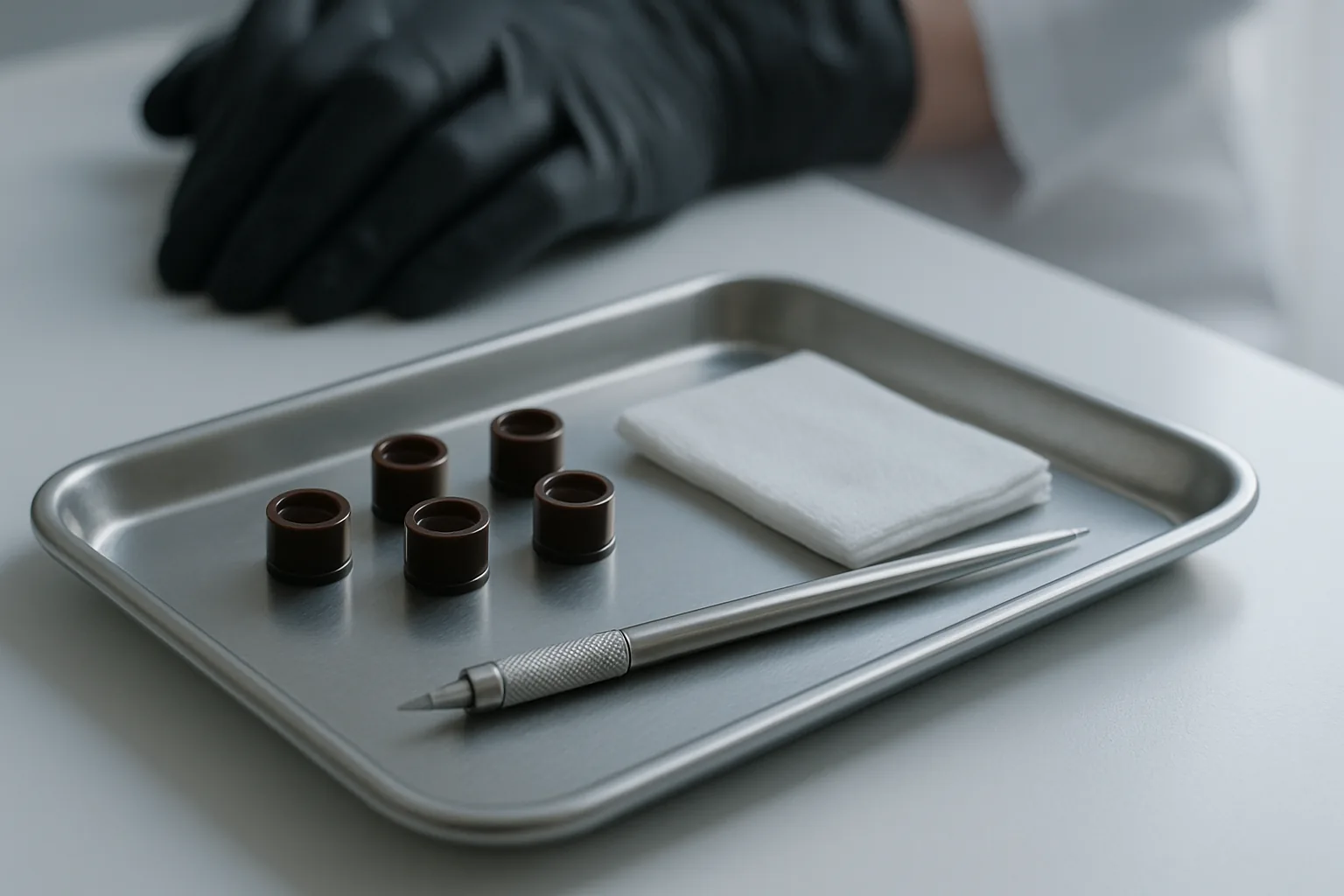
Microblading leaves hundreds of open channels across your face for several days, and the sterility of the pigment going into them is not a given. A microbiological survey of 47 permanent makeup inks sold in the United States found live bacteria in 9 of them, and three of the eighteen inks that advertised themselves as sterile were among the contaminated ones. Case literature documents bloodstream infections, septic shock, and necrotizing soft tissue infection within two weeks of a tattoo or PMU procedure, with non-tuberculous mycobacteria as an emerging cause.
Here is the pregnancy-specific twist that rarely gets explained. The infection is no more likely because you are pregnant. It is harder to treat. Tetracyclines including doxycycline are avoided in the second and third trimesters over fetal dental staining and bone growth concerns, and systemic fluoroquinolones are avoided throughout. Those two classes are exactly what dermatology reaches for when a skin infection is atypical, resistant, or mycobacterial. You are still left with amoxicillin and cephalexin, which cover ordinary staph and strep perfectly well, but the shelf you would need for the unusual organisms is largely closed. Choosing an elective facial wound at the moment your treatment options narrow is a poor trade for eyebrows.
The Numbing Cream Argument Is Usually Backwards
This is where the industry’s reasoning tends to fall apart, so it is worth being precise.
Artists frequently tell nursing clients that lidocaine will pass into breast milk and harm the baby. LactMed, the NIH lactation drug database, does not support that. Lidocaine transfers into milk in low amounts, is poorly absorbed by an infant’s gut, and is not expected to cause adverse effects. Local anesthesia does not require pumping and dumping. On that specific claim, the artist is wrong.
The legitimate concern is dose and route rather than milk. PMU numbing happens in two stages, and the second stage goes onto skin the blade has already opened. Absorption of topical anesthetic rises with surface area, contact time, and loss of barrier integrity, which is why products like EMLA are labeled for intact skin only. Secondary PMU gels are often compounded well above over-the-counter strength, sometimes stacking lidocaine with prilocaine, tetracaine, and epinephrine, with little oversight of the mixing. Prilocaine and benzocaine both carry a methemoglobinemia risk through their aromatic amine metabolites, and that risk climbs on abraded skin under occlusion.
None of that is a reason to worry about a nursing mother’s milk. It is a reason not to put an unregulated, high-concentration anesthetic cocktail onto an open wound during pregnancy, where the pharmacokinetics have never been characterized.
Pregnancy Hormones Make the Result Unpredictable
Even setting safety aside, there is a purely cosmetic argument that persuades many clients on its own: this is the worst possible moment to judge brow color.
Estrogen and progesterone both drive melanogenesis, upregulating tyrosinase and stimulating melanocytes directly. That is why melasma affects up to half of pregnant women and peaks in the third trimester, and the central face is its favorite territory. Implanting pigment into skin whose melanocytes are running hot is a guess. Healed color can land darker or cooler than planned, and post-inflammatory hyperpigmentation along the strokes becomes more likely, a mechanism our guide to microblading on dark and deeper skin tones covers in more detail.
Three more things work against a good result. Blood volume rises roughly 40 percent in pregnancy and the skin is more vascular, so the brow bleeds more at the needle, and blood dilutes pigment at the moment of implantation. Fluid retention changes the shape of your face, so mapping done at 32 weeks may not flatter the face you have three months later. And whatever goes in now is still there when your hormones normalize, healing into skin that behaves differently from the skin it entered. The pigment chemistry guide explains why color drift is hard to predict even under stable conditions.
There is an unglamorous practical layer too. Microblading means two hours semi-reclined with your face still, which in late pregnancy competes with reflux, back pain, supine hypotension, and a bladder with no patience. Heightened smell makes pigment and disinfectant unpleasant. Ibuprofen is off the table for soreness after 20 weeks.

What the Consent Form Is Actually Doing
Clients sometimes assume there is a law. There generally is not. No state body art code prohibits tattooing a pregnant person outright, though some jurisdictions, San Diego County’s Safe Body Art Act among them, require practitioners to ask about pregnancy during intake.
What exists instead is a professional standard enforced through paperwork. When an artist says “my insurance won’t let me,” that is usually shorthand rather than a named policy exclusion. The real mechanism is simpler: your intake form is a medical record, and a documented yes next to “pregnant” plus any adverse outcome is an indefensible position for the artist regardless of what caused it. Declining is the only defensible choice available to them.
Which leads to the one piece of advice worth more than everything above. Do not lie on the form. Clients occasionally tick no to get the appointment, and it removes the artist’s ability to adjust anything at all, from anesthetic choice to aftercare instructions. It also means that if something goes wrong, the person treating you is working from a false history.
A Realistic Timeline for Booking
The useful answer is not “wait until after,” because “after” covers a very wide range.
If you are not nursing, most artists will book you from around three months postpartum, and hormones broadly settle between three and six months. The stronger constraint is often pigmentation: pregnancy melasma and other hyperpigmentation can persist a year or more, and you want it faded before anyone matches a brow shade to your face.
If you are nursing, policies vary more than any other question in this field. A meaningful number of artists will treat an exclusively breastfeeding client after the newborn period, and the lactation risk profile genuinely is lower than the pregnancy one. Others hold the line until weaning. Both positions are defensible, and if an artist declines, that is professional caution rather than a judgment of you.
The argument for waiting through lactation is mostly about results and logistics. Estrogen stays low for as long as you exclusively breastfeed, sometimes 12 to 18 months, and low estrogen means drier, less resilient skin with weaker barrier function. That is not a promising canvas for retention. More decisively, microblading demands ten days of disciplined aftercare: no sweating, no sleeping on your face, no water on the brows, nothing rubbing them. Newborn life is not compatible with that, and aftercare is roughly half of what determines your result. Plan for the full arc as well, since you need an initial session plus a perfecting visit six to eight weeks later, and both healing windows need protecting.
In the Meantime
The waiting period is not a cosmetic dead zone. Brow tinting, henna, lamination, and good pencil work all improve brows without breaking the skin, and our brow lamination comparison covers what lamination can and cannot do. One caution worth flagging: prostaglandin-analog brow growth serums, the same drug class as glaucoma drops, are not established as safe in pregnancy, so run those past your OB rather than your aesthetician.
Then use the time properly. Waiting is when clients do their best research, and a delayed booking with a well-vetted artist beats a rushed one every time. Read the full risks and contraindications guide, look at healed work rather than fresh photos, and book the consultation before the procedure. The brows will still be there in six months. The window where your skin, hormones, and antibiotic options are all doing something unusual will not be.
Sources
- FDA on why no pigment is approved for injection into skin
- Microorganisms for a survey finding live bacteria in sealed permanent makeup inks
- Medicina Clínica documenting systemic infections traced to tattoos and permanent makeup
- Pharmacotherapy with a 2025 review of which antibiotics are avoided in pregnancy
- LactMed covering what actually happens to lidocaine in breast milk
- Cureus on topical anesthetic absorption through a compromised skin barrier
- International Journal of Molecular Sciences explaining how estrogen and progesterone drive melasma
- Dermatology Times for the skin changes that follow pregnancy and persist through nursing
- County of San Diego and the Safe Body Art Act intake requirements