Getting Microblading Abroad: Price, Flying Home, and Planning Around the Touch-Up
Published on September 13, 2026
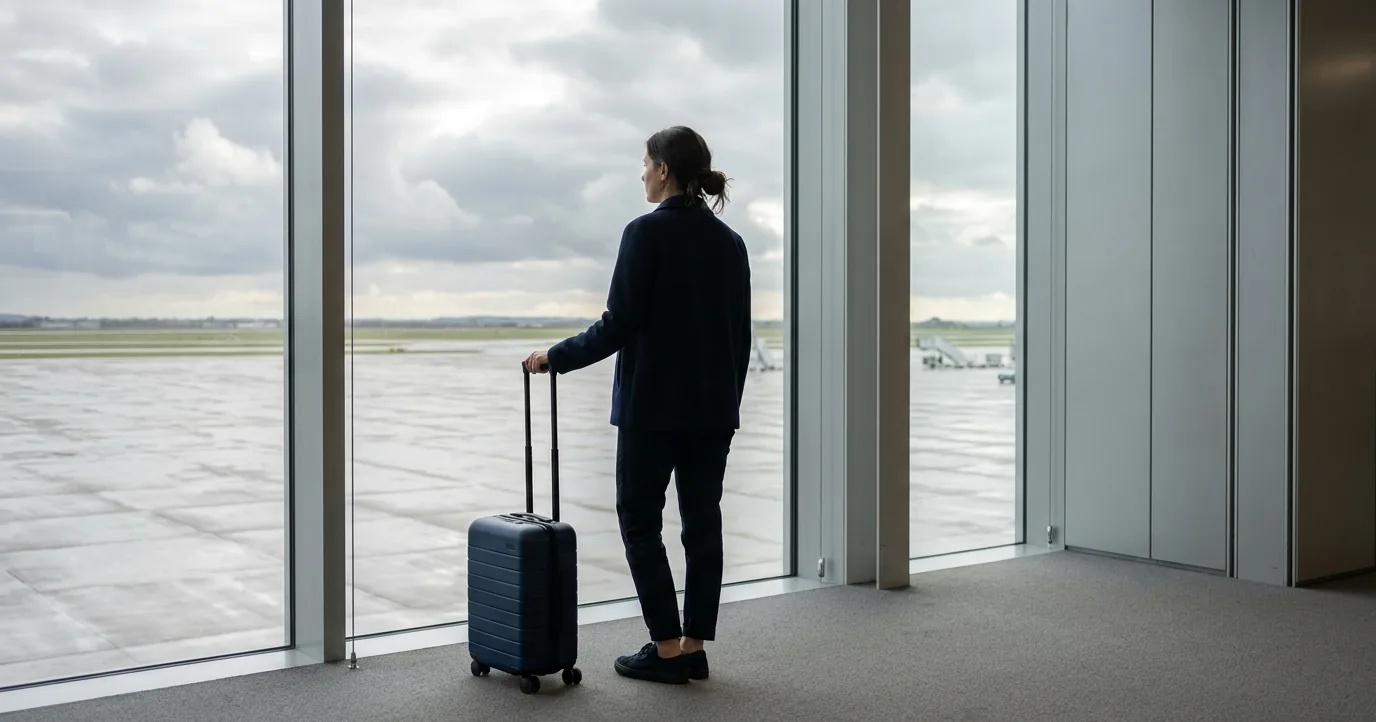
The arithmetic is not subtle. A microblading session that runs $400 to $800 across most of the United States, and $1,000 to $1,500 at a premium studio in New York or Los Angeles, can be booked in Seoul for somewhere around $200 to $400. Thailand often quotes lower still, and Turkey and the Eastern European studios sit somewhere in between depending on the clinic. Add a flight and a week of hotel and the total can land close to what one appointment would have cost at home, with a holiday attached. Written down like that, it reads as free money.
It usually is not, and the reason has very little to do with the quality of the work. Some genuinely excellent hairstroke artists are working in Seoul and Istanbul right now. The problem is structural: microblading is not a purchase, it is a six to eight week process with a mandatory second appointment sitting in the middle of it, and the trip most people book treats it as a purchase. What follows is the logistics, not the sales pitch.
The Price Gap Is Real, and the Quote Is Not the Bill
Take the quoted number at face value and it is still only one session. A first pass is not a finished brow anywhere in the world, at any price, because no artist can predict how a particular face will hold pigment until it has healed once. Our two-year cost breakdown puts the honest total at the initial session plus a perfecting visit plus an annual colour boost, and the comparison people actually make is one overseas session against one domestic session. Those are not the same two things.
Overseas studios are perfectly aware of this, which is why many of them advertise the touch-up as included. It usually is included, at six to eight weeks, in a city you will have left.
The Six-Week Touch-Up Is the Part Nobody Books
The perfecting visit exists because retention is uneven and personal. The artist looks at where the pigment stayed, where it dropped out, how the colour settled in your skin, and corrects for it. Skip it and you keep whatever the first pass gave you, gaps and all. On dry or normal skin that can be a decent result. On oily skin it frequently is not, and our skin type pairing guide is worth reading before you decide which of those you are.
There are only four honest ways this ends, and it is better to pick one before booking than to discover it in week six.
Fly back. Clean, and it works if the destination was somewhere you were going anyway or the fare is genuinely cheap. Otherwise the second flight is the arbitrage.
Stay for eight weeks. A real option for some people and an entirely different kind of trip for everyone else.
Have it done at home. The most common plan and the most fraught, for reasons covered further down.
Accept a single pass. Legitimate if you go in knowing it, and a bad surprise if you do not.
Flying Home With Fresh Brows
Cabin pressure is not the thing to worry about. Microblading pigment sits in the upper dermis and altitude does not move it. Two other things do matter.
The first is dryness. Cabin humidity runs somewhere around 10 to 20 percent, drier than most deserts, and healing brows respond to that by forming hard, tight scabs. A hard scab that catches on a pillow or a sleeve and lifts early takes pigment out with it, which is exactly the mechanism behind the patchy healed result described in our day by day healing timeline. Keep aftercare balm in your carry-on inside the liquid allowance and reapply through the flight rather than waiting until you land. Mild facial puffiness on a long sector is common, harmless, and gone in a day.
The second is time. Seoul studios that work with international clients will often clear a client to fly the same day or the next, and it is true that nothing about the plane itself is dangerous. Give it 48 hours anyway, and two to three days if the itinerary allows, because those are precisely the hours in which you might want to walk back into the studio and have somebody look at your face. The CDC’s advice for medical tourists is to stay on the ground for ten days after chest or abdominal surgery. Microblading is not surgery and does not need anything like that, but it tells you which direction the caution runs.
Small things that help: wash your hands before touching your face on a plane, do not sleep with the brow pressed into a travel pillow, and keep the window blind down, because a window seat at altitude is a great deal of ultraviolet on skin that cannot take it yet.
Your Holiday Is Scheduled Inside the Worst Two Weeks
The CDC puts it plainly for anyone travelling for a procedure: typical vacation activities, meaning alcohol, strenuous exercise, sunbathing, swimming and long tours, can delay or impede healing. For brows, that guidance is not general caution, it is specific.
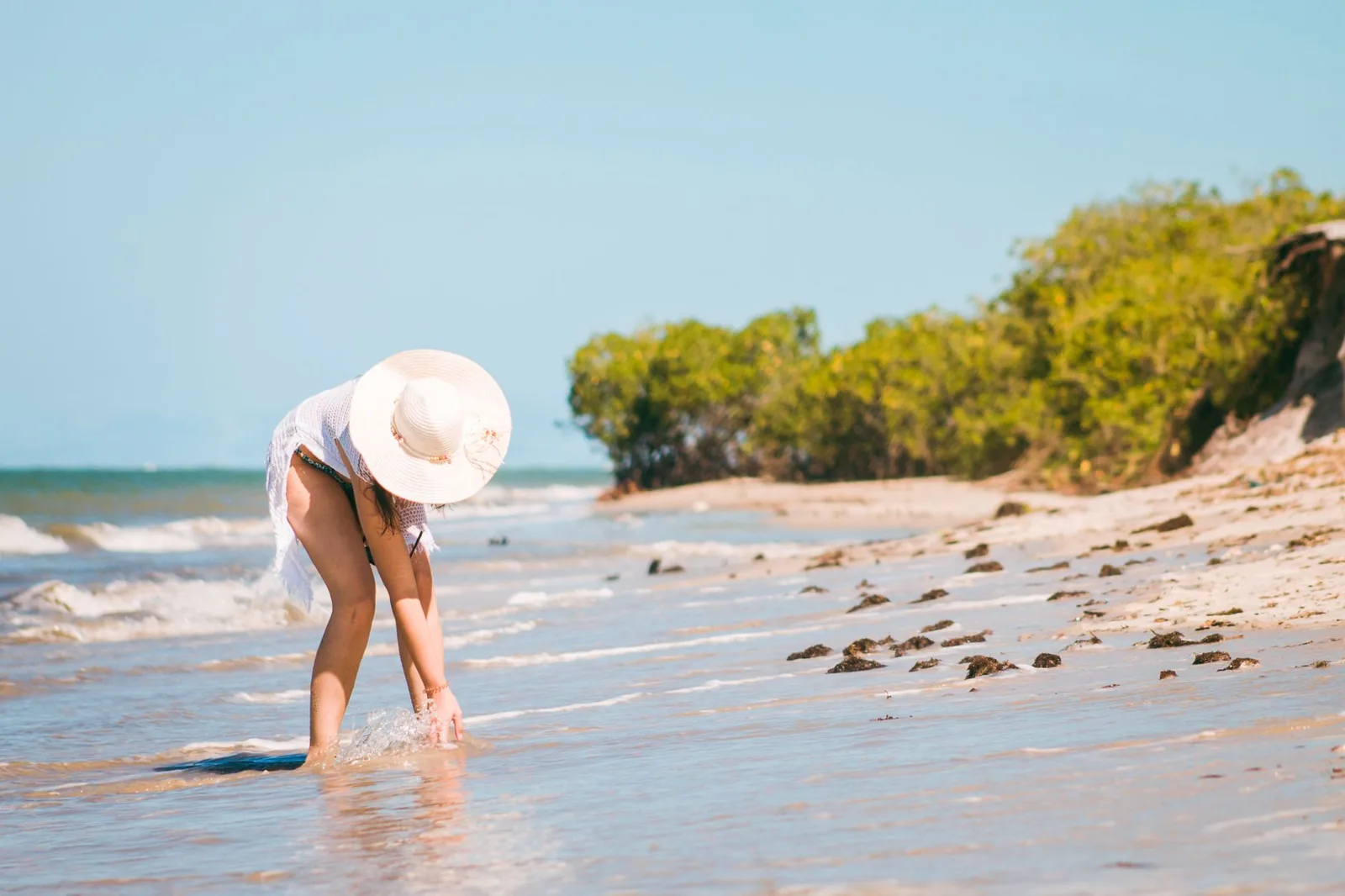
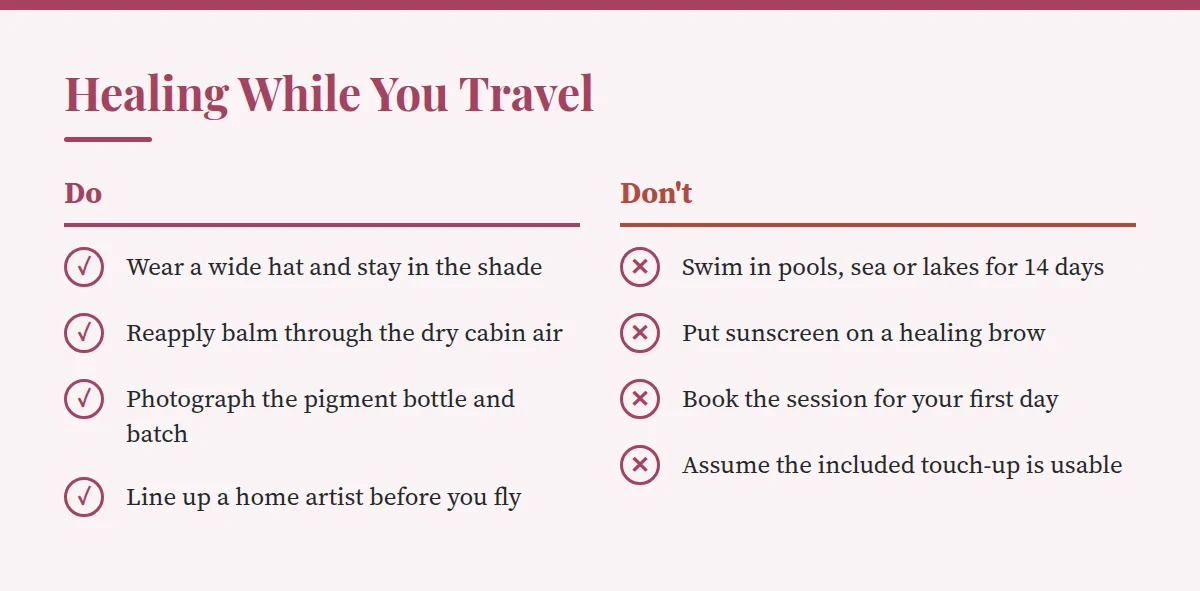
No swimming for fourteen days, and that covers the hotel pool, the sea, and the lake. Chlorine is a disinfectant designed to destroy small organic things and it does not distinguish between bacteria and fresh pigment. Sea water and fresh water are gentler chemically and carry their own bacterial risk instead. Either way, submerging your face softens the scabs and floats pigment out of skin that has not sealed yet.
No direct sun for the first one to two weeks, which is awkward, because you also should not be putting sunscreen on a healing brow. That leaves a wide hat and shade as the only tools you have. Sweat from hiking or a hot climate works on the same scabs from the other direction, and the long-term picture in why microblading fades fast is largely a story about ultraviolet and salt and chlorine doing this repeatedly over years.
Read the two paragraphs above against the trip you were planning. If the beach days and the appointment overlap, the trip is designed to waste the appointment.
Vetting an Artist You Cannot Talk To
Korea is the instructive case, because its rules changed recently and the marketing has not caught up. Tattooing by non-medical practitioners was illegal there for 33 years under the Medical Service Act, and semi-permanent makeup fell inside that. In September 2025 the National Assembly passed a Tattooist Act that defines tattooing and semi-permanent makeup together, creates a national exam and licence, and requires hygiene training plus per-procedure records of the inks used. It takes effect two years after promulgation, with a further two-year transitional period for existing practitioners. In other words, the licence that will eventually mean something does not exist yet, so the word “licensed” on a Seoul studio’s English page today is describing an academy certificate.
The European picture is different and easier to check. Under REACH, roughly 4,000 substances were restricted from tattoo and permanent makeup inks from January 2022, and Pigment Blue 15:3 and Pigment Green 7 followed in January 2023. A studio in the EU is working inside that list. A studio outside it is not, and neither position tells you the artist is good, only what constrains their supply cabinet.
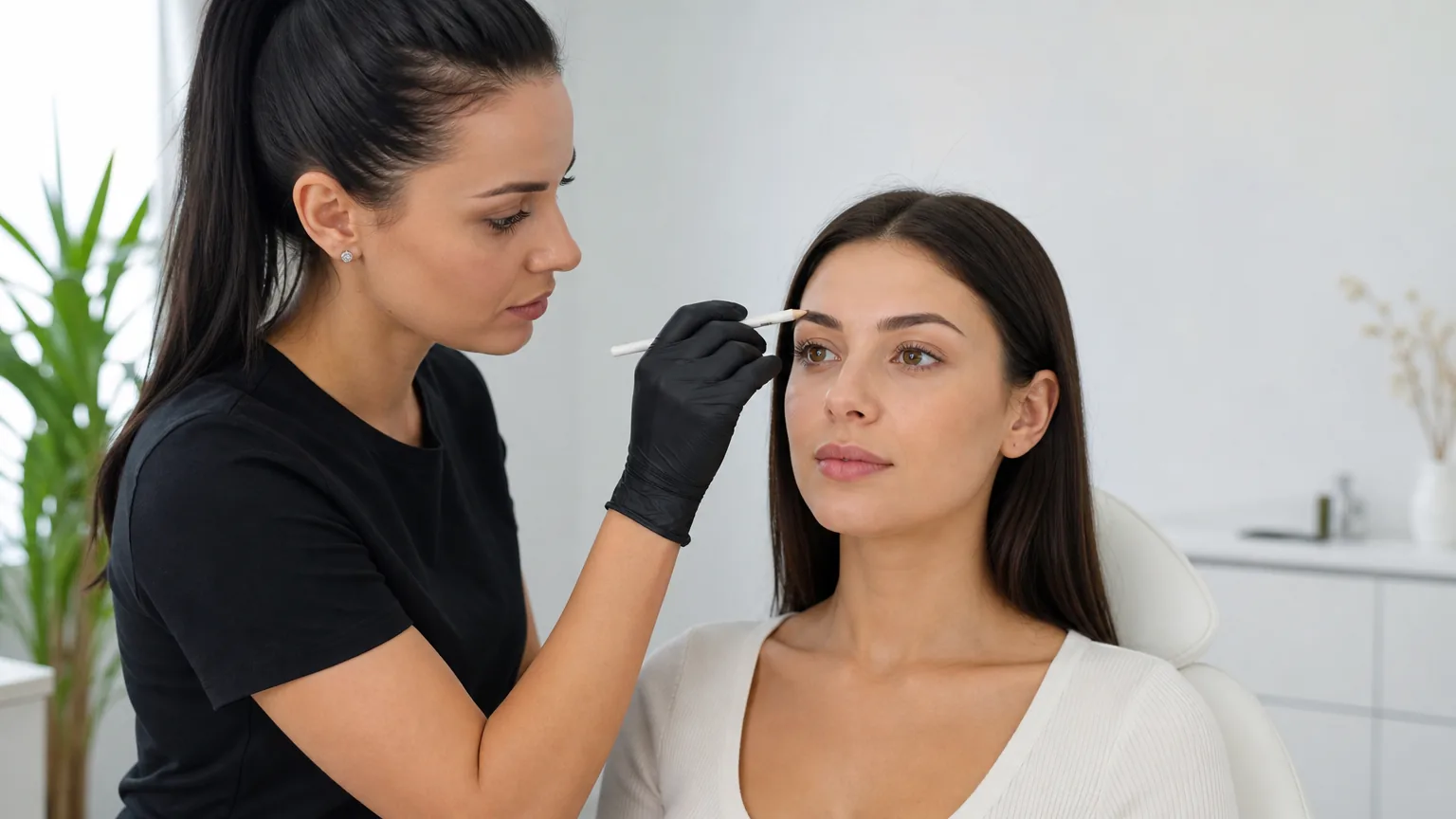
What to ask for is the same everywhere, and none of it needs fluent shared language: healed photographs at twelve months on skin like yours rather than day-one shots, blades opened from sealed single-use packaging in front of you, and a medical history and consent form you can actually read. The CDC’s standing advice to medical tourists, to request copies of records in English, applies here too. Use a translation app for the paperwork, and treat the design conversation differently. If nobody in the room can discuss brow shape with you, do not sit in the chair, because shape is the part you cannot undo. Our questions to ask before booking travels well across borders.
Write Down What Goes Into Your Face
Before you leave the studio, get the pigment brand, product line, shade name and batch number, and photograph the bottle. If you ever need a colour correction, a dermatologist consult, or an artist at home who has to match or counteract that pigment, this is the single most useful thing you can bring back.
Get the numbing cream brand too. Most reactions in the microblading chair are not to pigment at all but to the topical anaesthetic, the ointment or the tape, as covered in our guide to contact reactions to numbing cream, ointment and tape, and an unfamiliar product with an ingredient list you cannot read is a poor place to find that out. Patch testing needs 24 to 48 hours, which means arriving two days before the appointment. Build that into the itinerary rather than skipping the test.
Finding Someone at Home to Inherit the Work
Assume no artist will touch another artist’s brows sight unseen. Standard practice is to email clear photographs before booking or attend a consultation first, and studios generally state outright that they cannot guarantee a result over existing pigment. If the incoming work is too dark, too dense, or has drifted in colour, the honest answer is often lightening or removal before anything new goes in.
Two practical consequences. First, you will pay a new-client or correction rate, not a touch-up rate, and that single line item is usually what erases the saving. Second, look specifically for artists who advertise correction work and can show healed before-and-after cases, rather than hoping a generalist will take it on.
Do all of this before you fly. An artist who has already seen your pre-procedure photographs and agreed to take the six-week visit is worth more than the discount that started the whole plan.
Build the Itinerary Backwards
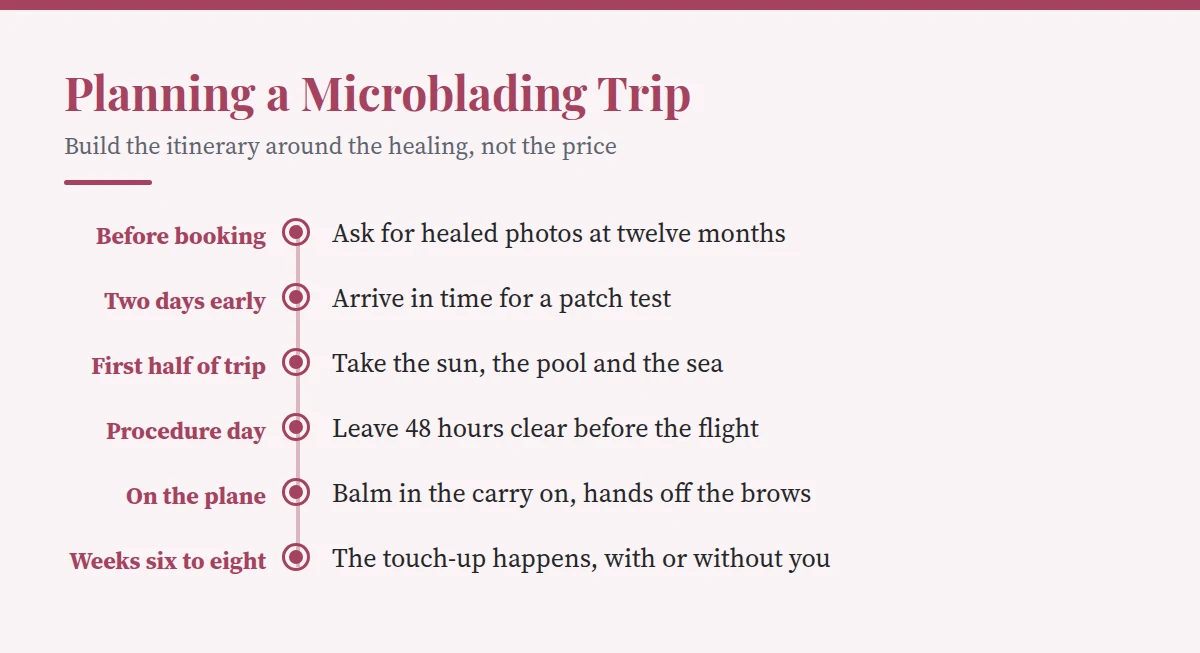
Book the artist first and build the trip around their calendar, not the other way round. Land at least two days early for the patch test. Front-load the sun, the pool, the sea and the hot springs into the first half of the trip. Put the appointment in the last third, leaving at least 48 hours before the flight home. Have your home-side artist identified, shown photographs, and quoted before you go.
If the trip cannot take that shape, the useful conclusion is that you are planning a holiday with microblading bolted onto it, and the brows are better done at home.
One last thing worth weighing at the booking stage rather than the aftermath: recourse across a border is genuinely hard. A complaint, a refund request, or a report to a health authority runs through a foreign regulator in a foreign language, usually long after you have flown home. Results vary far more by artist skill and skin type than by country, and microblading is a regulated tattoo procedure wherever you have it, so an unlicensed or unverifiable practitioner is a safety risk in Seoul exactly as they are in Ohio. Anyone with eczema, rosacea, psoriasis or another active condition near the brow should see a dermatologist before booking anything, and everyone should patch test.
Sources
- CDC Yellow Book on coordinating follow-up care at home before you travel for a procedure
- Emerging Infectious Diseases for what went wrong for roughly 145 US patients who travelled for cosmetic work
- The Korea Herald with the act that finally brought semi-permanent makeup under a tattooist licence
- ECHA covering which pigments EU studios may no longer keep in the cabinet
- Microblading Korea on how soon a Seoul studio will clear a client to board
- Ellebrow for why chlorine and sea water stay off the list for two weeks
- Korea Clinic Guide with a side by side of prices in Korea, the US, Turkey and Thailand