Born With Sparse Brows: Microblading for Ectodermal Dysplasia, Clouston Syndrome, and Other Inherited Hair Conditions
Published on November 6, 2026

Most people who book a brow consultation are describing a loss. Their brows thinned with age, fell out during chemotherapy, or never recovered from years of tweezing, and the artist’s job is to put back something that used to be there. A smaller group has nothing to put back. Their brows were sparse, pale, or missing from early childhood, because of a gene they were born with.
That changes the consultation more than it first appears. There is no old photo to copy, and for most inherited conditions there is no flare to wait out. But the skin under the brow can be part of the same condition, puberty can still move the hair in either direction, and a brow transplant, the other lasting fix, is often off the table. Our guide to microblading for medical brow loss covers brows lost to alopecia areata, thyroid disease, frontal fibrosing alopecia and trichotillomania. This one is for brows that were never fully there. (It is general information, not medical advice. The diagnosis, and any decision about your skin, belongs with a dermatologist or a genetics team.)
The Conditions Behind Brows That Never Grew In
Several inherited conditions leave brows sparse from the start. They differ in what else they affect, and for microblading, what else they affect matters as much as the brows.
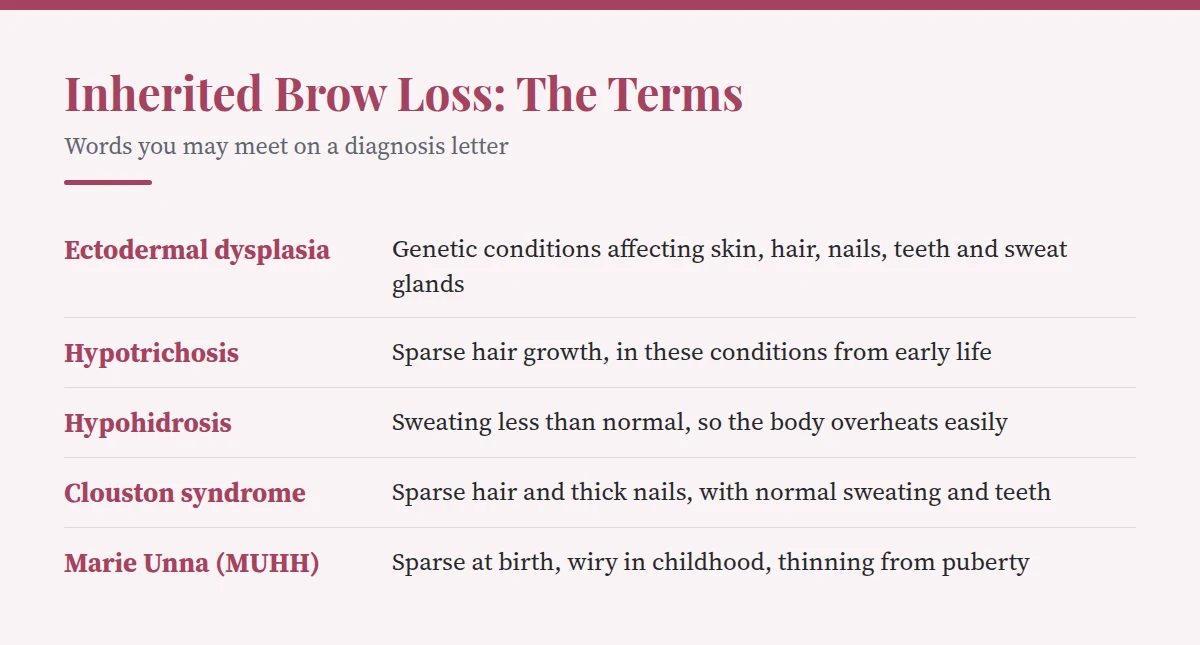
Hypohidrotic ectodermal dysplasia (HED). The ectodermal dysplasias are a family of genetic conditions that disturb the development of the skin, hair, nails, teeth and sweat glands, all of which grow from the embryo’s outer cell layer, the ectoderm. HED is the most common of them. MedlinePlus, the National Library of Medicine’s consumer reference, puts it at about 1 in 20,000 newborns and describes sparse scalp and body hair that is often light, brittle and slow to grow, along with too few working sweat glands. The brows are nearly always involved. In a 2025 study of 32 people with HED in Türkiye, Esener and colleagues found hair, eyebrow and eyelash abnormalities in every case, ranging from subtle thinning to marked sparseness.
Most HED is X-linked, so it usually hits males hardest. Women who carry one altered copy of the gene often have milder signs, which MedlinePlus lists as a few missing or unusual teeth, sparse hair and mild sweating problems. If your brows have always been thin and HED runs in your family, raise it with a doctor before anyone draws on your face.
Clouston syndrome. Also called hidrotic ectodermal dysplasia, Clouston syndrome comes from changes in the GJB6 gene and is autosomal dominant, so one affected parent is enough to pass it on. MedlinePlus describes scalp hair that is sparse, patchy, fragile and lighter than the rest of the family’s from infancy, with brows and lashes that are sparse or absent. The hair problems may worsen by puberty, in some people to complete loss of scalp hair. Nails grow slowly and turn thick and misshapen, and many people also have thickened skin on the palms and soles. Unlike HED, it leaves the teeth and sweat glands alone. It has been reported in many populations but is especially common among people of French-Canadian descent.
Marie Unna hereditary hypotrichosis. Some inherited conditions affect the hair and little else. Marie Unna hereditary hypotrichosis (MUHH) is one of them, and its timeline is unusual: hair is sparse or absent at birth, grows back coarse and wiry through childhood, then thins progressively from around puberty. In their case report and review, Srinivas and Hiremagalore note that the brows, lashes and body hair are sparse or absent, and that brow loss together with wiry, twisted hair is an important clue to the diagnosis. The nails, teeth and sweating are normal, and there is no effective treatment for the hair.
Conditions where the skin leads. In a few inherited conditions the skin is the bigger story. Keratosis pilaris atrophicans faciei, also called ulerythema ophryogenes, is a hereditary disorder in which rough, red bumps around the follicles of the brows and cheeks give way to an atrophic stage that scars, so the hair does not return. Miranda and colleagues note that it often starts in early infancy and tends to settle in adulthood, and Li and colleagues describe it as a rarely reported skin sign of Noonan syndrome. Netherton syndrome combines red, scaly, inflamed skin with fragile “bamboo” hairs, and the brows are where that hair defect shows most reliably: in two patients, Powell and colleagues found it more densely in brow hairs than in scalp hair, and every brow hair they examined had it.
Make Sure the Cause Really Is Inherited
Thin brows in a child are not automatically genetic. The first part of Nelson and Friedman’s 2026 review of brow loss runs through non-scarring causes from alopecia areata and fungal infection of the face to an underactive thyroid and eczema, and concludes that many of them are reversible: recognised early and treated, the brows can grow back. Srinivas and Hiremagalore list alopecia universalis, the most extensive form of alopecia areata, among the conditions that can be mistaken for MUHH. Tattooing a brow that treatment might have regrown is the mistake to avoid.

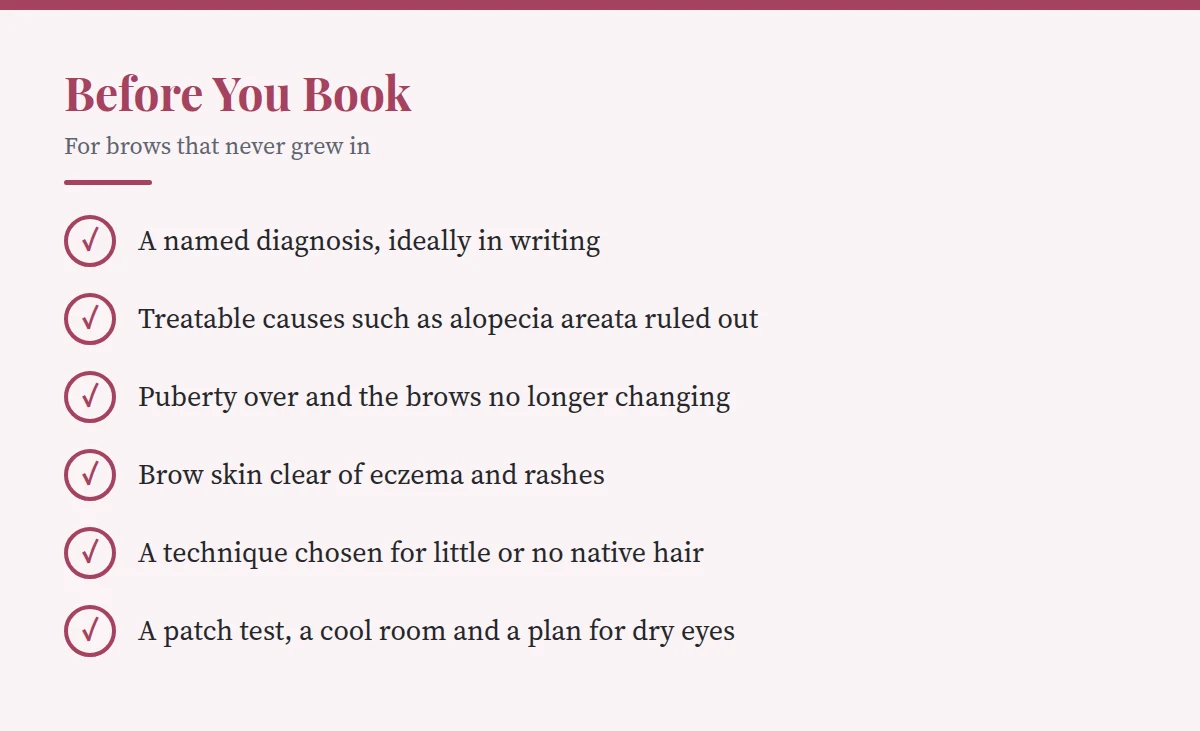
Getting a diagnosis means seeing a dermatologist or a clinical geneticist, and genetic testing can often pin down the exact type. For HED, MedlinePlus notes, the genetic cause stays unknown in only about one person in ten. Before microblading, a name for the condition answers questions an artist cannot. Ask for these in writing:
- The diagnosis, or the working diagnosis if testing is still under way.
- Whether the brow skin itself is affected: thin, dry, prone to eczema, or scarred.
- Whether the hair is still changing, and how it is likely to behave through puberty.
- Whether any treatment could regrow the brows, which is a reason to hold off.
- Anything that matters in the chair: trouble with heat, dry eyes, or skin that absorbs creams unusually well, which affects numbing cream.
Why Hairstrokes Need Real Hairs Around Them
Microblading was built for brows that already have some hair. The blade lays fine, crisp cuts filled with pigment that imitate individual hairs, and Hvas and Serup describe its leading use as adding these “hairstrokes” to the natural brow. Real hairs vary in thickness, colour and direction, and a few of them scattered through the strokes disguise how regular the strokes are. Take those hairs away and the same pattern sits on bare skin, where it can look printed rather than grown.
Pale, fine hair adds a second problem. Clouston hair is lighter than the family’s, and HED hair is often light too. Crisp, dark strokes beside pale wisps can read as two different brows, and a softer shade and a softer technique tend to sit better.
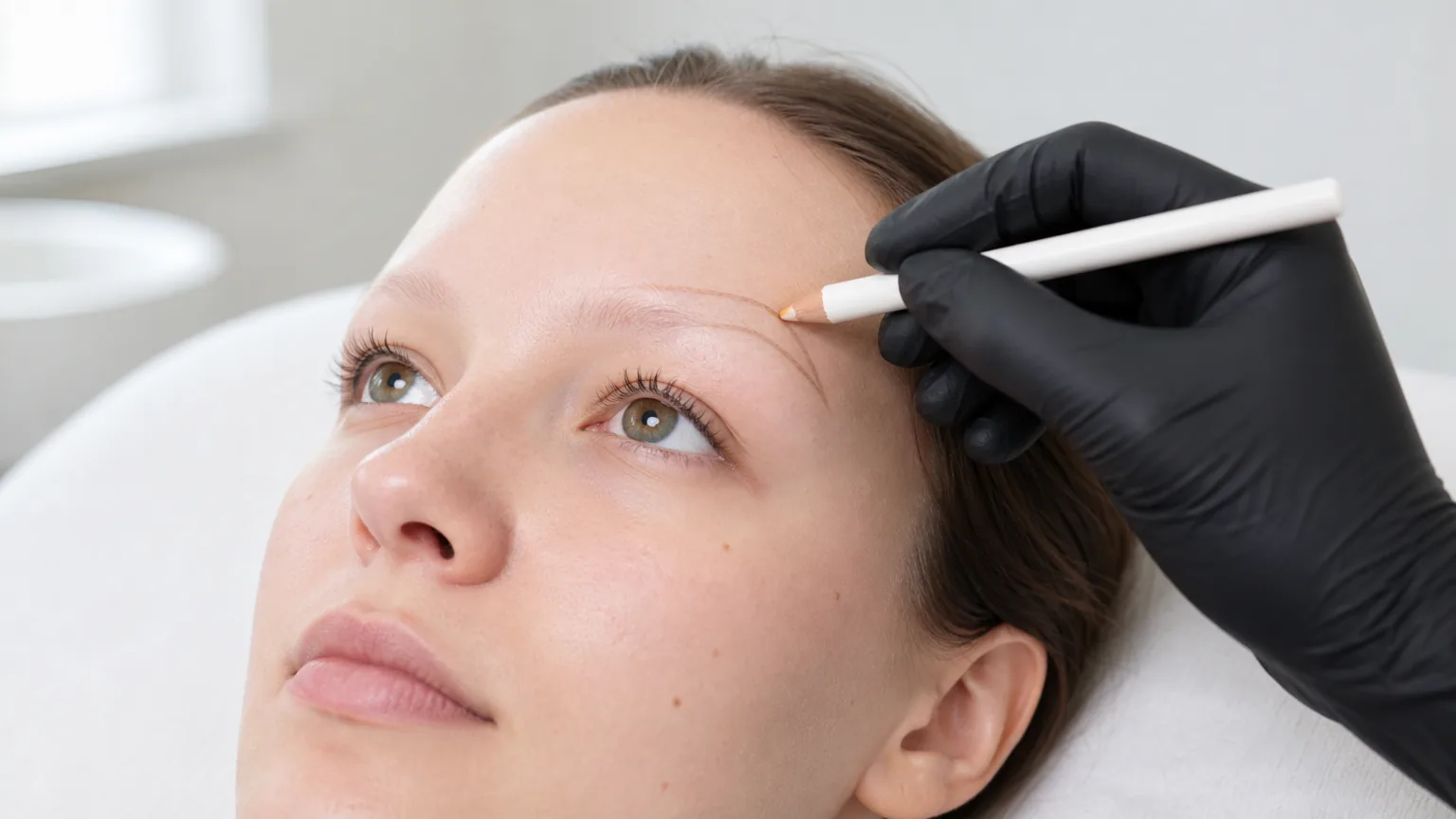
That is why artists working with little or no native hair often reach for shading instead of strokes, or alongside them:
- Powder or ombré brows. Marwah and colleagues describe these as fine dots, made with a machine, that give the look of powdered brows rather than hair strokes. The result reads like brow makeup, and it does not depend on hairs being there to blend with.
- Combination brows. Marwah’s team describes hand strokes at the head of the brow with machine shading toward the tail, and Hvas and Serup also discuss pairing microblading with machine shading of the brow skin. The strokes give texture where people look first, and the shading carries the shape.
- Machine hairstrokes, sometimes sold as nano brows, which draw hair-like lines with a fine needle on a machine instead of a blade. Our hairstroke brows guide explains how they differ.
Microblading is not ruled out. A dermatology team in India included it in the care of a teenager with HED, charting a symmetrical brow with stencils and implanting a chocolate brown pigment with a manual blade (Deo and colleagues). They also noted that the natural asymmetry of his face, brows included, kept the overall result short of what they usually achieve, and with no existing brow to follow, design has to start from the face alone.
Skin That Heals on Its Own Terms
In the ectodermal dysplasias the skin grows from the same layer as the hair, so the brow skin itself may be different, in ways that matter to a blade.
Thin, dry skin. MedlinePlus lists thin, wrinkled, dark-coloured skin around the eyes among the features of HED, along with chronic skin problems such as eczema. In a Japanese survey of 24 people with HED, Inazawa-Terada and colleagues recorded skin findings in 23 and darker skin around the eyes in seven, and eczema-like skin, asthma and food allergies were all significantly more common than in healthy controls. Esener’s group also recorded dry skin and atopic dermatitis. Thin skin leaves less margin for placing pigment at the right depth. Marwah and colleagues list colour that bleeds and spreads after being placed too deep among the complications of microblading, and Hvas and Serup note that microblading carries a risk of scarring.
Eczema and allergy. Active eczema in the brow area means waiting until it settles. Oregon’s tattoo rules, to take one state, bar tattooing over rashes and other skin disorders in the area being treated. Our guide to microblading with seborrheic dermatitis, eczema or rosacea covers what “cleared” should mean before booking. Whatever the condition, insist on a patch test before any pigment goes in, though a clean result is reassuring rather than a guarantee, as our look at patch test limits explains.
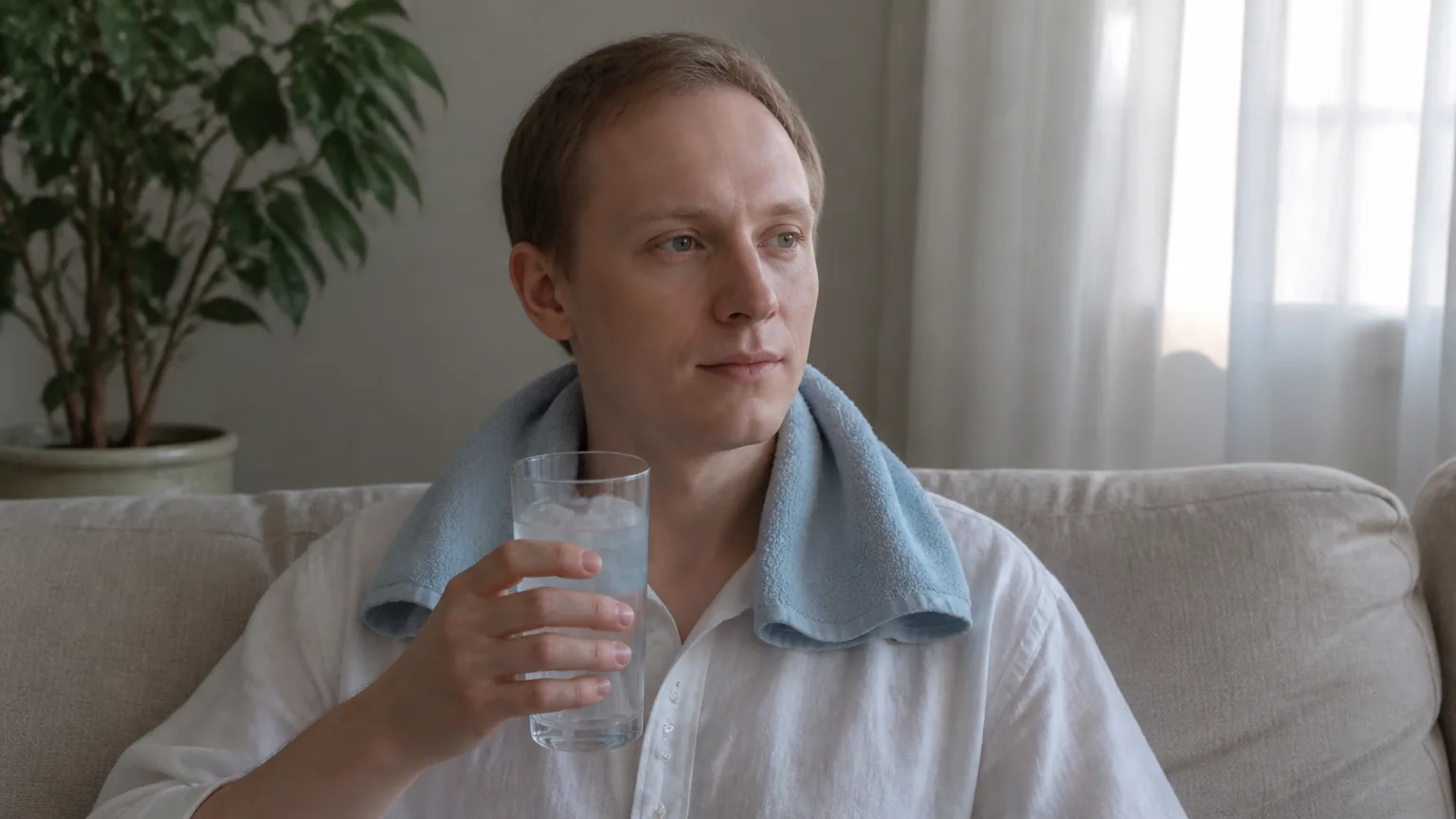
Heat. People with HED can overheat dangerously because they sweat little or not at all. DermNet, the dermatology reference, recommends air conditioning at home, school and work, and notes that cooling water baths or sprays can help hold body temperature down. Fresh microblading, though, has to be kept as dry as possible for the first week or two of healing, so the water spray that keeps you cool is exactly what aftercare rules out. Book a cool room, plan the session for a cooler season, and ask your doctor how to stay cool that first week without wetting your brows. Clouston syndrome leaves sweating normal, so this applies to HED and the other types that affect the sweat glands.
Eyes. Dry eye is common in HED, Callea and colleagues explain, because the tear glands can be abnormal and the glands that make the tears’ oily layer partly or wholly missing, and it brings discomfort, light sensitivity and redness. A brow appointment means a long stretch lying under a bright lamp close to your face. Tell the artist beforehand, bring the eye drops your doctor recommends, and ask for breaks.
Numbing cream. Most studios numb the brow with a topical anaesthetic before and during the work. If your condition affects the skin barrier, Netherton syndrome above all, ask a doctor before any goes on. In three people with Netherton syndrome treated with a prescription ointment, Allen and colleagues measured blood levels of the drug within or above the range targeted in organ transplant patients taking it by mouth. None showed signs of toxicity, but the authors concluded that the faulty skin barrier puts these patients at risk of absorbing much more through the skin than usual.
Teenagers: Let Puberty Finish First
Because these conditions show early, the request often comes from a teenager, or from a parent who has watched their child draw brows on every morning for years. The law sets the first limit. Microblading counts as tattooing, so tattoo age rules apply, and our guide to microblading and minors sets out how they vary by state. Some leave a medical route open: Oregon allows tattooing under 18 “when authorized or prescribed by a physician’s statement.” A diagnosis can turn it into a medical conversation, but it does not make the timing right.
The stronger reason to wait is that puberty can still move the brows, in either direction. The National Foundation for Ectodermal Dysplasias (NFED) notes that hair improves after puberty for some people with ectodermal dysplasia, with some gain in density and thickness and darker colour, and that body hair, the group it puts brows in, may thicken and darken at puberty. MUHH runs the other way, with hair loss beginning around puberty, and in Clouston syndrome the hair problems may worsen by then. A brow designed at fourteen can sit badly against the hair at nineteen.
Even inside a hospital treatment plan, the brows came last. Deo’s patient was first seen at 15, and his microblading came more than three years later, after fat grafting and nose and lip surgery, alongside dental work and counselling.
In the meantime, the options that wash off are good ones. Pencil and brow powder can be practised and changed at will. For children with brow loss, García Castro and colleagues, a group of dermatologists in Spain, point to temporary brow tattoo stickers sold online as a painless, inexpensive, non-permanent option.
Is a Brow Transplant an Option?
Moving hair into the brows is the other lasting fix, and for many people with ectodermal dysplasia it is not available. NFED’s hair treatment guide says people with ectodermal dysplasia are not candidates for hair transplants because there is not enough donor hair to cover the thin areas, and it warns against artificial hair implants, whose fibres can cause allergic reactions, severe irritation and scarring. Deo’s patient asked for a scalp and brow transplant and was turned down because his hair was too fragile, and microblading was the alternative.
Brows need far fewer hairs than a scalp, though, and it has worked. Nilforoushzadeh and colleagues moved hair from the back of the scalp into the outer thirds of the brows of a 17-year-old with ectodermal dysplasia, and she was still happy with the result two years later. Miranda and colleagues rebuilt a man’s brows with single follicle grafts once his keratosis pilaris atrophicans had gone quiet. These are single cases, not a track record, but if your scalp hair is reasonably healthy, ask a hair restoration specialist before committing to pigment.
If You Go Ahead
- Choose a licensed artist with medical brow experience. Microblading is a regulated procedure, and an unlicensed practitioner is a real safety risk. Ask how many clients they have treated with little or no native brow hair, and ask to see healed results.
- Bring the clearance letter, and expect the artist to read it and ask questions.
- Design from your face, since there are no old photos to copy. Deo’s team charted the shape with stencils. Pencil the agreed shape on and wear it for a few days before the appointment.
- Start lighter and softer than you think you want. Colour can be added at the touch-up. Taking it out is slow and expensive.
- Plan the room and the week: a cool room, breaks for dry eyes, and a way to stay cool that keeps water off your brows.
- Expect a touch-up and some unevenness. Results vary with the artist’s skill and your skin type, and on thin, dry or eczema-prone skin they vary more. Microblading is semi-permanent, not permanent, so plan for top-ups as it fades.
The Bottom Line
Being born with sparse brows does not rule out microblading, and for many people with ectodermal dysplasia, pigment is the only lasting option on the table. It does put three questions ahead of the booking: what the condition is, what it has done to the skin, and whether the hair has finished changing. Answer those with a dermatologist or genetics team first, choose a technique built for brows with little or no hair, and the brow you finally get can be one you keep.
Sources
- MedlinePlus Genetics on Clouston syndrome’s hair, nail and skin features
- MedlinePlus Genetics for hypohidrotic ectodermal dysplasia, including the milder signs in women who carry it
- National Foundation for Ectodermal Dysplasias on how hair changes in ectodermal dysplasia, including at puberty
- NFED with its hair treatment guide, covering transplants and implants
- DermNet for ectodermal dysplasia, overheating and cooling
- Esener and colleagues reporting brow, lash and skin findings in 32 people with HED
- Inazawa-Terada and colleagues on skin findings and allergic disease in a Japanese HED survey
- Callea and colleagues reviewing dry eye and the facial features of HED
- Deo and colleagues describing microblading within a teenager’s HED treatment plan
- Srinivas and Hiremagalore on the Marie Unna pattern of hair loss
- Miranda, Farjo and Farjo with brow reconstruction in dormant keratosis pilaris atrophicans
- Li, Thomas and Haber linking ulerythema ophryogenes to Noonan syndrome
- Powell and colleagues on why brow hairs show the Netherton hair defect best
- Allen and colleagues measuring how much topical drug Netherton skin absorbs
- Nelson and Friedman on the reversible, non-scarring causes of brow loss
- Hvas and Serup for microblading technique and its medical uses
- Marwah, Kerure and Marwah with a dermatology review of microblading, ombré brows and complications
- Nilforoushzadeh and colleagues reporting a brow transplant in a teenager with ectodermal dysplasia
- García Castro and colleagues on temporary brow tattoo stickers for children
- Oregon Administrative Rules for the tattooing rule on minors and skin disorders