Flaky, Red, or Itchy Brows: Microblading With Seborrheic Dermatitis, Eczema, or Rosacea
Published on October 26, 2026

A lot of people book a microblading consultation because of their skin, not in spite of it. The brows flake by mid-afternoon, pencil catches on dry patches, and redness makes every shade of brow powder look wrong. Then the artist takes one look and says not today, or not at all, and nobody explains which of the two it really was.
Three conditions come up again and again in these conversations. Seborrheic dermatitis is the one that lives in the brows themselves. Eczema often involves the thin skin around the eyes. Rosacea centres on the middle of the face, but its redness can spread up to the forehead. None of them is an automatic no. A dermatology chapter on who should and should not be tattooed puts it plainly: chronic skin disorders “per se are not strict contraindications for tattooing.” What each one changes is the timing, the technique, and how much can go wrong in the two weeks your brow spends healing. This guide covers how each condition behaves under the blade, what “cleared” has to mean before anyone tattoos you, and when a dermatologist’s note is worth the appointment.
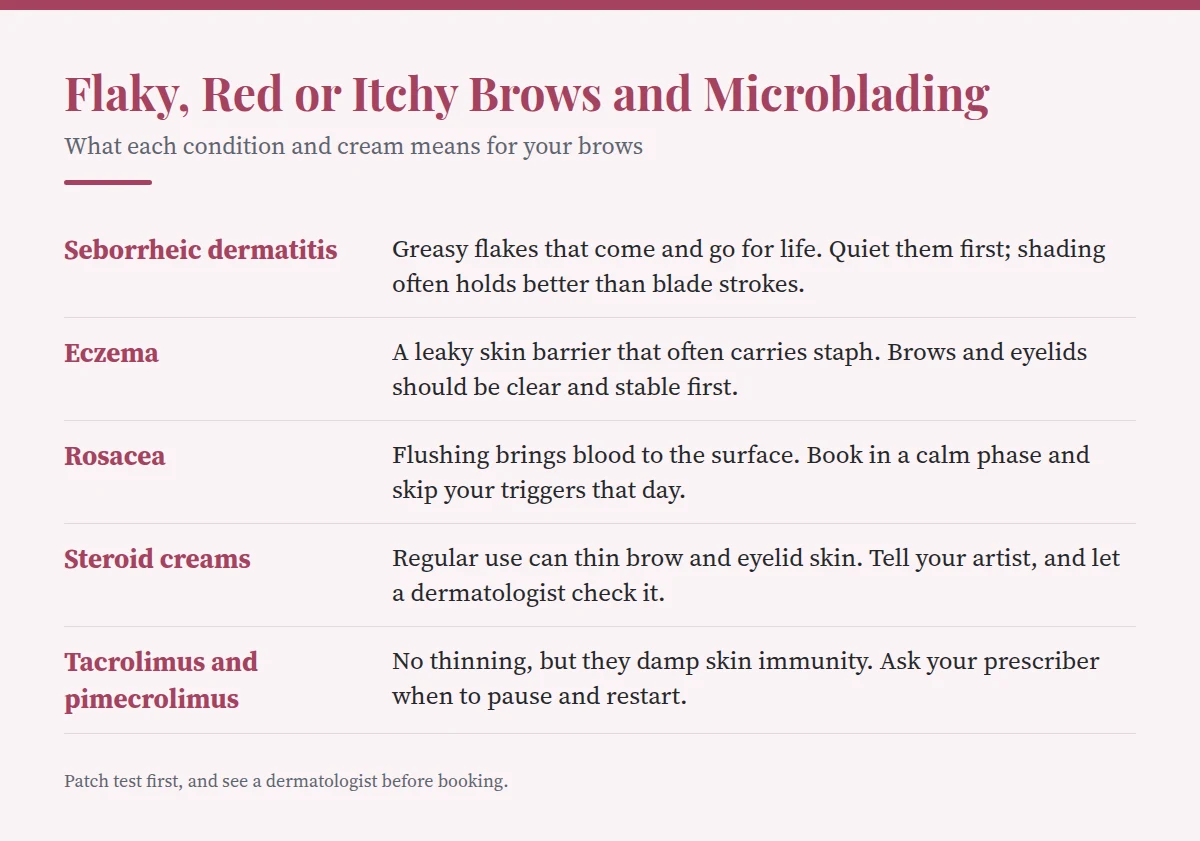
Seborrheic Dermatitis: The Flakes That Live in the Brows
If your brows shed fine, slightly greasy flakes, seborrheic dermatitis is the usual suspect. MedlinePlus lists the scalp, eyebrows, eyelids, the creases of the nose and the skin behind the ears among its common sites, and calls it “a chronic (life-long) condition that comes and goes, but it can be controlled with treatment.” Stress, fatigue and weather extremes are on its list of risk factors. The American Academy of Dermatology (AAD) adds that flares are often seasonal, mostly in winter and early spring, and that on darker skin tones the rash often looks pink, slightly purple, or lighter than the surrounding skin. Those pale patches are one of the causes covered in our guide to light patches around microbladed brows, so a brow that is already lighter in places deserves a diagnosis before anyone adds pigment to it.
Three things make seborrheic dermatitis awkward under a blade. It favours oily skin, which MedlinePlus names as a risk factor, and oily skin is where crisp blade strokes most often heal soft and blurred. It flakes, and a brow that sheds scale while it heals invites picking, and pigment leaves with whatever is picked. And it needs maintenance for life. MedlinePlus lists over-the-counter dandruff shampoos first, then prescription options for severe cases: antifungals such as ketoconazole and ciclopirox, a corticosteroid, or tacrolimus or pimecrolimus. Whatever keeps the flakes away will be going on the healed brow for years, and anything that lifts scale is also exfoliating, which matters because, as one dermatology review of microblading notes, “Colour fades or changes due to sun exposure or exfoliation.” It is fair to expect touch-ups on a shorter cycle than average.
The bigger question is whether it is seborrheic dermatitis at all. DermNet describes sebopsoriasis, an overlap of seborrheic dermatitis and psoriasis that turns up in the same places, eyebrows included, with deeper red, more defined edges and thicker scale. Antifungals tend to clear seborrheic dermatitis and do little for psoriasis, and DermNet notes that the answer often becomes clearer with time and response to treatment. The distinction is not academic. Psoriasis is one of only three diseases that dermatologists classically expect to appear along fresh trauma (the Koebner phenomenon), which is why flaky brows that might be psoriasis belong in the conversation set out in our guide to microblading with an autoimmune condition.
Eczema: A Barrier Problem at the Edge of the Brow
“Eczema” is a family rather than one disease. MedlinePlus describes it as a term for several different types of skin swelling, with atopic dermatitis the most common. A rash that arrived with a new brow gel, tint or hair dye is worth suspecting as contact dermatitis instead, which is its own problem with its own fixes, and our guide to contact reactions in the microblading chair walks through it, including why a damaged barrier makes aftercare balms more likely to sensitise you.
Atopic dermatitis matters here because of where it sits and what it carries. The National Institute of Arthritis and Musculoskeletal and Skin Diseases (NIAMS) lists the skin around the eyes among the typical sites in teens and adults, and describes changes in the skin’s protective outer layer that let it lose moisture. It also says infections “are common and may make the disease harder to control.” A meta-analysis of 95 studies found Staphylococcus aureus living on the eczema patches of 70 percent of patients, and on clear-looking skin in 39 percent, with colonisation rising as the disease got more severe. Most of the included studies were of fair to poor quality, so treat the exact figures loosely, but the direction is not in doubt. A freshly microbladed brow is a field of fine cuts sitting on that skin.
Then there is the itch. Every healing brow itches for a few days. In eczema, NIAMS notes that scratching “leads to further redness, swelling, cracking, ‘weeping’ clear fluid, crusting, and scaling,” and on a healing brow, cracking, weeping and crusting all carry pigment out of the strokes with them. Eczema is not one of the classic diseases that follow trauma, but the same dermatology chapter adds that, by experience, the Koebner phenomenon “may complicate any dermatological disease,” and a microblading review lists koebnerization of active skin disease among the procedure’s complications. A flare that traces the new strokes is uncommon, not impossible.
For people whose eczema has thinned the brows themselves, the door is open, just later. A dermatology review of micropigmentation lists brow loss from severe atopic dermatitis among the conditions it can camouflage, but only once medical treatment has switched the disease activity off.
Rosacea: Flushing, Bleeding, and Skin That Reacts to Products
NIAMS says rosacea usually affects the centre of the face and may start as a tendency to flush or blush. It is chronic and cycles between flare-ups. The NHS lists the common triggers as alcohol, spicy foods, hot drinks, sunlight, hot or cold temperatures, aerobic exercise and stress, and describes “a burning or stinging feeling when using water or skincare products.” When rosacea reaches the eyes, NIAMS notes, the eyelids may swell and become red at the base of the lashes, which puts it right under the brow.
A microblading appointment stacks several of those triggers into two hours: nerves, a warm room, and a cleanser and numbing cream on skin that already stings easily. A face that flushes brings more blood to the surface, and bleeding is exactly what an artist works to keep down, because blood and fluid in the strokes dilute pigment and hurt retention. Redness also makes it harder to read your true skin tone when matching pigment, and harder to tell, a few days later, whether a red brow is a flare, an infection, or ordinary healing.
Treatment can also collide with the brow. The AAD says intense pulsed light “can reduce flushing and improve your skin’s texture,” and IPL or vascular laser near tattooed brows needs planning, which is what our guide to sequencing cosmetic treatments around microblading is for. Rosacea creams such as metronidazole, azelaic acid and ivermectin are not aftercare and should not go on a healing brow unless the prescriber knows it is a fresh tattoo. And a red brow is not a reason to reach for hydrocortisone on your own: rosacea itself appears on the list of common side effects of topical steroids, which brings us to the creams.
The Creams That Change the Skin the Blade Enters
Topical steroids are the backbone of eczema and flare care, and on the face they come with a cost. A Cochrane summary in American Family Physician notes that they can cause skin atrophy, a thinning of the skin, on sensitive areas such as the face and eyelids. A review of their side effects notes that local reactions occur regularly with prolonged use and depend on the drug, its base and where it is applied. The most frequent include atrophy, rosacea, perioral dermatitis, acne and purpura (easy bruising), while delayed wound healing, pigment changes and worse skin infections turn up less often. Nearly every item on that list is something a brow artist would rather not tattoo into.
Thin skin leaves less room for error on depth. The same stroke sits relatively deeper, and the microblading review is blunt that “Colour may bleed and spread due to deep deposition.” Fragile, bruise-prone skin bleeds more during the work, and slower healing keeps the wound open for longer. Whether your brow skin has thinned, and whether it has recovered since you stopped, is a judgement a dermatologist makes by examining it. An artist cannot make it from a consultation photo, so if you have used a steroid on your brows or eyelids regularly in recent months, say so.
Tacrolimus and pimecrolimus, the topical calcineurin inhibitors, are often prescribed to avoid that problem. They do not thin the skin, which is why DermNet says they “may be applied to all skin surfaces including the head, face, neck, around the eyes, and skin folds,” and a mild, short-lived burning on application is their most common side effect. They work by damping down the immune response in the skin, and DermNet says they are usually paused if an infection develops. We could find no published study of microblading on skin being treated with them. A practical guide for dermatologists on tattooing patients with chronic skin disease notes that some treatments may need to stop because they can influence the result. When to pause and when to restart is a question for the prescriber, and the same applies to tablets and injections, from methotrexate and ciclosporin to the newer biologics. Never stop a prescribed medicine on your own to make yourself a better candidate.
One case shows why a new rash on a tattooed brow is a diagnosis job, not a cue to reach for the usual tube. A 63-year-old woman came to a dermatology clinic with itchy red patches on brows tattooed two months earlier. Steroid ointment and steroid tablets had not helped, and when the patches were treated as contact dermatitis they spread to her cheeks and forehead instead. Patch tests to metals were negative, and a second look at the scale found a fungal infection, which needed eleven weeks of oral antifungal treatment to clear.
What “Cleared” Has to Mean
The dermatology chapter quoted at the top sets the standard: tattooing “should be delayed until the skin is clear of any (or any new) lesions and is quiescent.” Those are two different tests. Clear means nothing is visible today. Quiescent means the skin has stayed that way. In some states the first test is also the law. New Jersey’s body art rules state that “No body art shall be done on a skin surface that has a rash, pimples, boils, infections, scar tissue or manifests any evidence of unhealthy conditions,” so an artist who turns away a visibly flaring brow may simply be following the rules.
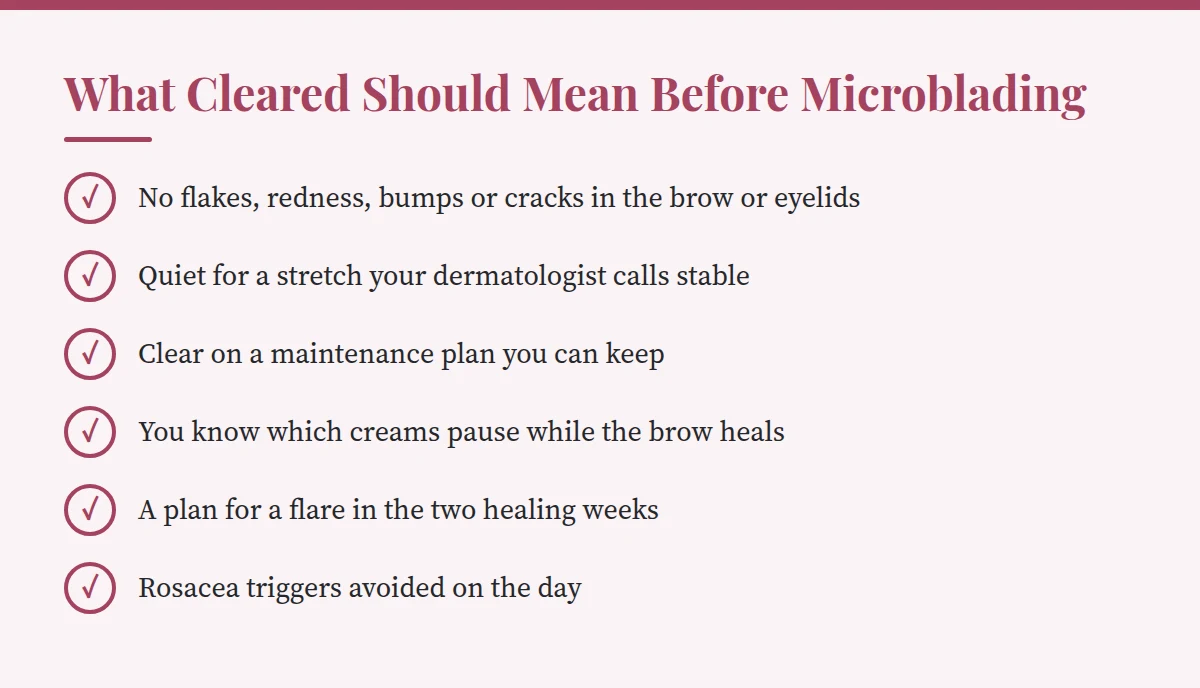
In practice, cleared should mean all of the following:
- Nothing visible on the day. No scale, redness, bumps, cracks, weeping or crust in the brow or the skin around it, eyelids included.
- Quiet for a stretch, not just this week. No study sets a number of weeks, so any fixed waiting period an artist quotes is a house rule. The test that counts is whether your dermatologist would call the disease stable.
- Clear on a plan you can keep. Skin kept quiet by maintenance treatment can count, and that is how the micropigmentation review frames it. You simply need to know which parts of that plan pause while the brow heals.
- A plan for a flare. Know in advance what you will do if the brow flares in the two healing weeks, and who you will call.
- Triggers handled on the day, for rosacea. No alcohol, hot drinks or workout beforehand, and a request for a cool room.
When a Dermatologist’s Sign-Off Is Worth Asking For
Ask for one if any of these apply: nobody has ever diagnosed your flaky brows, you have used a steroid on your brows or eyelids in recent months, you use tacrolimus or pimecrolimus near your eyes, you take a tablet or injection for your skin, your eyelids or eyes are involved, your eczema has been infected before, or an artist has already turned you away.
Go in with specific questions. Is my skin quiet enough for a cosmetic tattoo on the face? Has the brow skin thinned? Which creams pause, for how long, and when do they restart? What should I use if it flares while the brow is healing? Then ask for the answer in writing. A short note gives your artist something concrete to work from, and it belongs alongside the condition and the medication list on the health form described in our guide to the microblading intake and consent form.
When Hairstrokes Are the Wrong Tool
Sometimes the answer is yes, with a different method. Oily, flake-prone brows are the classic case for machine shading (powder or ombre brows), which tends to heal more evenly than blade strokes on oily skin. Machine hairstrokes and nano brows are generally less traumatic than a manual blade, which helps when healing is slower than average. But the pigment is the same pigment, and a gentler tool does not make an actively flaring brow fit to tattoo.
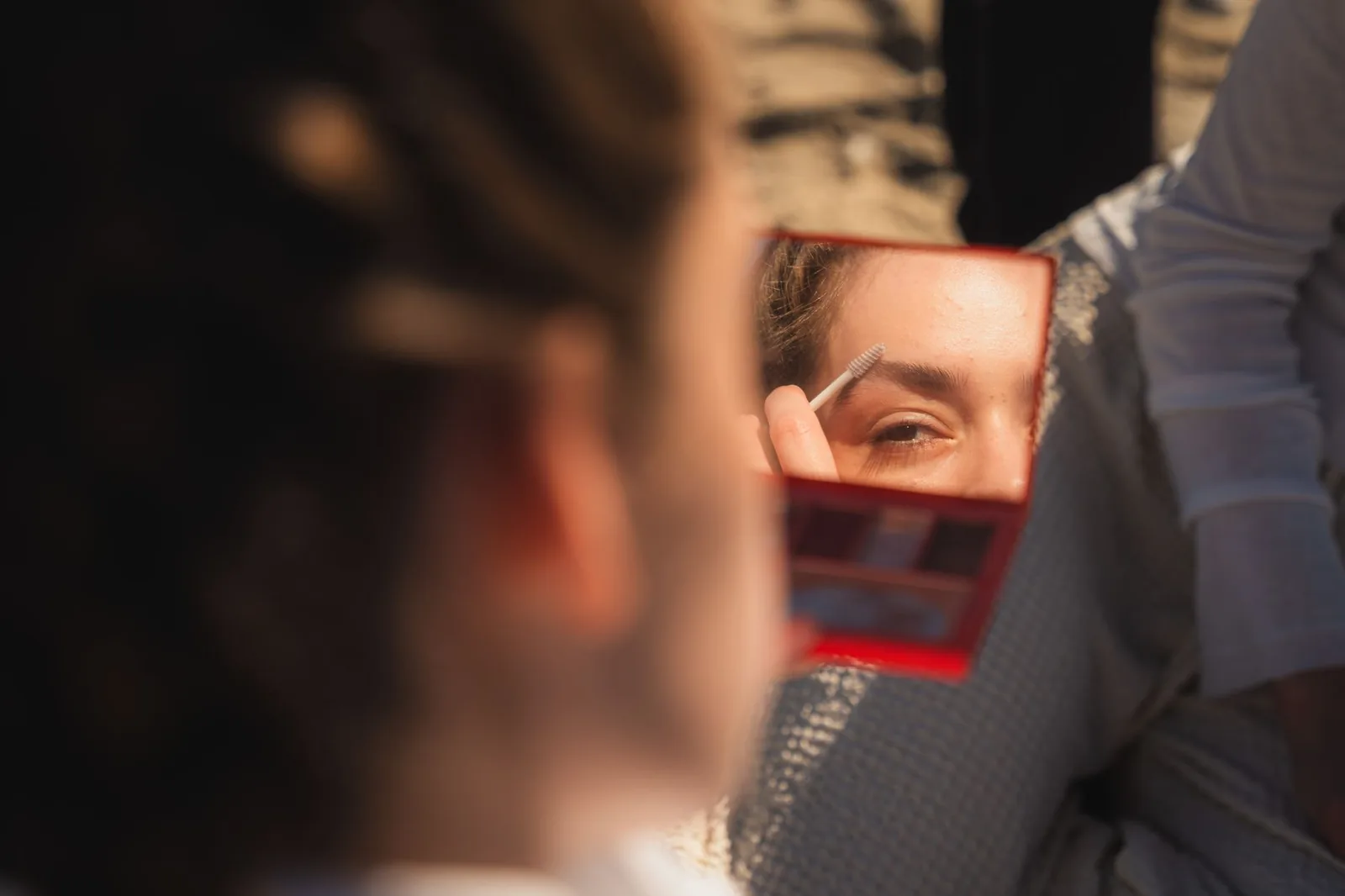
Sometimes the answer is not yet, and pigment-free options carry you in the meantime. Brow pencils, powders and gels work, though fragranced or new products deserve a test patch on skin that reacts. Tinting and lamination use chemicals of their own, so they belong in the same conversation with your dermatologist rather than serving as a way around it. A consultation that ends in “not yet, and here is why” is a good one.
Microblading is a regulated tattoo procedure, and an unlicensed practitioner is a genuine safety risk, all the more so on skin that already reacts. Insist on a patch test before any pigment goes in, expect results to vary with the artist’s skill and your own skin, and remember that this is semi-permanent work that fades and needs touch-ups. If you have eczema, rosacea, seborrheic dermatitis or any other condition around your brows, see a dermatologist before you see an artist.
Sources
- MedlinePlus on where seborrheic dermatitis appears, what worsens it, and how it is treated
- American Academy of Dermatology for seasonal flares and how seborrheic dermatitis looks on darker skin
- DermNet with the overlap between seborrheic dermatitis and psoriasis known as sebopsoriasis
- Nicolas Kluger on which chronic skin conditions rule out a tattoo, and why active disease waits
- MedlinePlus for eczema as several different conditions, atopic dermatitis the most common
- NIAMS on atopic dermatitis around the eyes, the itch, and infection
- Totté and colleagues with a meta-analysis of staph bacteria on eczema skin
- Marwah, Kerure and Marwah for a dermatology review of microblading, its fading, and its complications
- Kerure and colleagues on micropigmentation for brow loss once skin disease is controlled
- NIAMS covering where rosacea appears, how it flushes, and rosacea of the eyelids
- NHS with the common rosacea triggers and stinging from skincare
- American Academy of Dermatology for rosacea creams and intense pulsed light for flushing
- American Family Physician on topical tacrolimus for eczema and steroid thinning on the face
- Hengge and colleagues covering the local side effects of topical corticosteroids
- DermNet for how topical calcineurin inhibitors are used around the eyes
- Kluger and De Cuyper with a practical guide to tattooing patients with chronic skin disorders
- Ishizaki and colleagues on a fungal brow infection after tattooing that was treated as allergy
- New Jersey Department of Health for the rule against body art on skin with a rash (N.J.A.C. 8:27-4.3)