Red and Warm Pigments Cause the Most Reactions: Why a Patch Test Can Pass and Your Brows Still React
Published on September 19, 2026
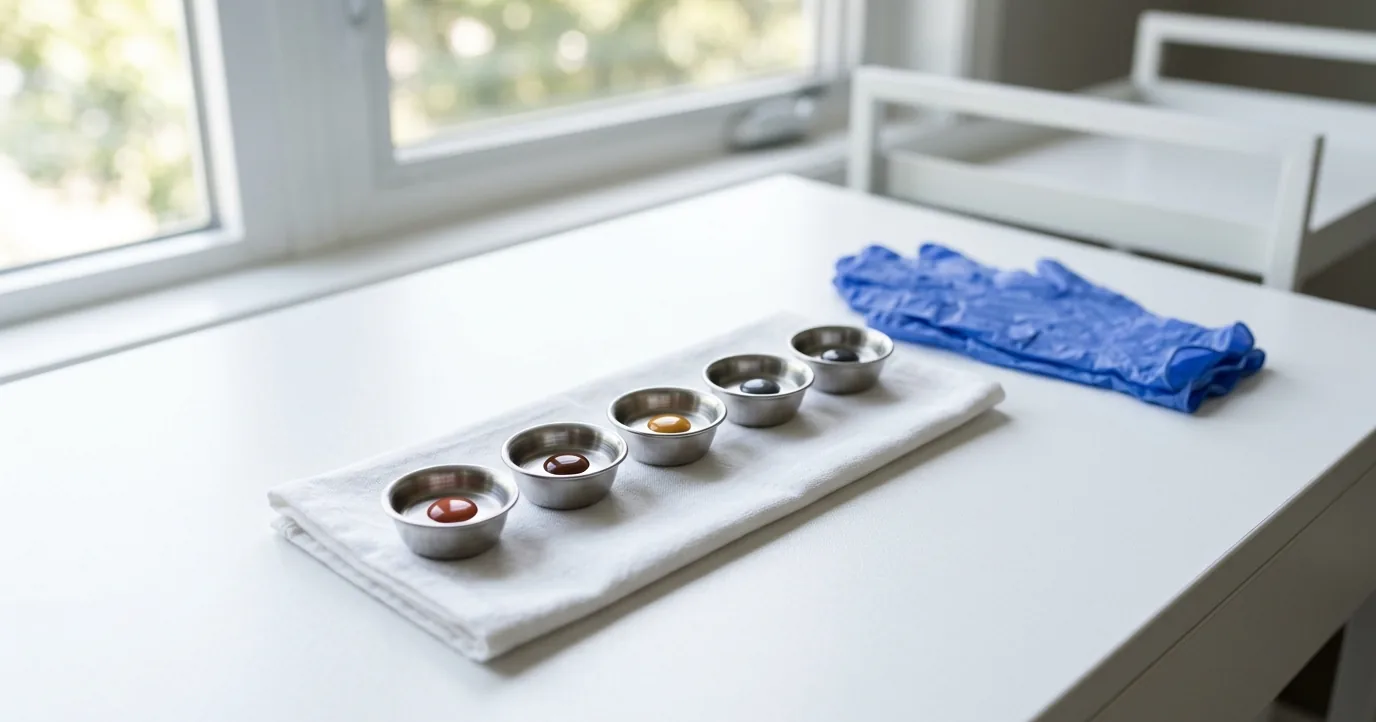
A client books a patch test three weeks before her appointment. The dab of pigment behind her ear does nothing at all, so she goes ahead. Fourteen months later her brows start to itch. They puff up in the evenings, the strokes sit slightly raised above the surrounding skin, and nothing from the pharmacy touches it. Her family doctor treats it as eczema. She is certain the pigment is not the culprit, because she was tested.
Almost every step of that sequence is predictable from the published research, including the part where the test passed. So is the colour involved. Two decades of patch-test series in tattooed patients, combined with a recent survey of what American permanent makeup inks actually contain, keep pointing at the same narrow group of colourants: the organic reds, oranges and yellows, rather than the black iron oxide most clients assume is the risky ingredient.
Why Red and Warm Shades Carry the Risk
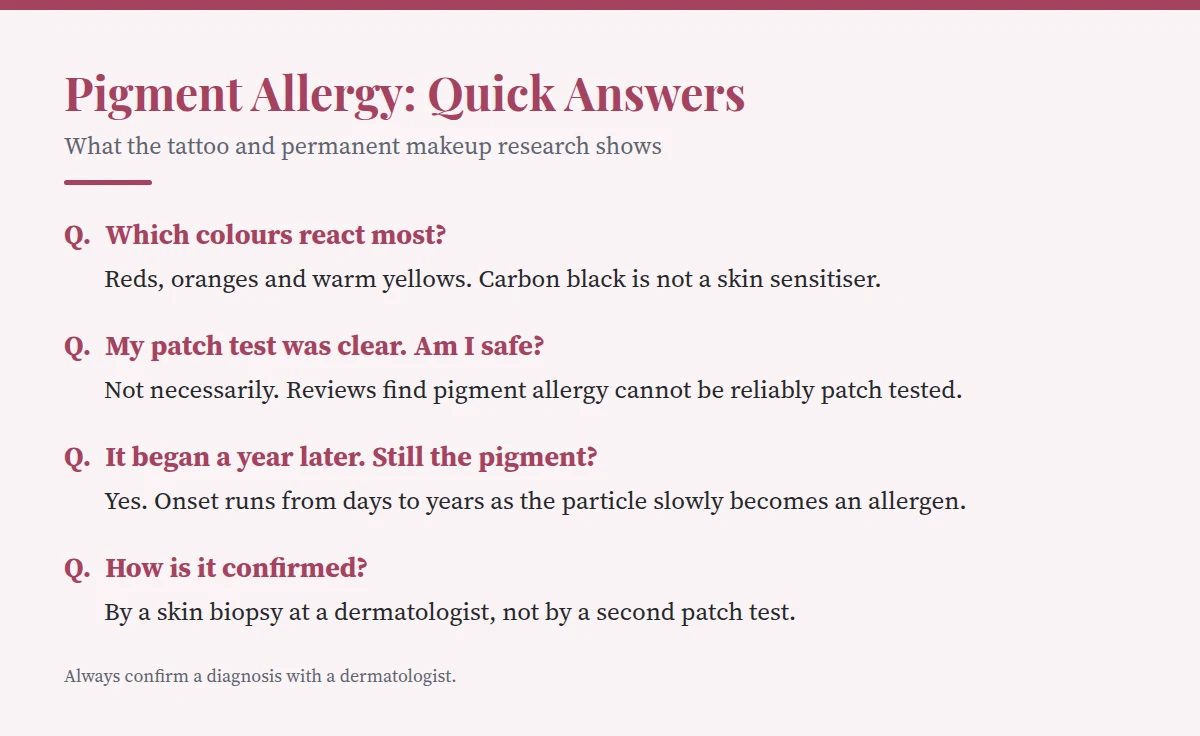
Colour is the strongest single predictor of an allergic tattoo reaction, and it is not close. Red pigments cause the most reactions by a wide margin, with hypersensitivity to the pigments behind black, blue, purple and green inks being much less common. Red is also the pigment responsible for most lichenoid tattoo reactions and the main cause of the pseudolymphomatous type.
Historically the offender was cinnabar, or mercuric sulfide, a notorious sensitiser that has largely left the market. Its replacements did not solve the problem. Modern reds and warm shades are built from synthetic organic chemistry: azo dyes, quinacridone, diketopyrrolopyrrole, anthraquinone. Individual case reports name specific molecules. A published case of contact dermatitis to a red quinacridone pigment is notable because the reaction did not stay inside the tattoo, spreading into skin the ink never touched. Another describes allergic reactions traced to three separate inks that shared one ingredient, Pigment Yellow 65, which is exactly the pattern you would expect from a true chemical allergy rather than a one-off bad batch.
The counterintuitive half of this is black. Carbon black, the workhorse of brow pigment, is not a skin sensitiser. That does not make black pigment harmless, because black is the colour most tied to the granulomatous and sarcoid-type reactions covered in our guide to bumps, lumps and granulomas after microblading. It means the two problems run on different tracks. Black tends to produce a firm, calm lump. Warm colour tends to produce an itch.
What Is Actually in a Brow Pigment Bottle
A 2024 survey in the Journal of the American Academy of Dermatology catalogued 974 permanent makeup inks sold in the United States and found 79 distinct pigments, with the average product containing four of them. Twenty were inorganic metals, including carbon, iron, chromium, manganese and molybdenum. The other 59 were organic, most of them azo, quinacridone or anthraquinone dyes. Ten of the 79 already had documented cases of allergic contact dermatitis behind them.
Set that against the same team’s earlier survey of 1,416 body tattoo inks, where only 10 of 44 pigments were metallic. Brow pigment is not a gentler, more natural cousin of tattoo ink. If anything it leans further into the organic chemistry, because those pigments hold a true brown and a warm undertone in a way iron oxide alone cannot, a trade-off our pigment chemistry guide works through in detail.
You will also rarely find any of this on the label. The 1997 to 2022 review of patch-tested tattoo patients notes that binders and industrial biocides are frequently absent from ink declarations entirely. The EU restricted more than 4,000 hazardous substances in tattoo and permanent makeup inks from January 2022, but that restriction targets carcinogens, mutagens and toxic metals, not allergens, so a compliant bottle can still be full of sensitisers. In the United States the framing is blunter still: no colour additive is approved for injection into the skin, permanent makeup included.
Why It Can Take Months or Years to Show Up
The delay is the part that convinces clients it cannot possibly be the pigment, and it is the most mechanically interesting thing about these reactions.
A pigment particle in the bottle is generally too large and too inert to interest your immune system. It becomes an allergen through haptenisation, a slow process in which the particle degrades in the dermis and the resulting smaller fragments bind to your own proteins, creating something the immune system can finally recognise as foreign. Sunlight accelerates it. So does time, and so does anything that breaks the pigment apart faster. Onset in the literature runs the full spread, from days after the appointment to years later.

Laser removal is the clearest demonstration of the mechanism. Fragmenting pigment with a laser dumps a large quantity of freshly exposed surface into contact with the immune system all at once. One case report describes a woman who developed severe reactions in both treated and untreated tattoos after two picosecond sessions, with biopsy findings consistent with hypersensitivity to red pigment and a widespread eczematous eruption elsewhere on her body. It is a hard argument against treating removal as the obvious first move once brows have already turned reactive.
The Uncomfortable Truth About the Patch Test
Here is the finding that the industry has not absorbed. The comprehensive review of patch-tested tattoo patients from 1997 to 2022 concluded plainly that tattoo allergy cannot be reliably diagnosed by patch testing with current knowledge.
Four reasons stack up. Pigments penetrate intact skin weakly, so a patch sitting on the surface for 48 hours barely delivers the substance. Haptenisation is slow, so even when the pigment does get in, the allergen has not been created yet by the time the patch comes off. The individual pigments are largely unavailable as standardised test allergens. And nobody yet knows which molecular fragments the immune system is actually reacting to, which makes designing a test difficult in principle. Patch testing common substitutes such as p-phenylenediamine or textile disperse dyes does not close the gap. The 2024 permanent makeup survey reaches the same conclusion from the other direction, warning physicians outright that patch testing to these ingredients can come back negative.
Where positive results do turn up, they cluster in specific circumstances: cheap inks intended for non-professional use, and patients whose reaction is eczematous with papules and infiltration. Reading the patch at day eight or ten instead of the usual 48 to 96 hours, and tape-stripping the skin first, both appear to improve the yield.
None of this is an argument for skipping the patch test. Insist on one anyway. It catches irritant responses, it catches the rare fast responder, and refusing to offer one tells you something about the studio. Just understand what a pass buys you. A studio patch test is far better evidence about the numbing cream, the aftercare ointment and the tape, which is where most studio reactions actually originate and which our guide to contact reactions in the microblading chair covers in full. On pigment specifically, a clean result is reassurance, not a guarantee.
Telling a Pigment Allergy From Its Lookalikes
Four things produce unhappy brows and they behave differently.
A pigment allergy itches, and itch is the dominant complaint rather than pain. It sits precisely on the pigmented strokes, and in a brow built from several pigments it may pick out only the warm-toned parts while the darker strokes stay quiet. The skin is raised, sometimes swollen or weeping, and it does not settle. It can spread past the brow. It also repeats, flaring with sun, illness or heat.
A granuloma is firm, deep, relatively calm and often not itchy at all, showing up as red-brown or flesh-toned nodules. An infection runs on a much faster clock, with pain, heat, pus or fever within days to weeks, and it can come from the bottle rather than the studio, as our piece on contaminated microblading pigment and FDA recalls explains. Ordinary healing is done inside two weeks and follows a schedule.
How a Dermatologist Confirms It
The diagnosis is made on a skin biopsy, not a patch test, which is worth knowing before you ask for the wrong appointment.
The largest series analysed 74 biopsies of allergic red tattoo reactions. Histiocytes and lymphocytes appeared in over 93 percent of samples, histiocytes dominated in 74 percent, well-defined granulomas were mostly absent, and eosinophils were uncommon at 8 percent. Interface involvement was present in nearly two thirds, and inflammation severity tracked with how deep the pigment sat. A separate immunohistochemical series of 19 biopsies found interface dermatitis as the lead pathology in 78 percent, with T lymphocytes in every sample and Langerhans cells in 95 percent, a profile the authors read as clearly allergic in mechanism.

The practical translation is short. Lead with the history. Say you had microblading, say roughly when, and say which shade if you know it. Bring a photo of the pigment bottle and the lot number if you kept one.
The White Patches That Can Follow
There is one more reason not to shrug this off. Chemical leukoderma is an acquired loss of pigment that can follow an allergic contact dermatitis, appearing weeks to months after the exposure. The patches are clinically and histologically indistinguishable from vitiligo, and the literature documents cases arising after diagnostic patch testing itself. The psychosocial impact is heaviest on deeper skin tones, where a pale patch contrasts sharply with the surrounding skin, which is one more consideration alongside those in our guide to microblading on dark and deeper skin tones.
This body of work covers contact allergens broadly rather than brow pigment specifically, so treat it as context rather than a documented microblading outcome. It is still the reason a reactive brow deserves a dermatologist rather than a year of waiting it out.
What to Do With This Before You Book
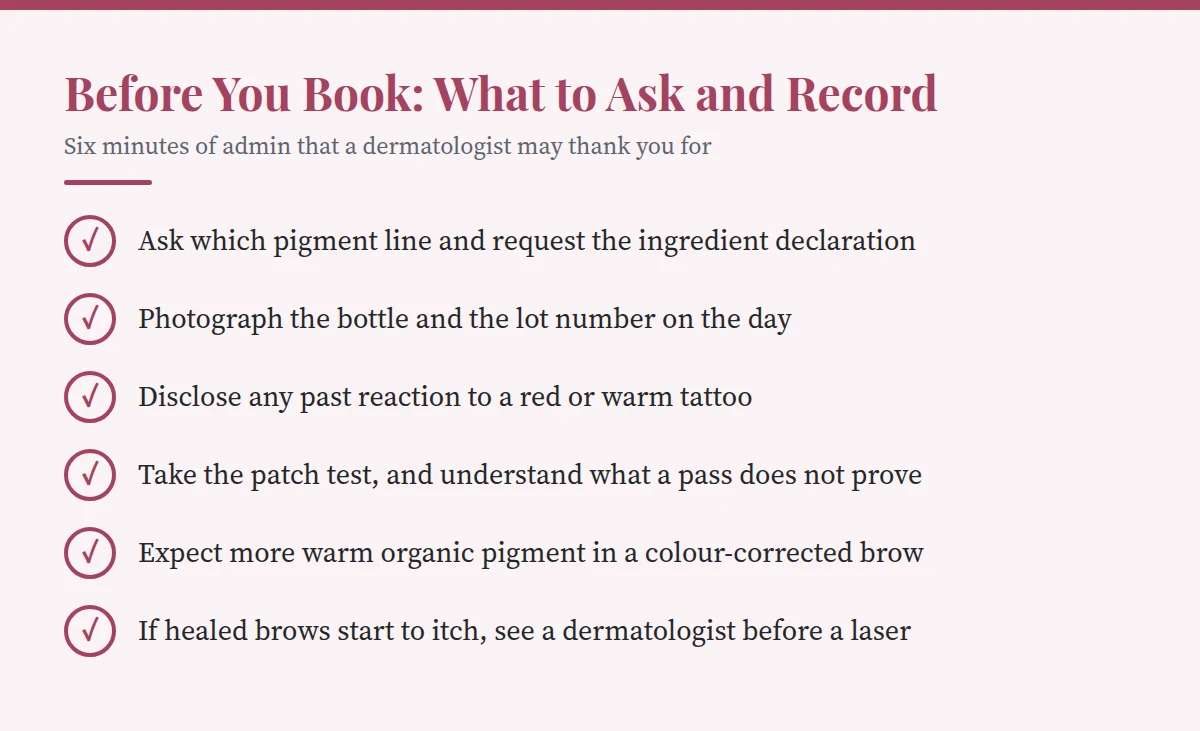
Ask which pigment line your artist uses and ask to see the ingredient declaration or safety data sheet. Photograph the bottle and the lot number on the day. If you have ever reacted to a red or warm section of a body tattoo, lead with that in your consultation, because it is the single most predictive piece of history you own. And if you are getting a warm-corrected brow, which is common on deeper skin tones and on anyone whose pigment has drifted cool, understand that you are getting more organic warm pigment by design. That is not a reason to decline. It is a reason to know.
Microblading is a regulated tattoo procedure and an unlicensed practitioner is a safety risk whatever their pigment shelf looks like. Results vary substantially with artist skill and skin type, and this is semi-permanent work requiring touch-ups rather than a permanent fix. Insist on a patch test before pigment goes into your face while understanding its limits, and if you have eczema, rosacea or any chronic skin condition, see a dermatologist before you see an artist.
Sources
- Rigali, Cozzi and Liszewski on the 974 permanent makeup inks surveyed and the pigments in them known to cause contact dermatitis
- Liszewski and Warshaw cataloguing the 44 pigments found across 1,416 American tattoo inks
- Schubert, Kluger and Schreiver with the 1997 to 2022 review concluding tattoo allergy cannot be reliably patch tested
- DermNet for which tattoo colours actually drive hypersensitivity reactions
- Greve and colleagues describing contact dermatitis to a red quinacridone pigment that spread beyond the tattoo
- González-Villanueva and colleagues on allergic reactions traced to three inks sharing Pigment Yellow 65
- van der Bent and colleagues analysing the histopathology of 74 red tattoo reaction biopsies
- Høgsberg, Thomsen and Serup finding interface dermatitis and raised Langerhans cells in red reaction biopsies
- Wong and Cheung reporting an id reaction and contact dermatitis after picosecond laser removal
- Lee and Gaspari reviewing chemical leukoderma following allergic contact dermatitis and patch testing
- FDA stating that no colour additive is approved for injection into the skin
- ECHA on the EU restriction covering thousands of substances in tattoo and permanent makeup inks
Further reading
- Bumps, lumps, and granulomas after microblading
- Microblading pigment chemistry: why brows turn blue, red, or grey
- Reactive skin in the microblading chair: numbing cream, ointment, and tape
- How dermatologists treat a microblading granuloma
- Contaminated microblading pigment, bacteria in sealed bottles, and FDA recalls