Microblading and Minors: Age Limits, Parental Consent, and Why Teen Brows Are the Wrong Canvas
Published on October 2, 2026

The booking looks like any other: a Saturday slot, a deposit paid online, a first name and a phone number. The artist only finds out at the consultation that the client is sixteen and her mother is still parking the car. Sometimes there is no mother at all, just a teenager with birthday money and a screenshot of somebody else’s brows.
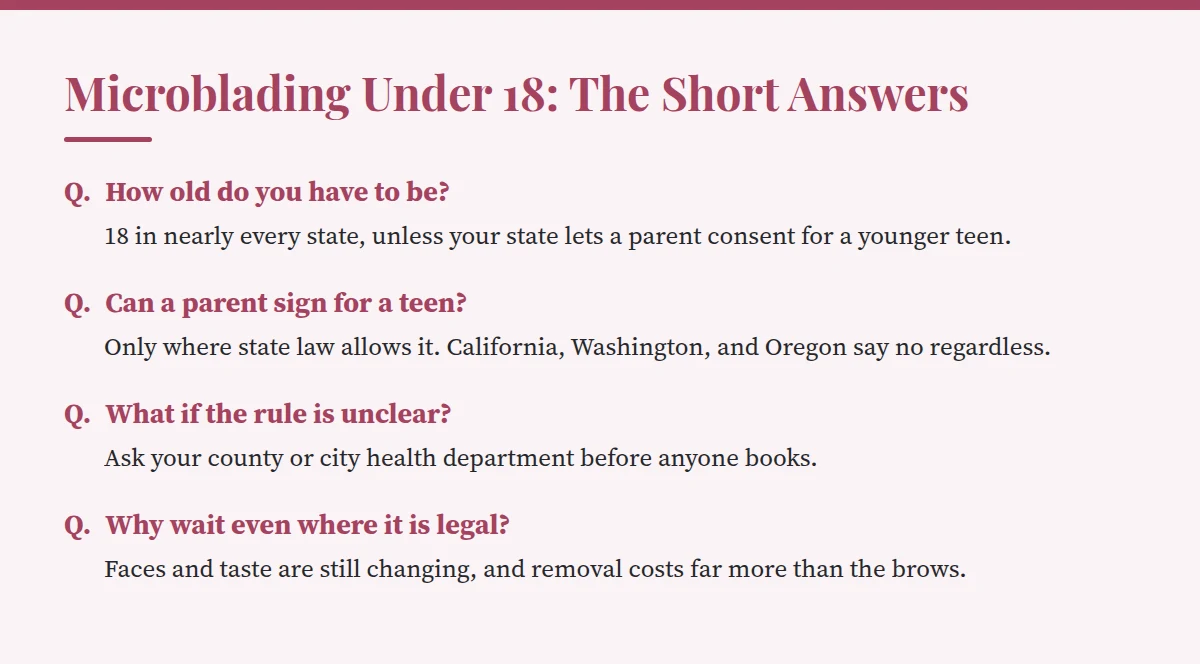
The short answer is that the law treats microblading as tattooing, so it falls under the same age rules as any other tattoo, and nearly every state bars tattooing minors on their own say-so. Some states let a parent consent for a 16 or 17-year-old on strict conditions. Others, including California, Washington, and Oregon, say no whatever a parent signs. The longer answer is that the practical case against teen microblading is stronger than the legal one. The face is still changing, so is the client’s taste, and the pigment will outlast the brow trend that inspired it. (This is general information, not legal advice. The rules change at state and county lines, so check your own.)
Microblading Is Tattooing, So Tattoo Age Laws Apply
Microblading is sold on the word “semi-permanent,” and plenty of parents hear that as something closer to a salon service than a tattoo. The law does not see it that way. The FDA’s consumer page lists microblading inks among the common types of tattoo and says plainly that permanent makeup is a type of tattoo. It also leaves the practice itself to state and local rules, which is why the age question gets answered state by state. Our explainer on whether microblading is a tattoo covers the legal and mechanical case in full.
State codes are written broadly enough to catch a hand blade, and some name brows outright. Texas covers marks made with “needles, scalpels, or other related equipment” and adds that the term “includes the application of permanent cosmetics.” California’s health code applies its age rule to “a tattoo or permanent cosmetics application,” and Georgia’s public health rules list “microblading of the eyebrow” in their definition of a cosmetic tattoo.
None of those definitions asks how long the result lasts. “Semi-permanent” describes how strokes soften over the years. It is not a legal category, and it does not lift microblading out of the tattoo rules.
Where a Parent’s Consent Counts, and Where It Does Not
When the American Academy of Pediatrics reviewed teen tattooing in 2017, it cited a National Conference of State Legislatures survey finding that at least 45 states have laws prohibiting minors from getting tattoos, and noted that “each state varies” in how it legislates. The state codes we read for this article fall into a few patterns.
Eighteen, full stop. California’s health code says a client must be at least 18 “regardless of parental consent.” Washington makes it a misdemeanor to tattoo anyone under eighteen and offers no consent route at all. Oregon prohibits tattooing under-18s “regardless of parental or legal guardian consent” unless a physician’s statement authorizes it.
Sixteen or seventeen, with a parent, on the state’s terms. Florida bars tattooing anyone under 16 except for medical or dental purposes by a licensed doctor or dentist. A 16 or 17-year-old can be tattooed only when a parent or legal guardian comes along, both show government-issued photo ID, the parent gives notarized written consent on the state’s form and proves the relationship, and a licensed tattoo artist does the work. Skipping any of those steps is a second-degree misdemeanor.
Only to cover something up. Texas forbids tattooing anyone under 18 unless the new tattoo covers an existing one, such as offensive language, gang symbols, or drug references, and even then a parent has to be physically present at the studio, sign an affidavit, and prove both who they are and that they are the parent or guardian. A first set of brows is not a cover-up. Breaking the rule is a Class A misdemeanor, and a minor who lies about their age to a tattoo studio commits a Class B misdemeanor of their own.
Unclear. State codes are not the whole picture, because counties and cities can add rules of their own. The Society of Permanent Cosmetic Professionals keeps a state-by-state reference but warns that it “may not be accurate to-date,” and tells people to examine their own state’s statutes and “contact county or city health officials” about local ordinances. If you cannot find a clear rule, take the question to the health department rather than reading silence as permission.
Two things hold everywhere. A parent’s signature cannot override a state that says no: in California, Washington, and Oregon, no consent form makes a sixteen-year-old’s microblading legal. And the teenager’s own signature is worth even less. As the Legal Information Institute puts it, “In most states, contracts entered by minors are voidable,” because the law presumes a minor lacked the capacity to enter them. A release signed by a seventeen-year-old is weak protection for anyone.
Medical cases are the usual exception. Most of these codes leave a route for physicians, and Oregon’s lets a physician’s statement authorize tattooing under 18. A teenager who has lost brows to alopecia areata or trichotillomania is having a medical conversation rather than a cosmetic one, and it starts with a dermatologist, because hair loss that is still active is a moving target for any design.
Why Teen Brows Are the Wrong Canvas
Even where the law allows it, the case against microblading a teenager rests on practical ground. An artist maps a brow to the face, the hair, and the skin in front of them. In a teenager, all three can still change.
The face is still growing. A brow is mapped to landmarks: the nose, the eye, the brow bone. In teenagers those landmarks are still moving. Measuring 1,156 children and teenagers and a group of young adults, Ferrario and colleagues found that girls’ faces had “almost completed growth” by 14 to 15, while boys the same age still had “a large increase” to come. A study by Koudelová and colleagues that followed children from 7 to 17 found the same split around the brows. In girls, the brow ridges grew more prominent mainly between 10 and 14, and facial growth practically stopped after 16. In boys, the forehead and brow ridges grew most between 11 and 14, the eye area kept deepening relative to the ridges as they aged, and facial growth was still going at 17, when the study ended. So for most girls, this argument has largely run its course by seventeen. For boys it holds longer, and for everyone the FDA’s warning stands: permanent makeup that flatters at first “may later clash with changing skin tones and facial or body contours.”
Thin brows may not stay thin. Brows that look sparse at fifteen have sometimes been plucked that way, and over-plucking is a recognized cause of brow loss in its own right. Regrowth takes months, not weeks. In their clinical review of brow and lash loss, Nguyen and colleagues give an eyebrow’s growth phase as two to three months, followed by a resting phase of another two to three. Before anyone decides a teenager’s brows need pigment, the tweezers should go away for at least one full cycle to see what comes back.

Teen skin is hard on fine strokes. MedlinePlus notes that acne is most common in teenagers and lists hormonal changes that make the skin oilier, including those of puberty, among its triggers. Oil blurs fine hair strokes over time, which is why artists often steer oily, breakout-prone clients toward other techniques. Acne also sets the calendar: an active breakout in the brow line means a new date, and a course of isotretinoin means waiting at least six months after the last dose, as our guide to microblading with acne-prone skin explains. And the American Academy of Pediatrics advises teenagers with a history of keloid scars to avoid body modifications that puncture the skin, which microblading does by design.
Trends Move Faster Than Pigment Fades
Brow fashion has a short half-life. Feser and colleagues, a plastic surgery team in Germany, open their study by noting that “the notion of an ‘ideal’ eyebrow has changed quite significantly over the past several decades.” Then they asked 357 people aged 12 to 85 to rank the same faces wearing three different brows. The under-30s preferred lower brows and ruled out arched ones, while the over-50s preferred exactly the opposite. That study compared different people rather than following anyone over time, so it cannot promise that your own taste will flip. It does show that the brow a teenager picks is the brow that looks right to teenagers today.
The FDA says it more bluntly. Styles “change with the season,” a tattoo that seemed stylish “may become dated and embarrassing later on,” and “changing tattoos or permanent makeup is not as easy as changing your mind.”
“Semi-permanent” does not rescue the decision. What softens over one to three years is the crispness of the strokes, not necessarily the pigment, and in many people a faint shadow or discolored residue lingers for years, as our look at microblading years later shows.
Research on body tattoos points the same way. In a study of 302 tattooed dermatology patients in Turkey, about a quarter regretted at least one tattoo, and those with regrets had gotten their first at 19.3 years old on average, against 22.7 for those without. The American Academy of Pediatrics, whose clinical report on teen tattooing counts permanent makeup as a form of tattooing, warns that adolescents “may overestimate the effectiveness of tattoo removal” and wants families told that removal is “difficult, expensive, and only partially effective.”
Removal is the expensive way to change your mind. The FDA describes it as “a painstaking process, usually involving several treatments and considerable expense,” and warns that complete removal without scarring may be impossible. Brows add their own complications: iron oxide pigments can darken under the laser, and some lasers thin the brow hair along with the ink. Our guide to removing bad microblading sets out the options and their limits.
What to Say Yes To Instead
A teenager who hates their brows has a real problem, even if the answer is not a blade. Almost everything microblading does for a brow can be done with something that washes off at night.

- Pencil, powder, or tinted gel. The same shape, practiced daily and removed at night. A brow artist can map a shape that suits their face and show them how to draw it, which doubles as a rehearsal: if they still want that exact shape at eighteen, they will know.
- Patience, if tweezers made the gaps. Growing over-plucked brows out costs nothing, and nothing about it is permanent.
- Tint or lamination, with care. Both wear off within weeks, but both are chemical treatments close to the eyes, so they need a patch test and a parent’s agreement first. Age limits reach here too: silver nitrate, a color additive the FDA has approved for brow and lash tint, is restricted to professional-use products that are “not intended for use on persons under the age of 16.”
- A doctor, if it is more than brows. Worrying about appearance is normal at sixteen. Distress that eats up hours of the day, or fixation on a flaw nobody else can see, is worth raising with a doctor, because it can be a sign of body dysmorphic disorder, which usually starts young. In one study, the average age of onset was 16.7, and two-thirds of cases began before 18. Cosmetic fixes rarely help: among 200 people with the disorder, 71% had sought dermatological, surgical, or other non-psychiatric treatment, and it “rarely improved” their condition. That conversation belongs with a doctor, not an artist.
For Artists: When a Minor Books Online
Most of these cases start online, because a booking form cannot see a face. A few habits close the gap.

- Put the age rule where people book. State your minimum age on the booking page and in the confirmation message, and ask for a date of birth on the form. That stops most underage bookings before a deposit changes hands, and it makes the conversation at the door shorter.
- Check photo ID at the consultation, before any mapping or numbing. Use government-issued photo ID, checked by the person doing the work and noted in the client record with the date. Washington’s statute shows what the law expects: not knowing a client’s age is no defense unless the artist made “a reasonable, bona fide attempt to ascertain the true age of the minor” by requiring photo ID and “did not rely solely on the oral allegations or apparent age of the minor.” The teenager who looks twenty-five is exactly who the check is for.
- Refund a minor’s deposit in full. A no-refund deposit is a contract term, and a contract with a minor is the weakest paper in your files. Keeping a sixteen-year-old’s money will look worse to a licensing board than an empty slot.
- Where the law allows it with consent, follow the statute to the letter. Whatever it specifies (which ages, which form, whether the parent must be present, whether the signature must be notarized, what proves the relationship) is the minimum. Keep copies with the client file. A statute that permits it does not oblige you, and an 18-plus policy is yours to set whatever the state allows.
- Read your insurance policy. Liability cover can set its own conditions on age and consent, separate from the law, and the time to find out is before a claim.
- Turn the refusal into a plan. Offer a consultation and brow mapping instead of the procedure, and a booking after the client’s eighteenth birthday. A teenager who leaves with a shape drawn on and a date in the diary is less likely to go looking for someone who never asks their age, or to order one of the at-home microblading kits that ask nothing at all.
The Bottom Line
Without a parent, eighteen is the legal floor almost everywhere in the United States, and where a state lets a parent consent for a younger teen, the law is setting a minimum rather than making a recommendation. The sensible floor sits later. Faces, taste, and brow fashion all keep moving through the teens, the pigment does not move with them, and taking it out costs far more than putting it in. A teenager who wants better brows can have them tonight with a pencil, and can book the real thing as an adult.
When that day comes, the usual rules apply. Choose a licensed artist working under your state’s rules, because microblading is a regulated procedure and an unlicensed practitioner is a genuine safety risk. Insist on a patch test before any pigment goes in. See a dermatologist first if you have eczema, rosacea, or another skin condition around the brows. And keep expectations realistic: results vary widely with the artist’s skill and your skin type, and microblading is semi-permanent, not permanent, which still means years.
Sources
- U.S. Food and Drug Administration on microblading inks as a type of tattoo, and who regulates the practice
- FDA for its fact sheet on changing faces, dated styles, and tattoo removal
- California Health and Safety Code with the rule setting 18 as the minimum age for permanent cosmetics
- Revised Code of Washington on the misdemeanor of tattooing a minor and the photo ID defense
- Oregon Administrative Rules for the tattooing rule covering clients under 18
- Georgia Department of Public Health with the rule that defines cosmetic tattoos to include microblading
- Florida Statutes on the conditions for tattooing 16 and 17-year-olds
- Texas Health and Safety Code for the tattoo studio chapter, including its cover-up exception for minors
- Legal Information Institute explaining why contracts signed by minors are voidable
- Society of Permanent Cosmetic Professionals with its state-by-state regulatory reference
- Breuner, Levine, and the AAP Committee on Adolescence on adolescent tattooing, state laws, and the limits of removal
- MedlinePlus for why acne is most common in teenagers
- Ferrario and colleagues on when facial growth finishes in girls and in boys
- Koudelová and colleagues with a study following facial growth from 7 to 17
- Nguyen, Hu, and Tosti for a clinical review of brow and lash loss, including the brow hair cycle
- Feser and colleagues on how the preferred brow shape varies with the viewer’s age
- Altunay and colleagues with tattoo regret and age at first tattoo among 302 patients
- Bjornsson and colleagues on the age body dysmorphic disorder usually begins
- Crerand and colleagues for how rarely cosmetic treatment helps body dysmorphic disorder
- Code of Federal Regulations covering the silver nitrate brow and lash tint rule and its age limit