Whiteheads, Milia, and Pimples During Microblading Healing: Which Early Bumps Are Normal
Published on July 30, 2026
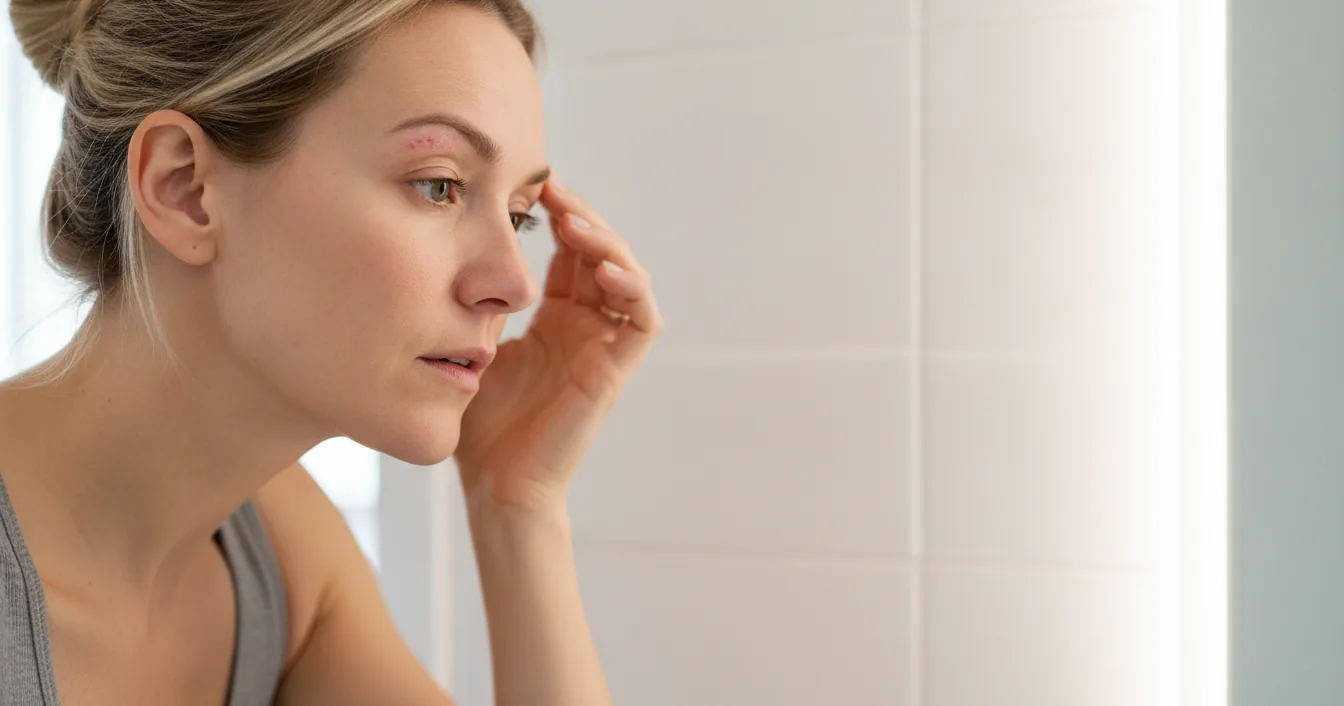
It is day five. The swelling has gone, the scabs have started to itch, and somewhere along your brow line there is a bump. Maybe a scatter of pinpoint white dots. Maybe one red spot with a white head sitting on top of a stroke. Maybe a small firm lump that will not shift. This tends to be the moment people start reading forums at midnight, and the forums are not much help, because every reply is either “totally normal, ignore it” or “that looks infected, go to urgent care.”
Most early bumps are neither. They are mechanical, predictable, and usually fixed by changing what you are putting on your brows rather than by treating anything. A few are not, and those have specific signatures worth learning. This guide is diagnostic rather than chronological. The question it answers is what is this bump, not what day am I on.
The Odds Are Better Than the Forums Suggest
The largest published look at early permanent makeup complications comes from a Japanese clinic that surveyed 1,352 clients after eyebrow or eyeliner procedures, with a median of just 15 days between the appointment and the response. That puts the data squarely in the window you are sitting in now. Complications of any kind were reported by 12.1% of clients. For eyebrow procedures specifically, the most common was itching at 8.2%. Infections turned up in three cases out of 1,352, a rate of 0.2%, and none of the reported symptoms had persisted by the time of the study.
There is a second piece of useful context from the other end of the pipeline. In a retrospective series of 308 tattoo and permanent makeup complications seen at a specialist tattoo clinic, 91.9% were chronic rather than acute. The problems that eventually send people to a dermatologist are overwhelmingly the late, persistent ones, not the ones that show up in week one.
The Four Bumps You Are Most Likely to Have
Pinpoint whiteheads from too much ointment. The most common early bump is also the most self-inflicted, and it has nothing to do with the pigment. Petrolatum-based aftercare balms are occlusive by design, which is the point: they hold moisture in and keep a scab supple. Apply more than a barely visible film and that same occlusion traps sebum and dead keratin in follicles already inflamed from being punctured. The result is a scatter of tiny white or yellow-white dots through the brow, often heaviest where you applied most. They show up a few days after you start the ointment, which for most protocols means day four onward, and they clear within days of easing off.
Milia. Milia look similar at a glance but behave differently. They are small keratin-filled cysts sitting just under the surface, firm, pearly, and domed, and crucially they have no opening. A whitehead will eventually discharge on its own. A milium will not, because there is nothing to squeeze out of it. They are a known consequence of occlusion plus minor skin trauma, and a microbladed brow offers both at once. Left alone, most resolve over a few weeks. If one is still there at your perfecting appointment, mention it, and if it persists for months a dermatologist can extract it in seconds with a sterile lance.
Actual pimples along the brow line. These are ordinary inflammatory acne or folliculitis, and the brow is a busy neighbourhood for both: dense follicles, sebaceous skin, and for two weeks you are applying ointment, sleeping awkwardly, skipping your usual cleanser, and touching the area more than normal. A brow-line pimple looks like a pimple anywhere else. It is a raised red papule, tender rather than hot, sometimes with a white or yellow point, and it stays one discrete spot instead of spreading. If you break out on your forehead in ordinary life, expect a healing brow to be no more resistant. Oily skin is more prone to all three of these, which is part of why some artists start oily clients on a drier protocol, as covered in our skin type pairing guide.
The scab that is not a bump at all. A surprising share of first-week bump questions turn out to be lymph and pigment that dried into a raised crust over a stroke. Under a bathroom light and a magnifying mirror, a thick scab reads as a lump. The tell is shape. Crusting follows the line of a stroke, while a whitehead, a milium, or a pimple sits as a round point independent of the pattern. Scabs also lift and flake on schedule between days five and twelve. If it is drying and shrinking, it is a scab, and the correct action is to leave it completely alone.
Pimple or Infection? The Differences That Matter
This is the distinction worth memorising, because it is the one where waiting has a cost. Five features separate an ordinary spot from an infection getting started.
Direction of travel. A pimple peaks and then improves. An infection gets worse day over day. Healing is supposed to be a downward curve after day three or four, so a brow that is redder, sorer, or more swollen on day six than it was on day four deserves attention no matter what the bumps look like.
Spread. Ordinary bumps stay put. Infection travels outward, often as a blush of redness pushing past the tattooed area into surrounding skin, sometimes with a defined advancing edge.
Heat. Hold the back of a clean finger near each brow. Inflamed skin is warm. Infected skin is noticeably hot compared with the rest of your face, and frequently on one side only.
What comes out. A whitehead discharges a small amount of thick white material and then stops. Infection produces yellow-green or foul-smelling pus, sometimes in volume, sometimes refilling after it drains.
Whether you feel unwell. This is the one people skip and the one that matters most. A systematic review of systemic infections linked to tattoos and permanent makeup found persistent fever with rigours (violent shivering) was common in bloodstream infections, and documented cellulitis and necrotising soft tissue infection developing within two weeks of a procedure, predominantly from Staphylococcus aureus or streptococcus. Local bumps plus fever, chills, or feeling genuinely ill is not a wait-and-see situation. Call a doctor the same day.
Pain quality makes a useful sixth clue. Tenderness you notice when you touch the brow is normal. Throbbing you feel without touching it is not.

Why Popping One Bump Can Cost You a Stroke
The urge to deal with a whitehead sitting directly on a hairstroke is strong, and giving in to it is one of the few aftercare mistakes that shows up permanently in the result.
Microblading pigment is deposited into the upper dermis, and through the first fortnight it is held there by tissue that is still knitting together, with a scab sitting over the top. Squeezing a spot does not just empty the spot. It compresses and shears the skin around it, lifts the scab early, and takes the pigment under that scab with it. What you see three weeks later is a gap in the stroke pattern, and gaps have to be re-tattooed at the perfecting visit rather than simply reinforced.
There is a second reason, and it is less reversible. Reviews of cosmetic tattoo complications single out fibrosis and scarring after microblading specifically, and picked, squeezed, or otherwise re-traumatised skin is exactly how a fine blade wound becomes a textured one. Pigment does not implant evenly into scar tissue, so a scarred patch can stay stubbornly sparse across several sessions. A whitehead that would have cleared in four days is not worth that trade.

The Aftercare Changes That Clear Them
Nearly every bump in the first three categories responds to the same short list, and none of it involves treating the bump directly.
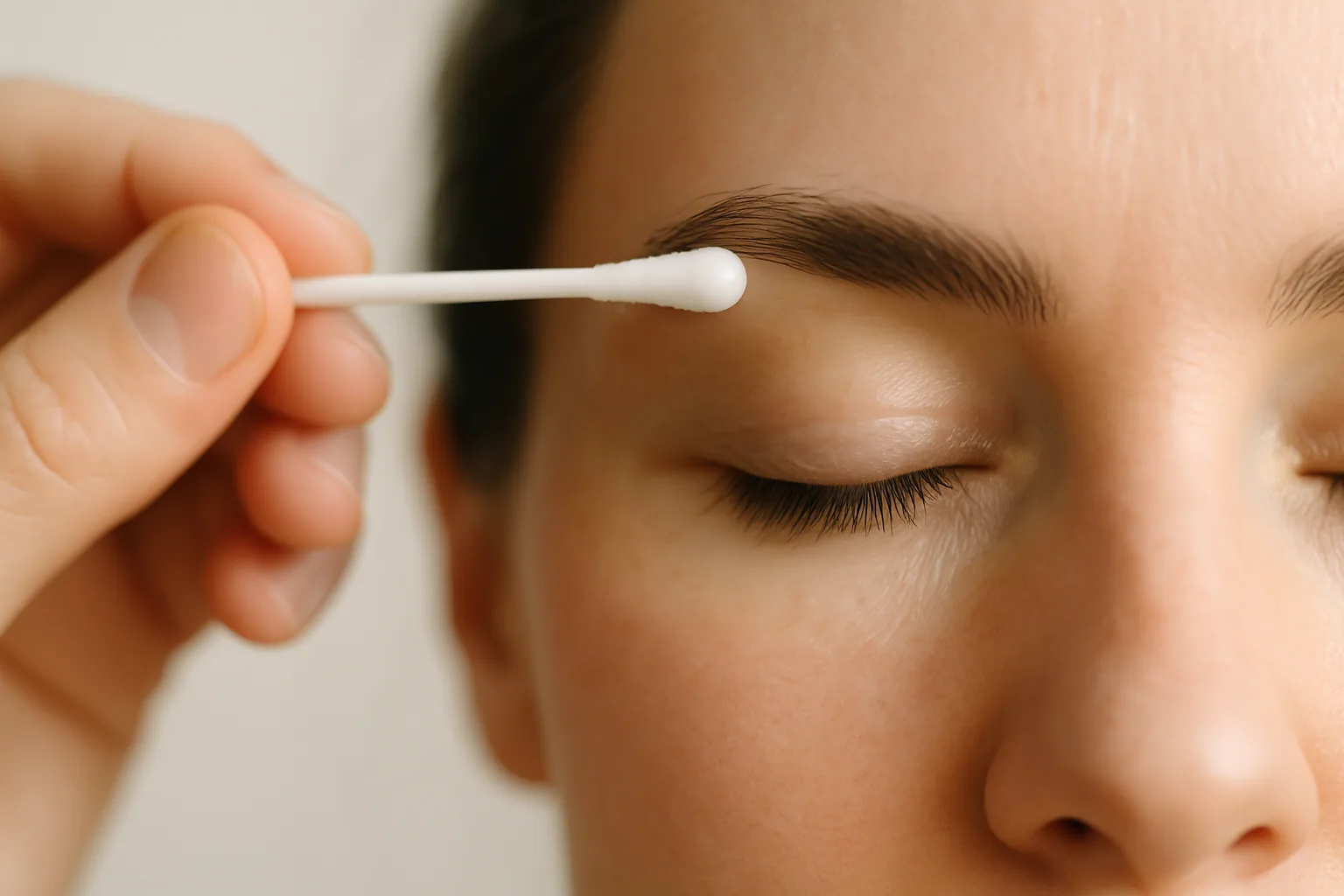
Cut the ointment right back. The instruction is a barely visible film, and the practical version is roughly a grain of rice for both brows, spread with a clean cotton swab rather than a fingertip. If whiteheads have already arrived, drop to once a day, or stop for a day and watch what happens. Oily skin often does better on dry healing with no ointment at all, and your artist can tell you whether that suits your skin.
Keep washing. Skipping cleansing to protect the pigment is a common instinct and it makes bumps worse. A gentle, fragrance-free wash twice a day with clean fingertips, patted dry with a fresh paper towel, is part of the protocol rather than a risk to it. Our aftercare guide sets out the full routine.
Change your pillowcase every couple of nights, keep your hair off your face, and keep your hands off entirely, including the reflexive brow rub.
Do not reach for your acne treatment. Salicylic acid, benzoyl peroxide, glycolic acid, and retinoids belong nowhere near a healing brow. They strip pigment and irritate skin that is still an open wound, and they will damage your result far more than the spot ever would. The same applies to hydrocolloid patches over the brow, which pull scabs off. Wait until you are fully healed and cleared.
Leave makeup, brow pencil, and concealer off until healing is complete, however tempting it is to camouflage a spot.
Two Bumps That Belong on a Different Track
Small clustered blisters, particularly weeping ones that arrive with burning or tingling rather than itching, are not acne. Herpes simplex reactivation is a recognised early complication of cosmetic tattooing, most notoriously with eyeliner but possible anywhere on the face, and it needs an antiviral prescription rather than an aftercare tweak. Anyone with a history of cold sores should raise it before the appointment, because prophylaxis is straightforward.
Firm lumps that appear after the brows have fully healed are a separate category too. If a bump surfaces at week six, or month three, or years later, sits raised and persistent, and never flakes or drains on any schedule, it has broken the healing timeline and is not an early-healing bump at all. That is the territory of delayed pigment reactions and granulomas, which our guide to bumps, lumps, and granulomas after microblading covers in detail.
When to Message Your Artist, and When to Call a Doctor
Message your artist for the routine things: whiteheads, a single spot, a bump you cannot identify, uncertainty about how much ointment to use. Send a photo taken in daylight without a flash. A good artist has watched thousands of brows heal and will usually recognise yours at a glance, and adjusting your protocol is their job.
Call a doctor, the same day, for spreading redness, heat, throbbing pain, yellow-green pus, fever or chills, or anything clearly worsening rather than settling. Lower that threshold further if you are immunosuppressed or taking medication that slows healing, for the reasons set out in our guide to microblading with an autoimmune condition. The warning-sign list in our risks and contraindications guide is worth reading before day one rather than during day six.
The honest summary is that a bump on day five is usually a message about your ointment, not about your brows. Look at where it sits, whether it is spreading, whether it is hot, and whether you feel well. Those four checks separate the nuisance from the problem almost every time. And whichever one it turns out to be, the answer is never to squeeze it.
Sources
- Medicine on a 1,352-client survey of eyebrow and eyeliner permanent makeup complications
- Current Problems in Dermatology for the early and late complications of cosmetic tattooing
- Medicina Clínica with the systemic infections that can follow tattoos and permanent makeup
- Journal of Cosmetic Dermatology documenting how many tattoo complications turn out to be chronic rather than acute
- Missouri Medicine covering the natural course of tattoo skin reactions and how they are managed