How to Become a Microblading Artist: Training, Certification, Kit, and the Real Startup Cost
Published on September 9, 2026

Almost everything else on this site is written for the person sitting in the chair. This one is for the person standing beside it, or thinking about becoming that person. Microblading gets marketed to aspiring artists as a two-day course and a six-figure income, and the gap between that pitch and the actual path is where most people lose their money.
Here is the honest version. The training course is the cheapest and shortest part of becoming an artist. What follows it, the certification, the licensing, the months of supervised practice on real faces, the insurance, the rent you pay before you have clients, is the part that decides whether you are still doing this in two years.
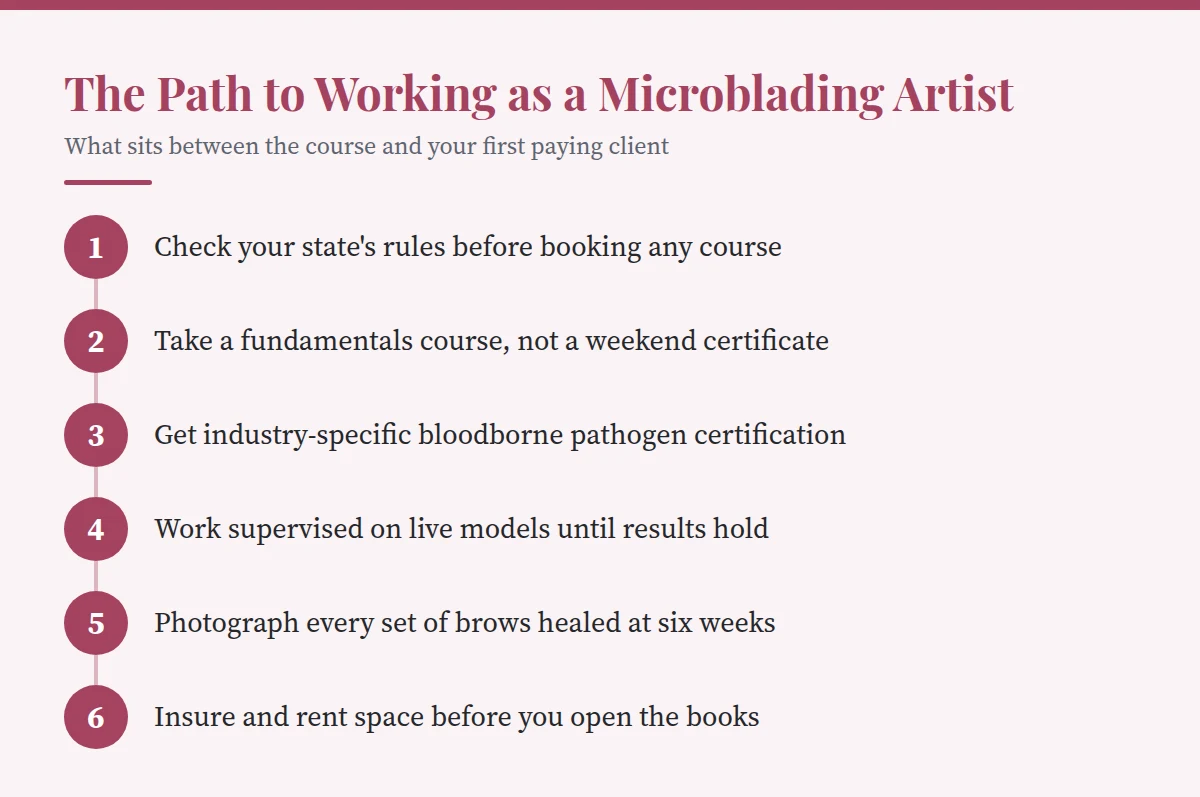
Fundamentals Training, and Why a Weekend Is Not a Career
Course pricing is all over the map. Academies commonly charge between about $1,700 and $3,000 for a fundamentals class, with one Miami program at $1,699, a Chicago equivalent at $2,899, and Houston and other markets landing around $2,500 to $3,000. The wider market runs from roughly $500 to $5,000 once you include everything from short introductions to extended programs.
The number worth measuring any of them against is the Society of Permanent Cosmetic Professionals guideline of 100 hours of education. A two-day class is about sixteen hours. That is not a criticism of two-day classes as an entry point, it is a warning about what a certificate from one actually means, which is that you attended. Industry trainers are fairly direct that three to five days rarely covers the depth of the work, and that anything advertised as complete in under a week at a suspiciously low price is worth walking away from.
Tuition normally includes a starter kit, pigments, course materials, and some form of continuing instructor access. Read what is actually bundled before you compare two prices, because a $1,699 course that supplies nothing and a $2,900 course that includes a full kit are closer together than they look.
The Certificate That Is Genuinely Not Optional
Bloodborne pathogen certification is the cheapest credential you will buy and the one you cannot work without. It typically costs $25 to $50, takes an afternoon online, and expires annually. Your health department will ask for it, your insurer will ask for it, and any studio renting you a chair will ask for it.
One detail people get wrong: it has to be the right course. Certification bodies want industry-specific bloodborne pathogen training from an approved list, not a generic workplace first-aid module you found for $9. Check which courses your state and your intended certifying body accept before you pay for one.
The SPCP’s Certified Permanent Cosmetic Professional credential sits above this. It requires a 100-hour training program, current bloodborne pathogen certification, and a proctored exam of 100 questions covering infection control, pigments, anatomy, regulations, and client management, with a passing mark of 81%. Keeping it means 12 hours of continuing education every two years. It is optional in most of the country and effectively mandatory in a few states.
Licensing Is a Local Question, and You Ask It First
There is no national microblading license. Most states treat the procedure as tattooing and regulate it through the health department rather than the cosmetology board, which surprises people who assumed a beauty credential would cover it.
The spread is real. Florida classifies microblading and permanent cosmetics as a form of tattooing, requiring a tattoo artist license, work performed inside a licensed establishment, bloodborne pathogen training, and proper biomedical waste handling. Minnesota’s health department requires 200 hours of hands-on practical time for a body art license. New Jersey, New Hampshire, and Maine accept the CPCP credential specifically. Some jurisdictions want an underlying esthetics or cosmetology license, others do not care.
Call your state or county health department before you book tuition, not after. The single most expensive mistake in this industry is paying $2,800 for a course that does not satisfy the requirements where you actually plan to work. The regulation exists for a reason, which is the same reason we tell readers that mail-order microblading pens are a health risk rather than a bargain: this is a procedure that breaks skin on someone’s face.
Supervised Practice Is the Part Nobody Sells You
You finish a fundamentals class able to draw a decent brow on latex. You are not yet able to feel the depth on live skin, which is the entire craft. That gap closes through supervised work on real models, and most apprenticeship programs expect you to have finished a fundamentals class before they will take you, precisely because they want to teach hands rather than theory.
An apprenticeship gives you something no classroom of eight students can: someone watching your specific pressure, your specific stroke direction, and telling you what went wrong six weeks later when the healed result comes back. Budget for this phase. Charge models the cost of your supplies and nothing more, and expect to work through twenty to thirty sets of brows before your results are consistent enough to price properly.
Screening is part of the training too. Learn the contraindications and the medical history questions before you are alone in a room with a client, and run a patch test on every client before pigment goes in, every time. Our risks and contraindications guide is the client-facing version of the same checklist.
A Portfolio That Survives Scrutiny
Fresh photos taken ten minutes after a session prove nothing, and clients are learning this. The portfolio that wins bookings is healed work photographed at six weeks and again at a year, in consistent light, from consistent angles, across a range of skin types.
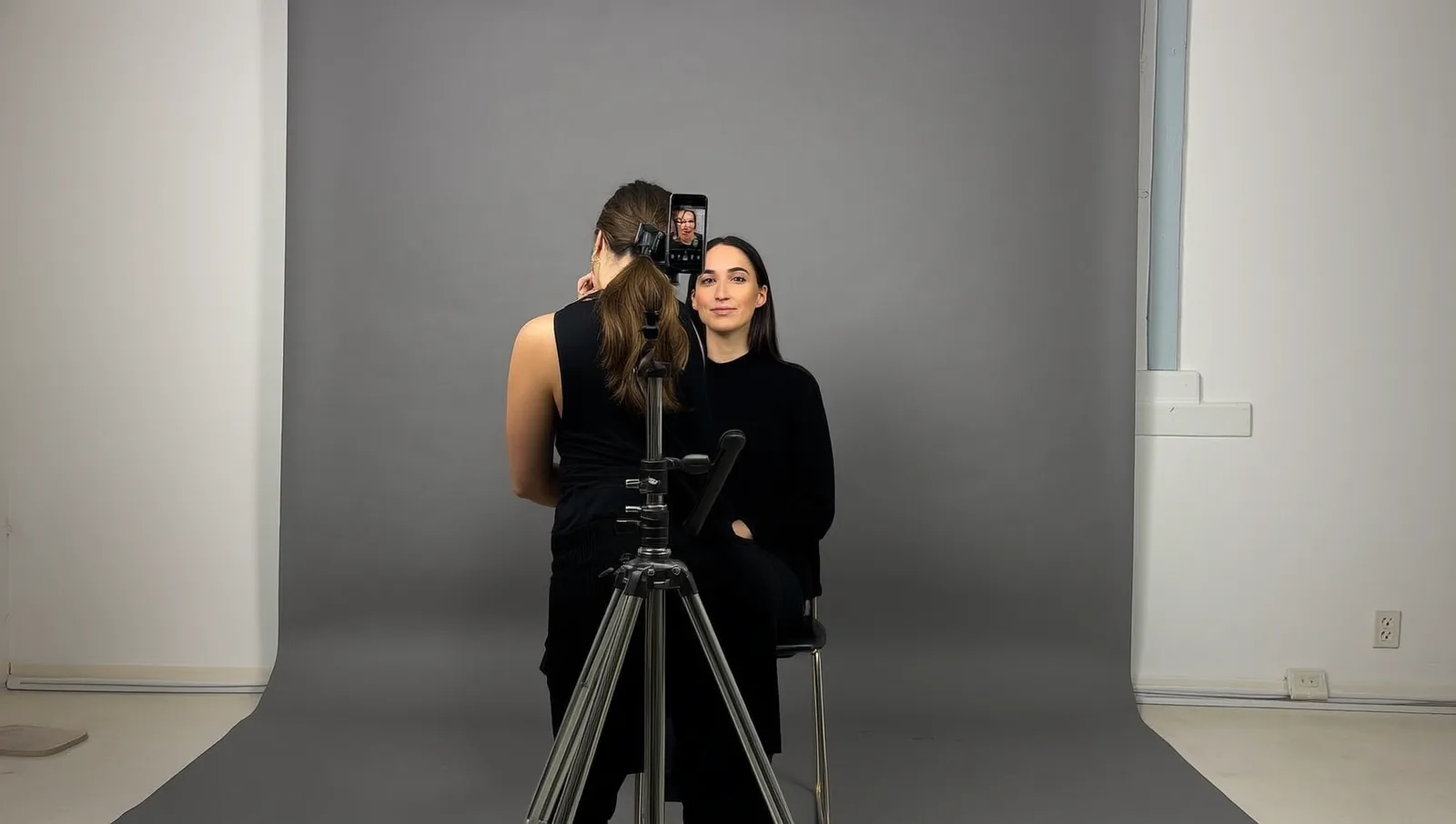
Shoot every model from day one, even the ones that go badly. Track retention against skin type, because oily skin and dry skin produce very different twelve-month results from identical work, a pairing problem covered in our skin type guide. And read the questions clients are told to ask before booking, because that list is what you will be answering in consultations.
The Honest Equipment List
Beyond the kit that came with your course: manual pen tools, sealed single-use blades in the configurations you actually use, a working pigment set rather than the three shades in the starter box, mapping pencils, topical numbing products you are legally permitted to use in your state, gloves, barrier film, aftercare kits for clients, a sharps container, and a biomedical waste disposal contract if your jurisdiction requires one. Consumables run around $30 per treatment.
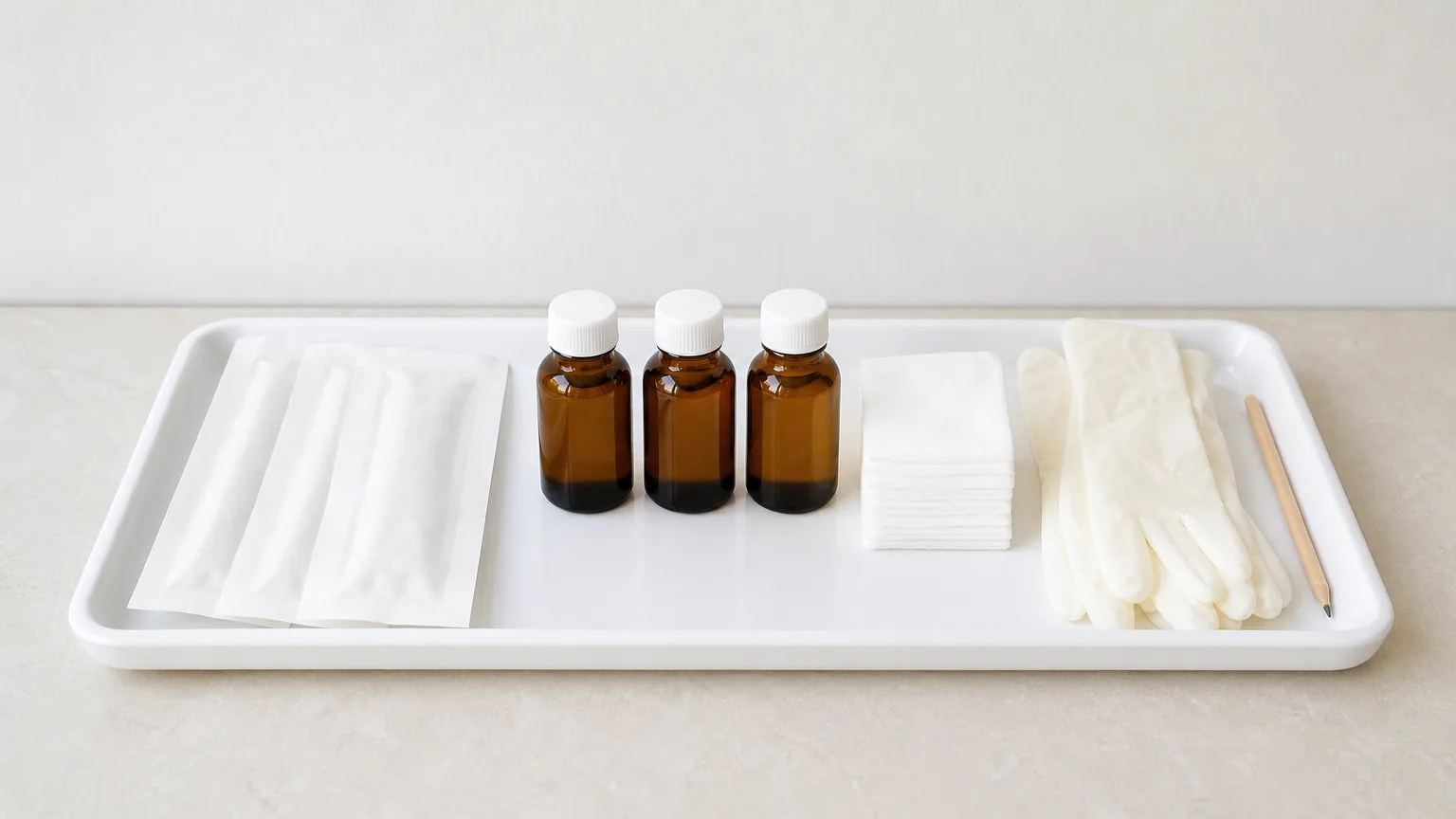
Client paperwork is equipment too. Consent forms, medical history intake, aftercare instructions, and photo release, ideally reviewed by someone who knows your state’s requirements.
Insurance, Rent, and the Real Cost of Entry
Insurance is cheaper than most people expect. Microblading liability policies commonly run $179 to $499 a year, with $290 and $349 both typical mid-market rates, and around $588 annually for a $1 million general liability policy. Some states push the total to $650 to $1,200. Insurers will require proof of your license and certification, so the credentials come first.
Space is the recurring cost that decides your first year. A room or booth in an existing salon typically runs $500 to $1,100 a month, with the wider market spanning $250 to $1,200 and New York City closer to $800 to $2,000. Commission arrangements take 20% to 60% instead of rent, which is a better deal when you have no clients and a worse one once you do.
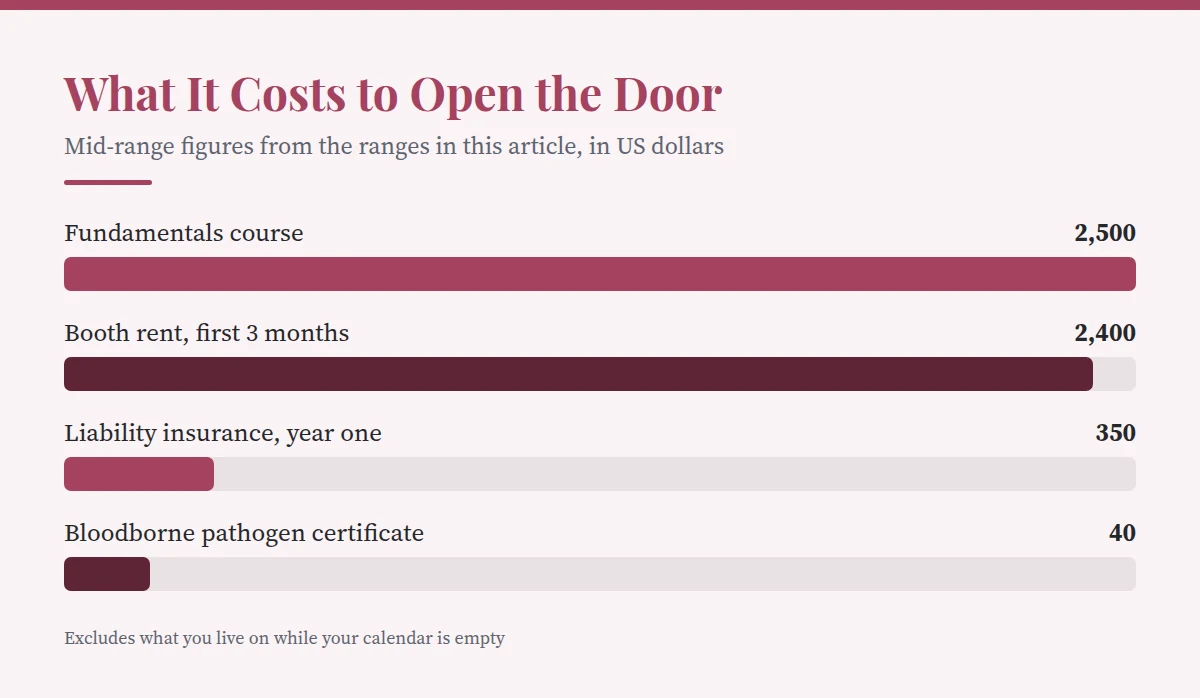
Add it honestly. A lean entry with a mid-priced course, a modest kit, certification, insurance, and three months of booth rent lands around $5,000 to $6,000. A more typical path with a better course, an apprenticeship, a full kit, and six months of rent while you build sits closer to $9,000 to $12,000. Neither figure includes what you live on while your calendar is empty.
A Realistic First Year
The national average microblading price is just under $600, with a range of roughly $200 to $2,000 depending on experience and market, and touch-ups at $100 to $200. A full day accommodates three to five treatments at about two hours each.
That capacity figure is where the six-figure claims come from. One widely cited model projects about $377,000 a year from three clients a day, fully booked, with no days off. Treat that as arithmetic rather than a forecast.
A realistic first year looks different. You spend the first months on models at cost, then price low while your portfolio is thin, perhaps $250 to $350 a set. If you average three clients a week across forty-five working weeks at $325, that is roughly $44,000 gross. Take out $9,600 in rent, about $4,000 in consumables, $400 in insurance, and marketing, and you are somewhere near $28,000 before tax in year one. That is a normal, healthy first year in this trade. Year three, with a full book and prices that reflect healed results, is a genuinely different number.
Is It Worth Doing
It is, if you go in with the right timeline. The artists who last treat the course as week one of a two-year apprenticeship, not as a qualification. They also keep learning, because the market is moving toward machine hairstroke work alongside the blade, a shift we cover in our hairstroke brows guide.
What kills careers here is not lack of talent. It is arriving with a certificate, no license, no insurance, no healed portfolio, and no runway, then discovering that clients are not waiting. Results in this trade vary enormously by artist skill and by the client’s skin, and building the judgment to know the difference takes longer than any course length implies. Budget for that, and the rest is a real profession.
Sources
- SPCP on what the CPCP credential actually requires of a practitioner
- SPCP for the 100-hour education guideline it asks regulators to adopt
- PMUHub with a working breakdown of artist earnings, rent, and supply costs
- Eye Design Store covering how certification pricing is put together
- Insureon on what permanent makeup artists pay for liability cover
- MicroBladers Studio for why trainers say a three to five day class is not enough