Microblading With Vitiligo: White Brow Hairs, the Koebner Risk, and Waiting for Stable Disease
Published on November 1, 2026

When vitiligo reaches the brows, it can take the colour out of the skin, out of the hairs, or out of both. Microblading looks like the obvious repair, since it puts pigment back where pigment is missing. The trouble is how it gets there. Microblading cuts the skin, and vitiligo is one of a handful of skin diseases that can follow a cut. The American Academy of Dermatology (AAD) warns people with vitiligo that a tattoo wounds the skin, that the wound can trigger new spots of vitiligo, and that those spots tend to show up about 10 to 14 days later.
That is a reason for caution, not a blanket ban. Whether microblading is reasonable depends on which type of vitiligo you have, how long it has been quiet, and what exactly is missing from your brows. This guide covers how vitiligo changes a brow, why the Koebner phenomenon is the risk that decides most cases, what “stable” should mean before anyone picks up a blade, how pigment looks in white skin, and how a cosmetic brow differs from the medical camouflage tattooing some dermatologists offer.
What Vitiligo Does to a Brow
In vitiligo the immune system destroys melanocytes, the cells that make skin pigment. The AAD describes the patches it leaves as lighter than your natural tone, white, or even pink, and notes that hair growing in a patch sometimes turns white as well. Dermatologists call white hair leukotrichia. DermNet, the dermatology reference run from New Zealand, says it affects the scalp, brows, lashes or body hair of somewhere between 10 and 60 percent of people with vitiligo.
For brows, that adds up to three different situations, and each needs its own answer:
- White skin under dark hairs. The patch runs through the brow, but the hairs are still pigmented. This is the most treatable version. Hair follicles hold a reserve of pigment cells, and DermNet explains that returning colour usually starts as brown dots around them. It also notes that the face and neck respond to light treatment better than the trunk or limbs.
- White hairs in white skin. The follicles have lost their pigment cells too. White hairs do not tell you whether vitiligo is active, according to DermNet, but they tend to predict a poorer response to treatment, because the reserve that repigmentation draws on is gone.
- Untouched brows, vitiligo elsewhere. Your brows are normal and you want microblading for the usual reasons. The question here is whether the procedure could bring vitiligo into a brow that never had it.
The type of vitiligo matters as much as where it sits. Segmental vitiligo stays on one side or one part of the body. DermNet notes that it involves the head in more than half of cases and often whitens the hairs inside the patch. The AAD says its colour loss usually spreads for 6 to 12 months and then stops, after which most people do not develop new patches. DermNet gives a wider window of six months to two years. Non-segmental vitiligo, the common type, shows up on both sides of the body and can produce new patches on and off for life.
Not every white brow hair means vitiligo, either. Hair that regrows after alopecia areata, brow hair included, can come back white or blonde at first, DermNet notes, and ordinary greying reaches the brows as well. If no one has diagnosed the white patch or the white hairs, start there.
Why a Blade Is the Problem: The Koebner Phenomenon
The Koebner phenomenon is a skin disease appearing at the site of an injury, in skin that was clear before. Nicolas Kluger, a dermatologist who has written widely on tattoo complications, notes that under the Boyd-Nelder classification only three diseases truly koebnerize: psoriasis, lichen planus and vitiligo. DermNet’s list of vitiligo triggers runs from cuts, abrasions and scratching to friction such as eye rubbing, and burns including sunburn. A microblading session puts hundreds of fine cuts into one small, visible patch of skin.
How often does it happen? A 2012 international consensus conference on vitiligo put the reported rate in non-segmental disease anywhere from 15 to 70 percent. In a Belgian study of 700 people with generalised vitiligo, 34 percent reported new patches appearing after an injury, and those patients tended to have more extensive disease, an earlier start, and a higher risk of losing more colour even with treatment. One experiment summarised by the consensus speaks most directly to brow tattoos: a 2 mm punch biopsy in normal-looking skin set off new depigmentation in 61 percent of people with generalised vitiligo, and in none of those with segmental vitiligo.
Brows have their own case reports. A 2011 case report from China described vitiligo appearing after an eyebrow tattoo, and dermatologists in Scotland have reported koebnerization after microblading. Neither proves a tattoo can start vitiligo from scratch, and Kluger answered the first with a letter arguing it showed association rather than cause. For someone who already has vitiligo, though, that debate changes little: injury is a known trigger.
Kluger’s chapter on tattoo contraindications adds the details a client needs:
- The phenomenon can appear days or years after the tattoo, and often in only part of it.
- It is more likely while the disease is active.
- It is more likely if you have already reacted this way to a scar, a scrape or an earlier tattoo.
- Tattooing along the edge of a vitiligo patch may make the patch spread.
That last point matters most for brows, because the edge of a patch is often exactly where the strokes would go. A new patch inside fresh brows is also hard to fix. Adding strokes injures the same skin again, and laser or saline removal wounds it again too. Psoriasis and lichen planus share the same mechanism, which our guide to microblading with an autoimmune condition covers alongside the drugs used to treat them.
What “Stable” Has to Mean First
Kluger’s general rule for tattooing over a skin disease is to wait until the skin is free of new lesions and the disease is quiet. Nobody has defined what that means for a brow tattoo in vitiligo. The closest yardstick comes from vitiligo surgery, where grafting also wounds the skin. Even there, one review found that four decades of practice had produced little agreement on how long a patient should be stable first. The 2012 consensus settled on two points worth borrowing.
Judge the patch, not the whole body. Within one person, different patches can be spreading, holding still and shrinking at the same time, so “overall” stability is unreliable. The skin in and around your brows is what counts.
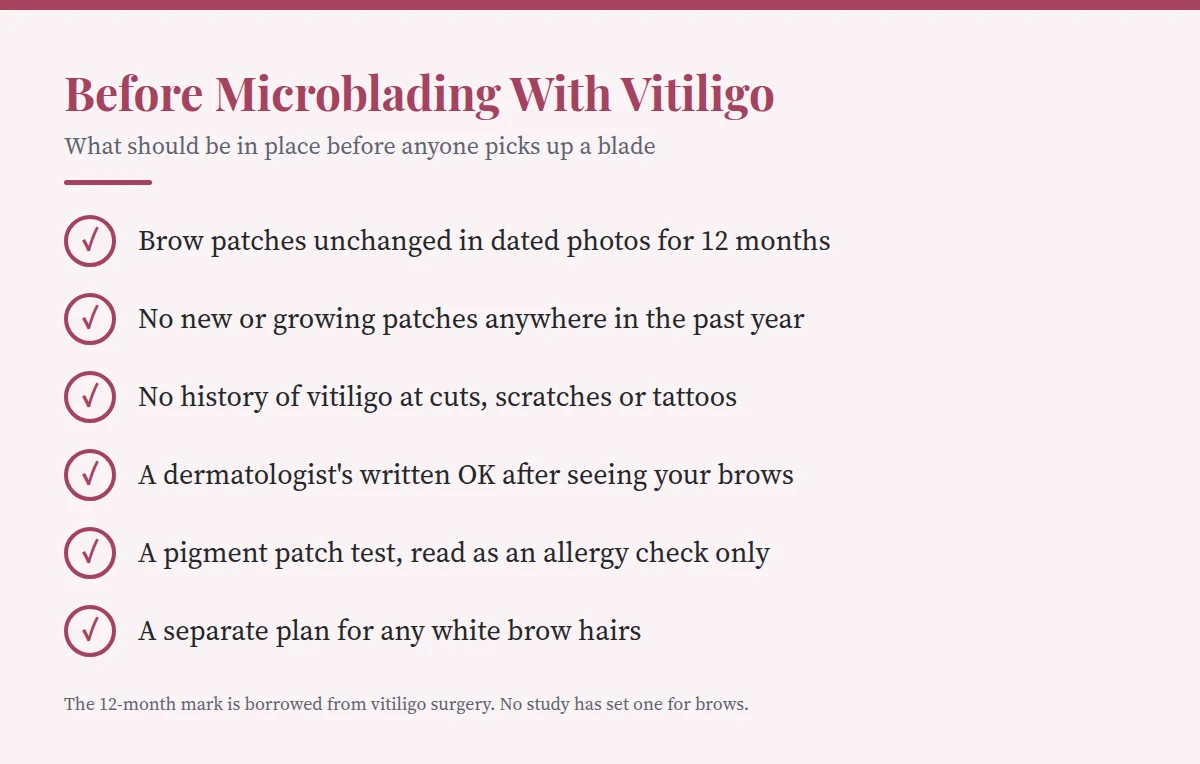
Use dated photographs over a full year. The consensus recommends judging stability on your own account, a clinical score, and serial photographs of the specific patch, and it treats 12 months of photographically confirmed stability as enough to call a patch stable for surgery. It is open that the 12-month figure was set arbitrarily.
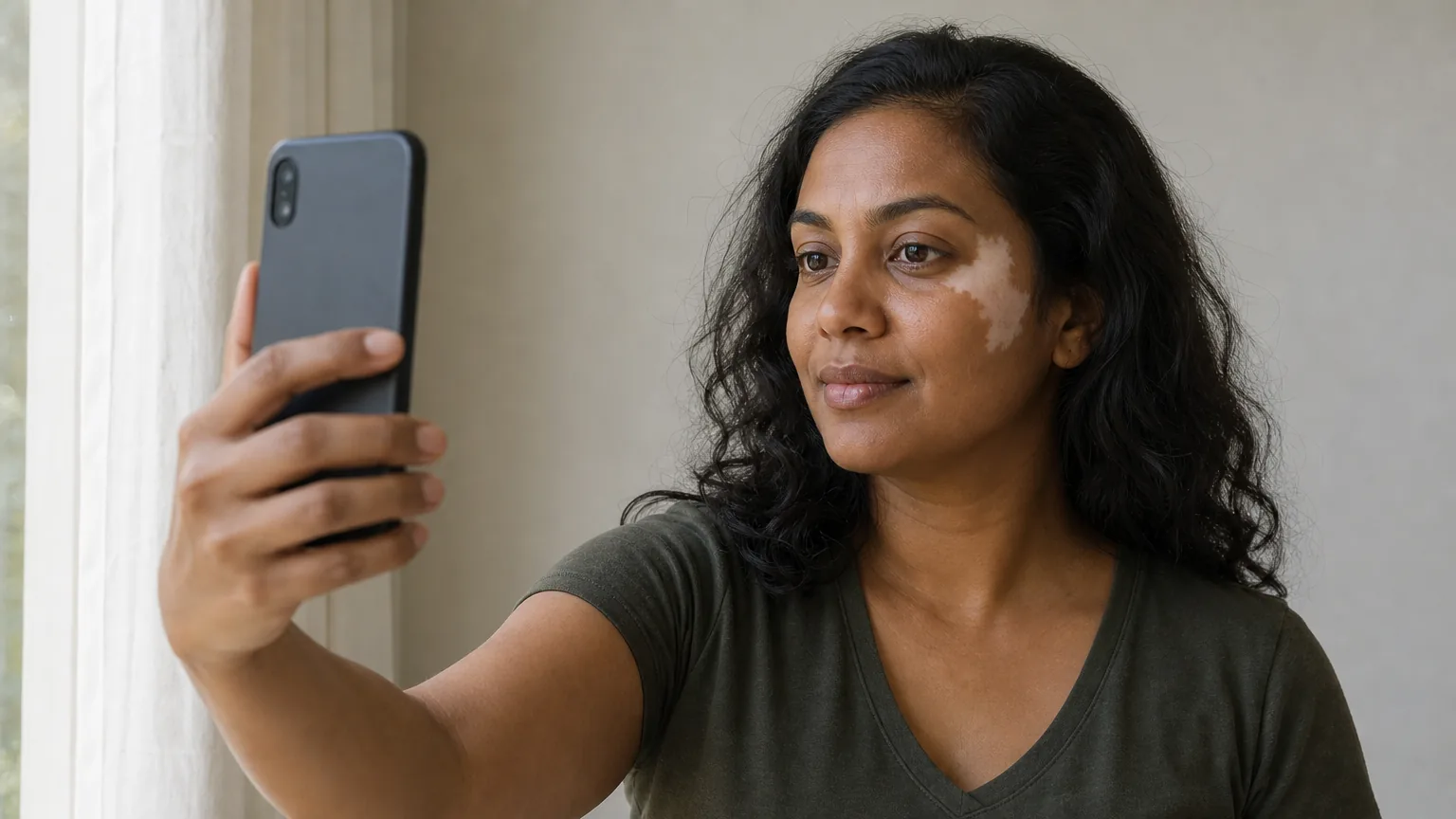
You can start that record today. Photograph your brows once a month by the same window, at the same distance, with no makeup, and keep the dates. It costs nothing, and it gives your dermatologist evidence instead of memory.
Several things should pause the plan:
- New patches anywhere in the past year, or a brow patch that has grown.
- Any history of vitiligo appearing at a cut, a scratch, a scar or an earlier tattoo.
- A brow patch that is responding to treatment right now. Let it finish. There is no published study of what brow strokes chosen against white skin look like once colour returns around them, so no artist can promise the result.
- Segmental vitiligo still inside its spreading phase.
On the evidence above, segmental vitiligo that has clearly stopped spreading is the more promising starting point. Non-segmental vitiligo can stay quiet for years and still flare, so a stable year improves the odds without removing the risk.
How Pigment Looks in White Skin
Kluger is plain that a tattoo does not look the same on vitiligo-affected skin as on normal skin, because the patch lacks melanin. A brow that crosses the edge of a patch can therefore heal as two slightly different halves: strokes sitting under white skin, and strokes sitting under your natural tone.

The seasons widen that gap. A patch cannot tan while the skin around it can, and the AAD points out that tanning makes vitiligo more noticeable by increasing the contrast. Brows matched in February can look different by August. Healed brows can also drift toward blue, green, grey or red after years of sun, a shift that a 2023 micropigmentation review by Indian dermatologists says calls for complementary colours to correct. The AAD’s own warning about tattoos in vitiligo puts it briefly: the colour may not blend with your skin, and it may eventually bleed.
White hairs add a layer that microblading cannot touch. The strokes sit in the skin, not in the hair, so white hairs stay white and lie across the new strokes. Unless the hairs are dealt with separately, the brow can look like grey hairs over a drawn-on shape.
Healing skin needs more sun care than usual, too. Skin without pigment burns easily, and the AAD warns that a bad sunburn can worsen vitiligo. Keep healing brows in the shade under a wide-brimmed hat, and add sunscreen once the skin has closed.
White Brow Hairs Need Their Own Plan
If the hairs are the main problem, the options run from a morning routine to a dermatologist’s procedure room.
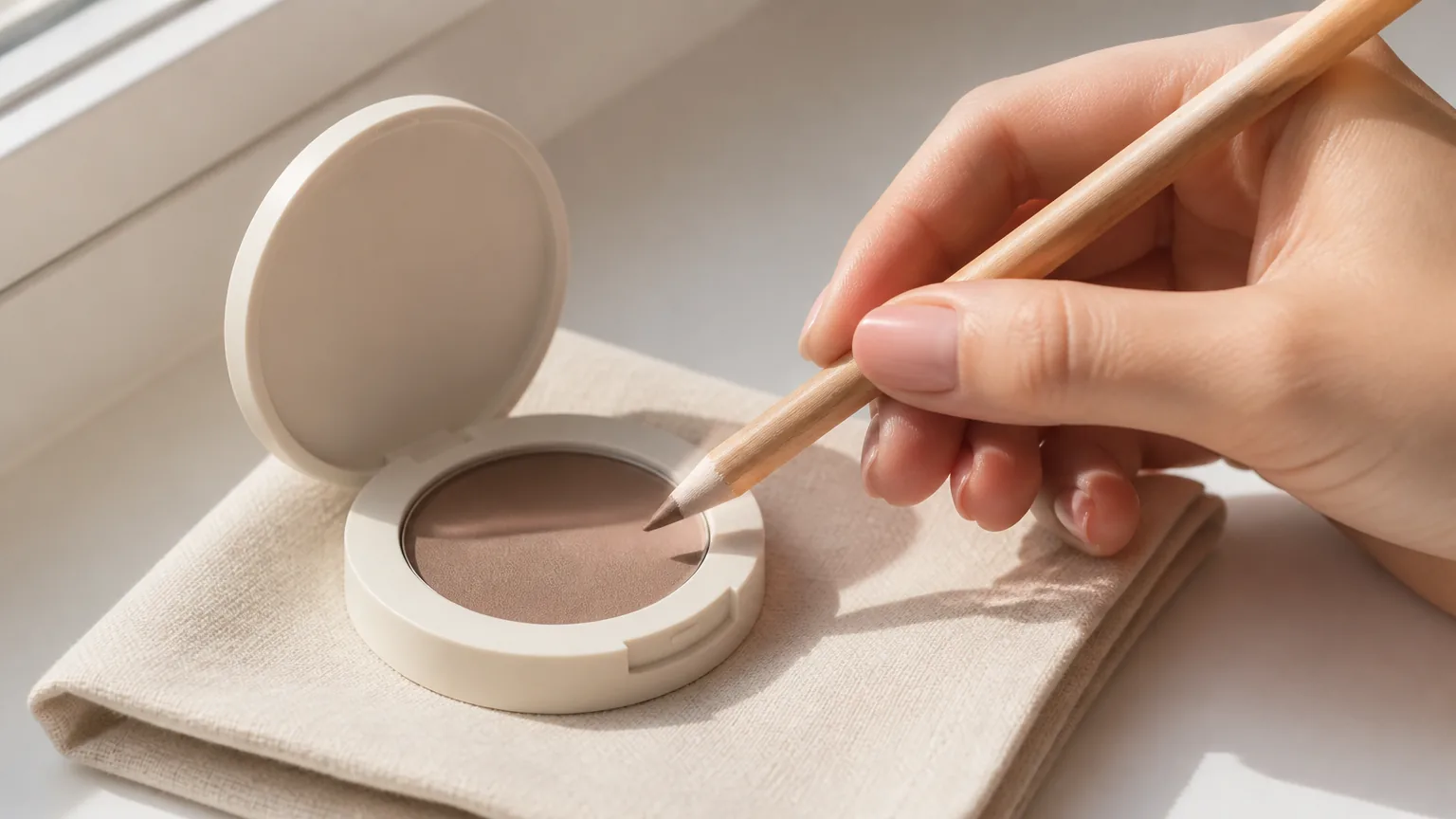
Makeup. A waterproof brow pencil, powder or tinted brow gel colours white hairs and pale skin for the day without wounding anything. The AAD suggests waterproof products for covering vitiligo and notes that makeup lasts about a day.
Tint. In the US, the only colour additive the FDA lists for brow and lash tint is silver nitrate, and only in professional products applied by a trained person, not sold to consumers. Box hair dye is not a stand-in: the FDA says hair dyes have caused eye injuries, including blindness, when used near the eyes. Henna is not permitted on brows at all, and black henna can leave a lifelong allergy, as our guide to henna brows and PPD explains. Any tint needs a patch test first. Expect to repeat the tint often, too: dermatologists at a Seoul hospital who dyed white eyelashes for 19 people with vitiligo reported very high satisfaction, but the dye had to be redone every three to four weeks, and they cautioned that frequent dyeing can sensitise.
Treatment for the hairs themselves. A 2025 systematic review of small studies, 98 patients in all, found that white brow hairs repigmented after several dermatologist-performed procedures, including skin grafting, cell suspension grafting and single-hair follicle transplants. A JAK-inhibitor cream, tofacitinib, has repigmented white lashes in a single case report. Grafting is reserved for stable vitiligo, so the same year of stability applies. These are the only options that can make the hairs grow in pigmented again, so ask about them before you settle for strokes drawn underneath.
Camouflage Tattooing Is a Different Procedure
Medical camouflage tattooing, also called micropigmentation, uses skin-toned pigment to fill vitiligo patches that have not responded to treatment. The aim is skin that matches the skin around it, most often on the lips, fingertips and hands, where vitiligo is stubborn. Microblading has a different aim: hair-like strokes in a brow colour, with no attempt to recolour skin.
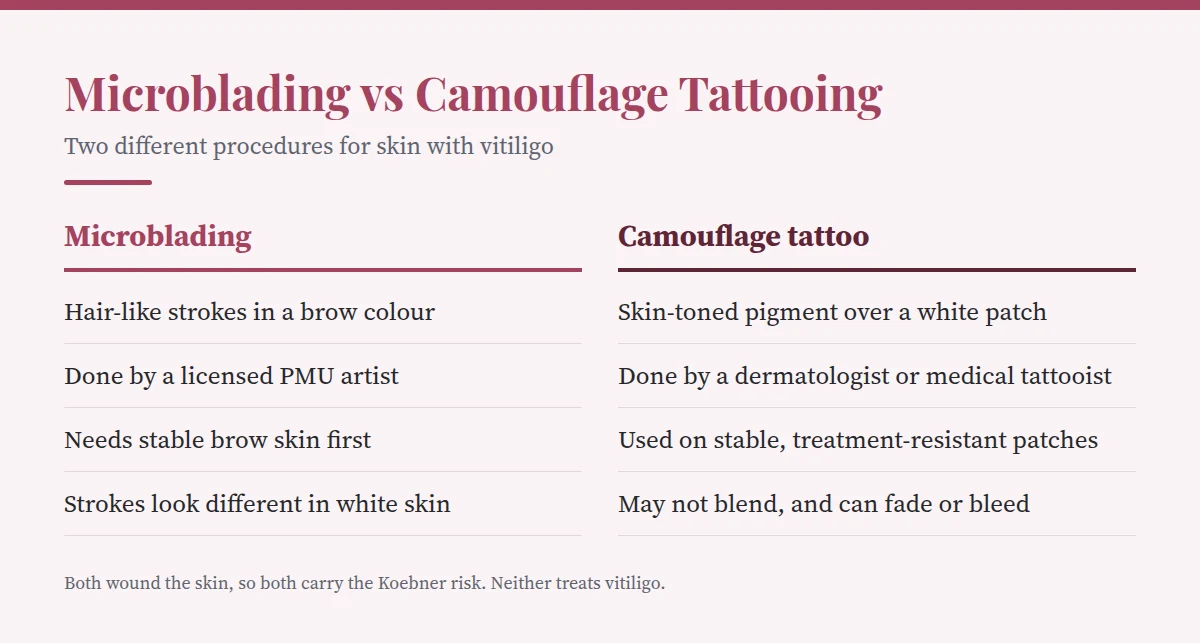
The camouflage studies are small but consistent. At Howard University’s vitiligo centre, iron oxide pigment gave a dramatic improvement straight away, with moderate fading in most cases during the first six weeks and no koebnerization seen. In an Indian series of 30 people with localised, stable vitiligo, 23 had excellent colour matching at six months, while five shed the pigment. Mucosal patches did best, and darker skin did better than fair. A Korean study on light to medium skin reported excellent matching in 80 percent of patches after a median of three sessions, though with a small sample and short follow-up. Every one of these selected stable or treatment-resistant patches, and the 2023 micropigmentation review warns that koebnerization can follow when disease activity has not been brought under control first.
Camouflage is also among the hardest work to undo. The FDA warns that flesh-coloured and white tattoo pigments, and permanent makeup generally, can oxidise and turn black under a laser. This is specialist work, usually done by dermatologists or by medical tattooists with paramedical training, the field described in our look at scar camouflage and areola work. What the two procedures share is the wound. Both can set off the Koebner phenomenon, both need stable disease, and neither treats vitiligo.
If Your Dermatologist Agrees
A yes from your dermatologist is the start of planning, not the end. Bring the dermatologist’s note and your dated photographs to the artist’s consultation, and mention vitiligo even if your brows are unaffected. Ask the artist to map the shape in pencil first, so you and your dermatologist can see exactly where strokes would fall in relation to any patch edge.
Have a patch test for pigment allergy, as before any brow pigment, but do not read it as a Koebner test. Kluger specifically discourages tattooing a hidden test spot to see whether someone will koebnerize: nobody agrees how much ink, which colour or how long a wait would make the test meaningful, a clean result can falsely reassure, and the test itself can sensitise you to an ink ingredient. A test stroke earns its place for keloid-prone skin, where the scar you are watching for grows in the test area. Koebner is less obliging, since it can surface days or years later.
During healing, do not scratch, pick or rub the brows, since friction and scratching are triggers in their own right. Watch the skin in and around the brows over the following weeks, photograph anything new, and call your dermatologist promptly if a white spot appears. The AAD notes that vitiligo treatment tends to work better the sooner it starts. If pale patches appear and you are not sure whether they are vitiligo or ordinary healing damage, our guide to light patches after microblading explains how dermatologists tell them apart.
The Bottom Line
Vitiligo does not rule microblading out, but it changes the question from “which shape?” to “is this skin ready to be cut?” The strongest candidates have brow skin that has stayed unchanged in dated photographs for a year (segmental vitiligo that has stopped spreading is the best case), no history of patches forming at injuries, and a dermatologist who has examined the brows and put the answer in writing. White hairs need a plan of their own, because strokes in the skin will not colour them.
If you go ahead, choose a licensed artist working in a regulated studio, since an unlicensed practitioner is a safety risk on any skin and a bigger one on yours. Insist on a patch test before any pigment, and keep your expectations honest: microblading is semi-permanent, not permanent, and results vary with the artist’s skill and with your skin. If you also have eczema, rosacea or another skin condition around the brows, see a dermatologist before booking.
Sources
- American Academy of Dermatology on the types of vitiligo, and brow and lash hairs turning white
- American Academy of Dermatology with self-care advice on tattoos, sunburn and cover-up products in vitiligo
- DermNet for vitiligo’s triggers, white hairs, segmental disease and repigmentation
- DermNet noting that brow and scalp hair can regrow white after alopecia areata
- Ezzedine and colleagues reporting the global consensus on vitiligo stability and the Koebner phenomenon
- van Geel and colleagues on what the Koebner phenomenon predicts in 700 vitiligo patients
- Lahiri and Malakar reappraising how long vitiligo must be stable before surgery
- Kluger on contraindications for tattooing, from Koebner risk to test spots
- Pan, Song and Xu describing vitiligo after an eyebrow tattoo
- Kluger replying that vitiligo on a tattoo shows association rather than cause
- Tierney and Kavanagh reporting koebnerization after microblading
- Kerure and colleagues reviewing micropigmentation for vitiligo, brows and colour correction
- Halder and colleagues with early results of micropigmentation for treatment-resistant vitiligo
- Mahajan, Garg and Gupta evaluating camouflage tattooing in localised stable vitiligo
- Ju and colleagues testing micropigmentation for vitiligo on light to medium skin
- Biswas and Kaliyadan reviewing treatments for white brow and lash hairs in vitiligo
- Ju and colleagues on dyeing white eyelashes in people with vitiligo
- US Code of Federal Regulations listing silver nitrate as a professional brow and lash tint, and barring henna from the brows
- FDA on hair dyes and the risk of eye injury near the brows
- FDA for why flesh-toned and white pigments darken under laser