The Microblading Intake and Consent Form, Section by Section: What to Ask, Record, and Refuse On
Published on October 24, 2026

Most microblading intake forms are downloaded rather than written. An artist buys a template, adds a logo, and never asks why each line is there. That is how a form ends up with a tick box for “autoimmune condition” and no space to name the drug, a page of risks signed at the bottom and never read aloud, and nowhere at all to write down the lot number of the pigment that went into the client’s face.
The paperwork has three jobs. It screens: who you treat today, who waits, and who brings a letter from their doctor first. It records what went into whose skin, so that a reaction or a recall months later can be traced back to a bottle. And it informs, because consent is only worth what the client was actually told. This guide takes the form section by section, for working and trainee artists. It is not legal advice: the code where you work is the floor, and your finished form deserves a read from your insurer or a lawyer who knows that code.
Start With What Your State Already Requires
There is no national microblading form. Most states regulate the procedure as tattooing, and their body art rules often spell out what the client file must hold. Two examples show both the overlap and the spread.
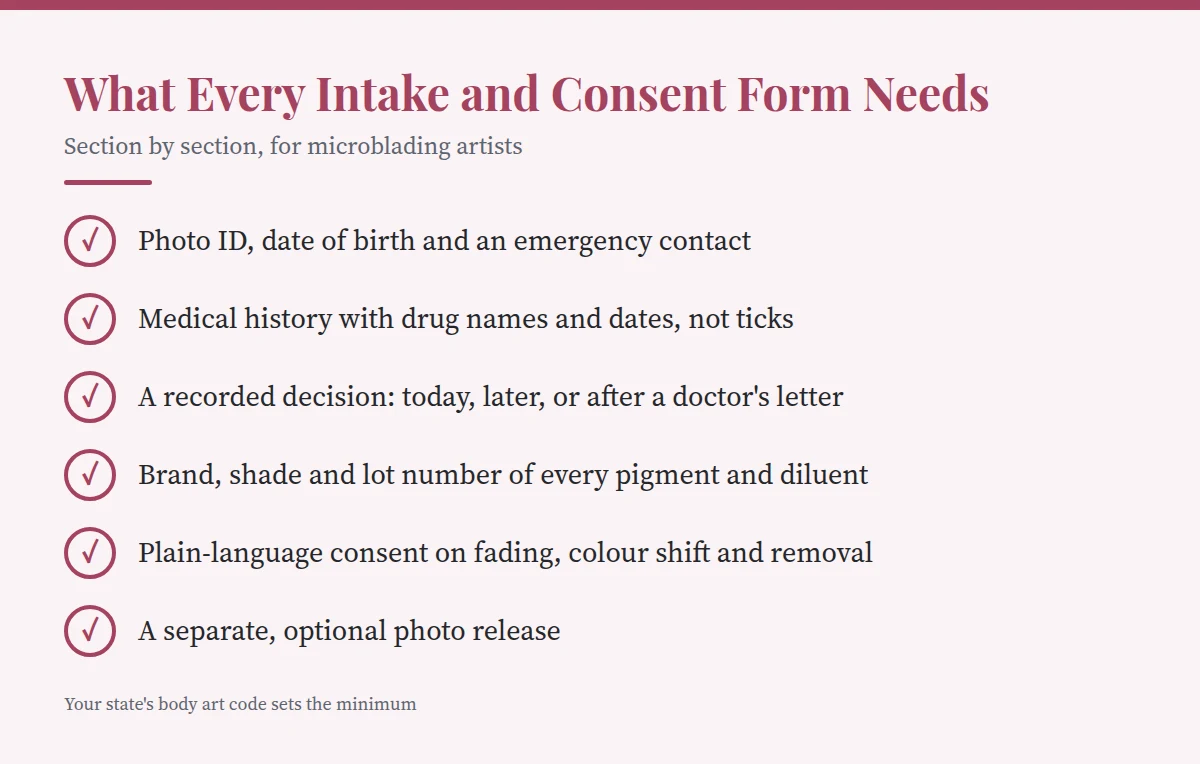
New Jersey requires an application for every procedure, recording the client’s name, date of birth, proof of age, address and an emergency contact. The health history must include medical conditions such as diabetes, allergies and skin conditions, plus a list of medications, and the consent form is reviewed verbally with the client before the work starts. Practitioners record every pigment used, lot number included, and client records are kept for at least three years.
Missouri’s tattoo rules reach microblading, because its statute defines a tattoo to include pigment placed “with the aid of needles or blades using hand-held or machine-powered instruments.” The health form must ask, among other things, about blood thinners, immunocompromising medication, diabetes and other diseases that affect healing, communicable diseases, allergies, and jaundice in the past year. Tattooists keep the lot number of each pigment used for each client, and records last at least two years.
Treat your own code as the starting list, then add the questions below, which no state lists in full. Counties and cities can add rules of their own.
Identity, Age, and Whether the Client Can Consent Today
Photo identification and a date of birth come first, because an age check is only as good as the document behind it. Minors are a separate conversation. New Jersey requires a parent or guardian’s written consent, copies of both IDs, and the parent present for the procedure, and plenty of artists decline under-18s altogether. Both states also bar working on anyone who appears to be under the influence of alcohol or drugs. A form cannot test for that, but it can record that you looked, and a client in no state to understand a consent form is in no state to sign one.
Medical History: Ask for Names and Dates, Not Ticks
A tick box tells you a condition exists, not whether it matters for a brow. For every yes, leave room for the drug or diagnosis by name, when it started or stopped, and who manages it. Marwah and colleagues, writing in a dermatology journal, list the history worth taking first: sun exposure, oily skin, sweating, ongoing laser or IPL sessions, a tendency to keloids, cold sores, retinol, vitamin C or exfoliating creams, isotretinoin and chemical peels. Our risks and contraindications guide covers the same ground from the client’s side.
Blood thinners. Ask by name: warfarin, apixaban, rivaroxaban, clopidogrel, daily aspirin, and the supplements clients forget, such as fish oil and vitamin E. Bleeding costs pigment. Marwah’s review describes leaving pigment over the finished brow for five minutes precisely because pinpoint bleeding loses it in places. Never suggest pausing a prescribed blood thinner. That call belongs to the prescriber, and the form should say so.
Isotretinoin. Ask whether the client has ever taken it, and the date of the last dose. Its prescribing information tells patients to avoid wax epilation and skin resurfacing during treatment and for at least six months afterwards, because of the risk of scarring. Artists apply the same wait to microblading by analogy, and our guide to microblading with acne-prone skin explains why six months is a floor.
Pregnancy and breastfeeding. Ask on the day as well as at booking. Most artists defer both, for reasons set out in our piece on why almost every artist says no during pregnancy.
Keloids and raised scars. Ask about keloids or thick raised scars anywhere on the body, and look at old piercings and surgical scars. The FDA warns that people who tend to form keloids may react to a tattoo the same way. A yes means a dermatologist’s view first, and some artists decline outright.
Autoimmune disease and immune-suppressing drugs. Ask for the diagnosis, whether it is active, whether it has ever involved the face or appeared in a scar, and every immune-modulating drug, from methotrexate and biologics to long-term steroids. Marwah’s list of complications includes koebnerization, where an active skin disease erupts in injured skin, and dermatologist Nicolas Kluger advises that people who are immunocompromised or live with chronic conditions discuss a tattoo with their doctor first. Our guide to microblading with an autoimmune condition covers which diagnoses change the answer.

Conditions that slow healing. Diabetes, impaired kidney or liver function, and current or recent cancer treatment. Missouri’s required warning names the first two.
Skin at the brow today. Rashes, active acne, eczema or rosacea flares, sunburn, infection, and any mole or spot in the brow line. New Jersey bars body art on skin with a rash, pimples, boils, infection or scar tissue, and Missouri bars it over evident lesions or infections. An unexplained spot is a dermatologist’s question, not yours.
Past reactions. Ask about reactions to tattoos or earlier permanent makeup, hair dye, black henna, brow tint, numbing cream, nickel and latex. New Jersey requires studios to keep latex-free alternatives for allergic clients, which only works if the form asked. Then patch test every client with the pigment you plan to use, and record the result. A clean patch test is evidence, not a guarantee, because some reactions to tattoo ink appear years later.
Previous brow work. Who did it, when, with which technique, and whether laser or saline removal followed. Old pigment changes the colour plan, and a client who reacted last time needs a referral before you plan anything.
Not Today, Not Yet, or Not Without a Letter
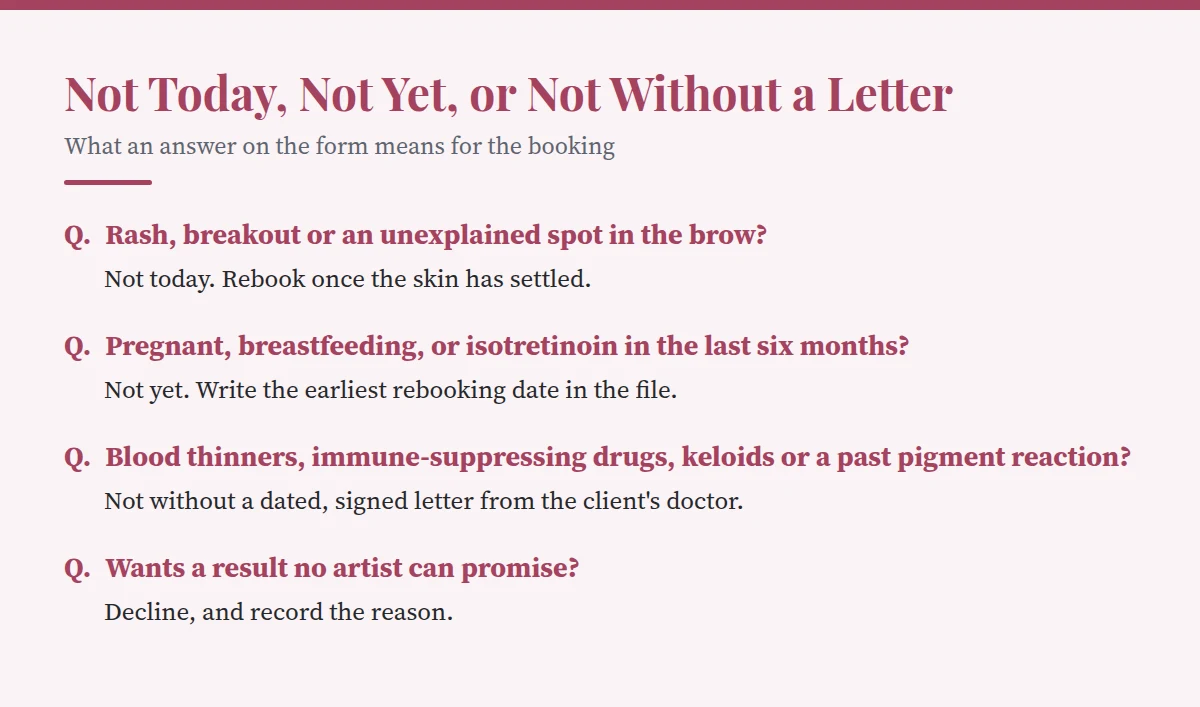
Every answer that matters should end in one of three decisions, recorded in the file with the reason.
Not today. A rash, breakout, infection, sunburn or unexplained spot in the brow area, a cold or fever, or a client who appears intoxicated. Rebook once it has resolved.
Not yet. A wait with a known end: pregnancy and breastfeeding, less than six months since the last isotretinoin dose, a recent peel or laser session near the brow, or an autoimmune flare that has not settled. Note the earliest rebooking date.
Not without a letter. Anything where the safe answer depends on a doctor who knows the client: blood thinners, immune-suppressing drugs, autoimmune disease with skin involvement, keloids, diabetes, cancer treatment, or a past reaction to pigment.
A useful letter is specific. It says the client is planning a cosmetic tattoo on the face, not “a beauty treatment,” confirms that the condition is stable, addresses any medication timing, and carries a date and a signature. File it with the application. It informs your decision rather than making it for you.
Sometimes the answer is simply no. Missouri’s rule lets a practitioner decline service “for any lawful reason,” and lawful is doing work in that sentence. Base a refusal on the skin, the health history or the request itself, such as a guarantee no artist can give or work outside your training, and record which.
Recording the Pigment: Lot Numbers Are the Recall Trail
Many templates leave this section out, and it is the one you need most on a bad day. When a client reacts, the FDA tells them to notify the artist “so they can identify the ink and avoid using it again,” and to ask for “the brand, color, and any lot or batch number of the ink or diluent.” If your file cannot answer that, neither can the client’s doctor.
Recalls run by lot. The FDA’s 2019 alert on contaminated inks named two lots of one black ink and a single lot of a red, and for a third maker’s black inks, every lot distributed between August and October 2018. A studio that wrote down only “brown, brand X” could not tell whether its clients were affected.
For every session, record:
- the brand, shade, lot number and expiry date of every pigment used, mixed or not
- the diluent or mixing solution, with its lot
- the lot printed on the blade or needle packet
- the topical anaesthetic used, and the aftercare product sent home
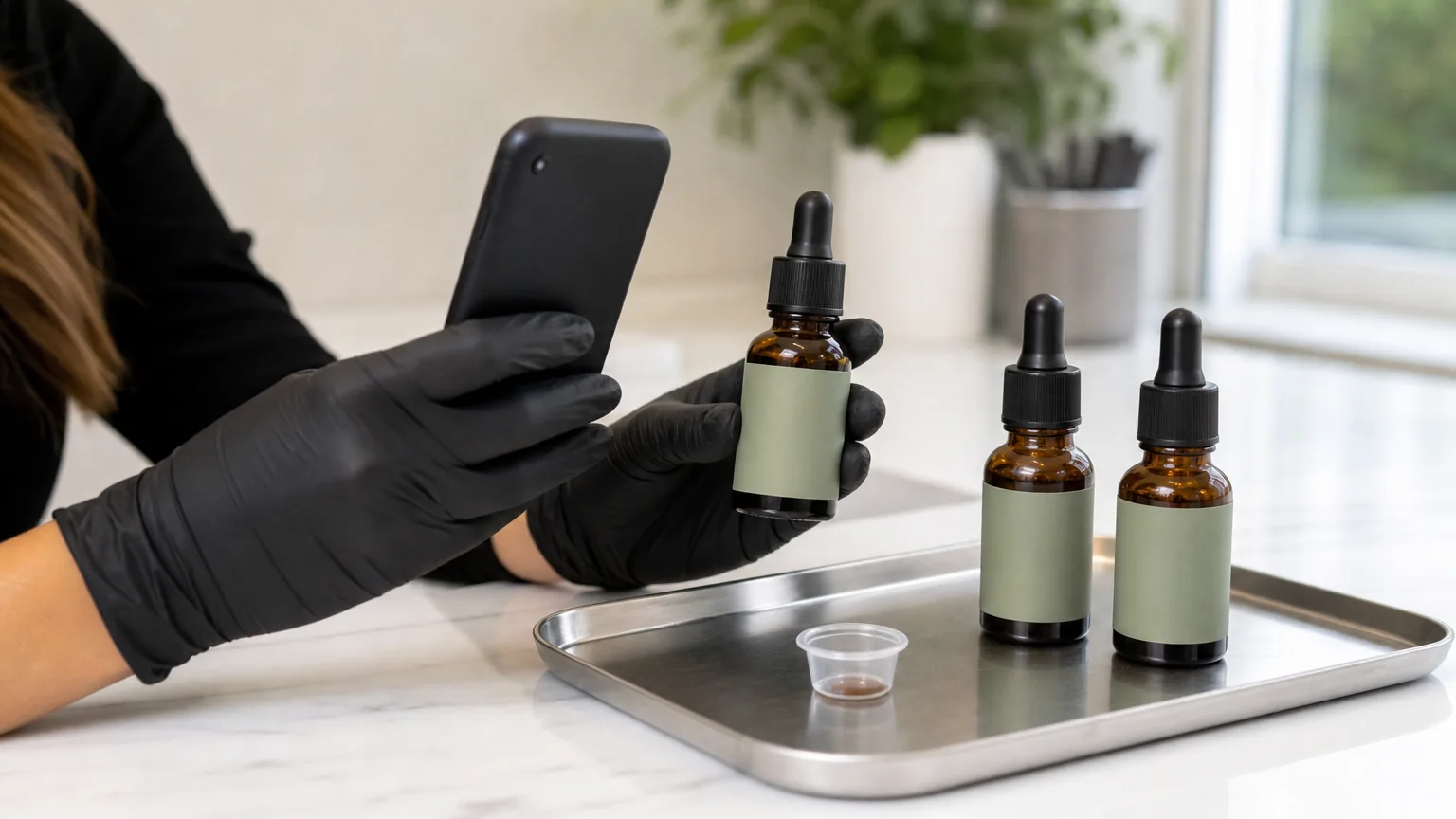
Photograph each label at the appointment. Then keep a second log that runs the other way, listing every client who received each lot, because a recall notice is searched by lot number, not by name.
The legal reporting duty sits with the company on the label. Under the Modernization of Cosmetics Regulation Act of 2022 (MoCRA), the “responsible person” (the manufacturer, packer or distributor named on the label) must send any serious adverse event report it receives to the FDA within 15 business days, and keep adverse event records for six years, or three for some small businesses. Serious includes an infection and significant disfigurement, such as a serious and persistent rash. Since December 2024, US cosmetic labels have had to carry a contact for these reports, as our guide to what a pigment compliance claim really means explains, so pass a client’s reaction on to that contact.
Artists can report too, through the FDA’s MedWatch form. Its tattoo safety guidance says it plainly: “Whether you’re a consumer, tattoo artist, or health care professional, tell the FDA.” New Jersey goes further. Studios there log every reported reaction with its site, the date the client noticed it, the date it was reported and any advice given, and they notify the local health authority within 24 hours, then in writing within two business days, when the client has sought or plans to seek medical treatment, when the studio has advised it, or when the reaction is or appears to be an allergy to pigment.
The Consent Section: Plain Words, Initialled Line by Line
New Jersey’s minimum makes a fair template anywhere: the procedure, its risks, the alternatives, the generally accepted results and the aftercare plan, reviewed out loud before you start. Missouri adds that the warning comes in person and in writing, and that the artist signs to confirm it was given. A single signature under small print meets neither in spirit. Put each risk on its own line, have the client initial it, and ask them to explain in their own words what the touch-up is for. If they cannot, you have not finished explaining.
Fading, and why it is uneven. Microblading fades, but not on a schedule and not always completely. Marwah’s review notes that although the procedure is regarded as semi-permanent, a few strokes last permanently. Say that fading depends partly on skin type, sun and skincare, that a touch-up at around six to eight weeks is part of the procedure, and that boosts will follow.
Colour shift. The same review reports that with heavy sun exposure, iron oxide pigments take on a reddish tinge while synthetic pigments turn a blackish grey. Name both directions, because a client warned about orange brows and not grey ones will remember the omission.
Reactions, early and late. Infection, allergy, granulomas and keloids, with the FDA’s note that it has received reports of reactions to tattoo inks right after the procedure and even years later. Add MRI. The FDA calls swelling or burning in a tattoo during a scan rare and short-lived, and tells people to mention the tattoo to their health care professional beforehand.
Removal. Removal is slower, costlier and less certain than application. The FDA notes that some removal procedures may leave permanent scarring and fail to remove a tattoo completely, and Missouri’s required warning says a tattoo “can only be removed or repaired with a surgical procedure that may leave permanent scarring and disfigurement.” On brown and black skin, removal can also leave pale patches around the brow, and not all of them regain their colour.
Alternatives and expectations. List the alternatives (powder or ombre shading, pencil, tint, lamination, or nothing at all), and state that results vary with the artist’s skill and the client’s skin. No artist can promise symmetry on a face that is not symmetrical.
Consent cannot excuse negligence. It records that the client accepted the known risks of a properly performed procedure, not unsanitary practice or work outside your licence, and a clause claiming otherwise mostly signals that you expect trouble.
The Photo Release Is a Separate Signature
Clinical photographs (before, fresh and healed) belong in the client’s file. Marketing use needs a page of its own. In New York, using a living person’s name, portrait, picture or likeness for advertising or trade without their written consent, or a parent’s for a minor, is a misdemeanour under the Civil Rights Law. Rules elsewhere vary, so check yours.

A good release is optional, and says the treatment does not depend on it. It names each use (website, social media, paid advertising, training), says whether the face will be shown or the brows cropped, and says whether the client will be tagged. It explains how to withdraw, and what withdrawal cannot undo: you stop using the photos, but you cannot recall a post that others have already shared.
Aftercare, Follow-Up, and Keeping the File
A signed copy of the aftercare sheet stays with you, since New Jersey makes the aftercare plan part of consent. At the touch-up, note the healed result and any change of plan. Record every reaction a client reports, as Missouri requires and New Jersey spells out, even where your state does not ask.
Keep the file at least as long as your state requires: three years in New Jersey, two in Missouri. Because the FDA has seen reactions surface years after the procedure, treat that minimum as a floor rather than a target. Store the file as the health information it is, locked and open only to the people who need it.
The Bottom Line
A good intake and consent form is a clinical tool before it is a legal one. Ask for names and dates rather than ticks. Decide between today, later and a doctor’s letter, and write the decision down. Record every lot that touched the client’s skin, and explain fading, colour shift and removal in words the client can repeat back. Patch test every client before any pigment goes in. Results vary with the artist’s skill and the client’s skin, microblading is a regulated procedure that unlicensed practitioners make genuinely unsafe, and it is semi-permanent, not permanent. Clients with eczema, rosacea or another skin condition around the brows should see a dermatologist before they are booked.
Sources
- New Jersey Department of Health on the body art rules for client records, consent, reaction reports and pigment lot numbers (N.J.A.C. 8:27-4)
- Missouri Office of Tattooing, Body Piercing and Branding with the rules on health forms, informed consent and record keeping (20 CSR 2267-5)
- Missouri Revised Statutes § 324.520 for the definition of a tattoo that includes hand-held blades
- FDA on tattoo safety, keloids, late reactions and asking for the ink’s lot number
- FDA with its 2019 alert naming the contaminated ink lots to avoid
- 21 U.S.C. § 364 defining the responsible person and a serious adverse event
- 21 U.S.C. § 364a setting the 15 business day reporting deadline and six-year records rule
- 21 U.S.C. § 364e for the adverse event contact every cosmetic label must carry
- DailyMed for the isotretinoin prescribing information and its six-month procedure warning
- Marwah, Kerure and Marwah with a dermatology review of the pre-procedure history and complications of microblading
- Nicolas Kluger on the cutaneous complications of tattooing and advice for immunocompromised clients
- New York State Senate for the Civil Rights Law section on using a person’s picture in advertising
Further reading
- Microblading risks, side effects, and contraindications
- Microblading with acne-prone skin and the isotretinoin wait
- Microblading while pregnant or breastfeeding
- Microblading with an autoimmune condition
- Nobody approves your brow pigment: FDA rules and compliance claims
- Light patches around microbladed brows on brown and black skin