From Brows to Paramedical PMU: Adding Areola Restoration and Scar Camouflage to a Microblading Practice
Published on October 10, 2026

Paramedical work used to be something brow artists heard about at trade shows. Now it is in the local paper. In 2025 an artist in northern Ontario took first place for areola tattooing at a Canadian permanent makeup championship, where entries were judged on symmetry, natural shading, realism, pigment technique and anatomical accuracy, and then announced a year of free areola tattooing for anyone in need. In January 2026, public radio in Missouri profiled a brow and lip artist who added nipple and areola tattooing during the pandemic after a run of online and in-person courses. The trade press now treats alopecia clients as a specialism of their own.
The appeal is obvious. This work changes how people feel in their own bodies in a way a fresh set of brows rarely does, and a brow practice already has the hygiene, the pigment knowledge and the consultation habits. What surprises artists who make the move is how little of the rest carries over. The client is often post-surgical. The skin is scarred, irradiated or numb, and it behaves unpredictably. Matching an areola or a scar is a different colour problem from matching a brow, and the clearance, consent, referrals and payment around the appointment all change. This guide is for the working brow artist weighing the expansion. If you are still at the start, how to become a microblading artist covers the foundations all of this sits on.
What Paramedical Work Actually Covers
The umbrella term covers several quite different jobs. Areola restoration recreates the colour of a nipple and areola on a reconstructed or flat breast, often with highlights and shadows that give the illusion of projection, which is what “3D” means in the ads. Scar camouflage adds pigment to a pale, mature scar so it blends with the skin around it, and stretch mark camouflage applies the same idea to striae. Scalp micropigmentation builds the look of follicles on a thinning or scarred scalp. Medical brow work for alopecia is the closest to what you already do.
A 2021 systematic review in Aesthetic Surgery Journal Open Forum pulled together 18 outcome studies covering baldness, vitiligo, scars and nipple-areola reconstruction, and found overall patient satisfaction of 91.7%, though the evidence behind it is mostly case series and cohort studies. Two details in it matter to anyone planning this move. Outcomes looked equivalent whether a physician, a nurse or a trained medical tattooist did the work, so the field is genuinely open to skilled non-physicians. And scar tattooing had the lowest satisfaction of any application, at 78%. The category many brow artists see as the easy add-on is the one most likely to disappoint.
You are also stepping into work that medicine already does. Most of the areola studies in that review describe surgeons or nurses doing the tattooing, and at one NHS hospital trust it is usually carried out in the outpatient department by a trained consultant or a breast clinical nurse specialist. Clients, and the clinicians you hope will refer to you, will measure you against that standard.
Where Brow Skills Carry Over, and Where They Stop
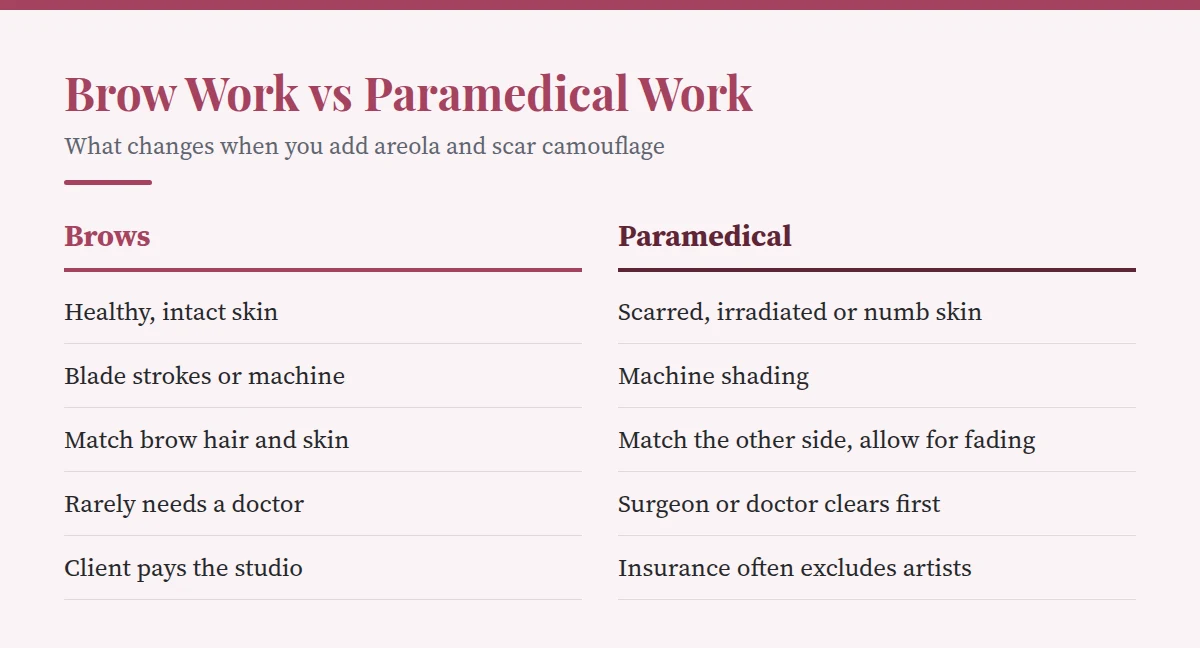
Plenty transfers: aseptic technique, bloodborne pathogen training, pigment handling, mapping for symmetry, and the discipline of judging your work on healed results rather than fresh photos. The differences are bigger than the overlap.
The tool. Areola and camouflage work is shaded with a machine, not drawn in strokes with a hand blade. If your training so far is blade-only, machine shading is the first skill to build, before any paramedical course.
The skin. A reconstructed breast may be an implant under thinned skin, tissue moved from elsewhere on the body, or skin that has been through radiotherapy. A 2019 review of medical tattooing in the head and neck lists unpredictable outcomes in scarred tissue among the technique’s main limitations. In a 97-patient Italian series, a history of radiotherapy was a statistically significant risk factor for needing the areola re-tattooed, while reconstruction with the patient’s own tissue was protective. The NHS leaflet adds two risks no brow client faces: flattening of a reconstructed nipple, and damage to a breast implant.
The feedback. Brow clients tell you, one way or another, when you are working too deep. Loss of sensation is common after breast reconstruction, and many clients feel little or nothing during the session. Depth has to come from your hands and your reading of the skin, not from the client’s reaction.
The colour. An areola has to match a living reference, the other breast, or a believable natural tone when both are gone, and the match keeps moving after the client leaves. A Stony Brook study of 71 photographs found tattooed areolas lose colour and definition over time, drifting toward the patient’s own skin tone before levelling off, and the authors suggest choosing pigments that anticipate the drift. A prospective Japanese study of 60 tattooed areolas found fading still under way between six and twelve months, by which point the tattooed side was 9% brighter than the natural one.
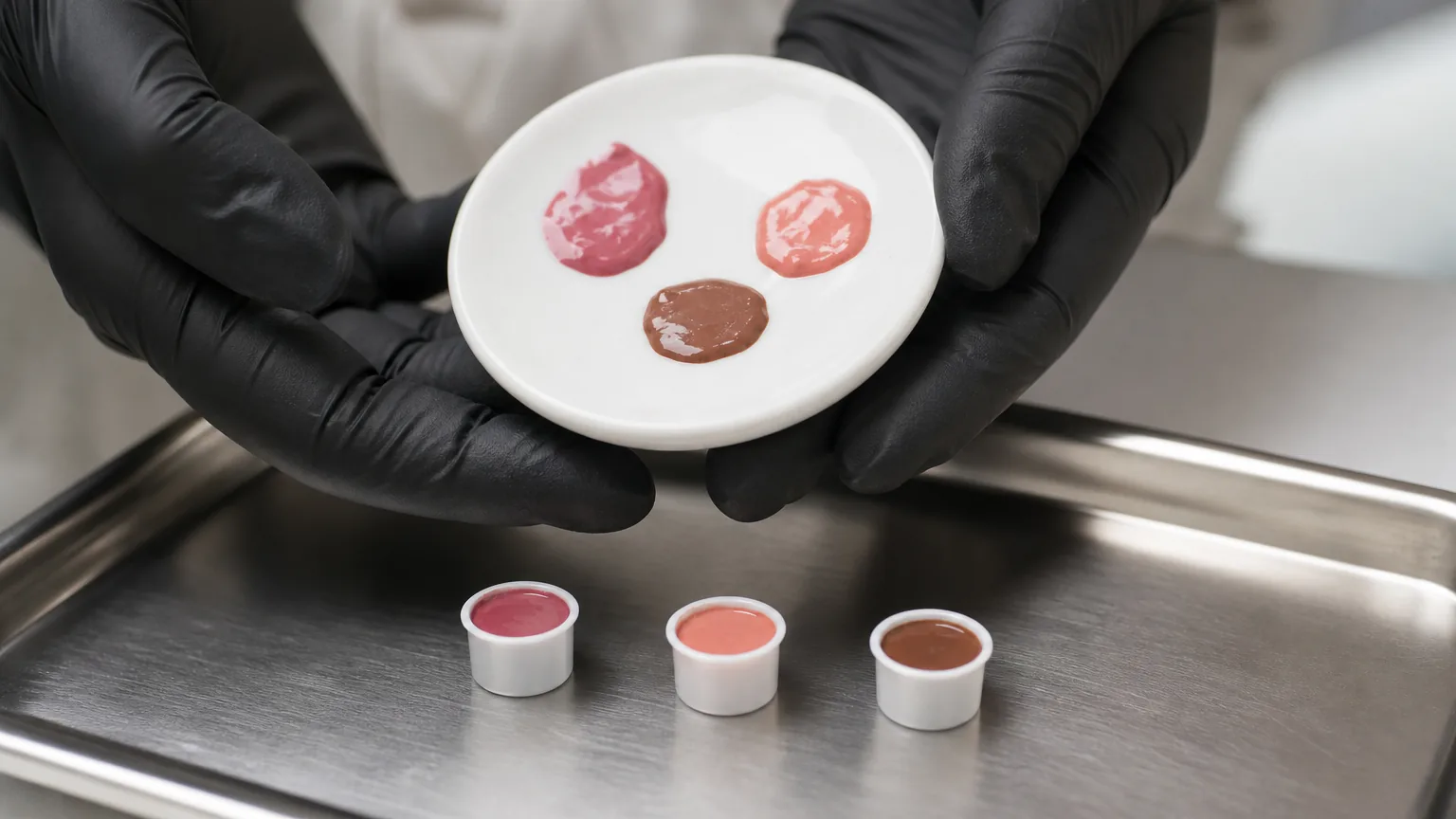
Areola palettes lean heavily on pinks, roses and warm browns, the shade family whose organic red colourants cause most permanent makeup allergies, which is why a clean patch test is reassurance rather than a guarantee. Patch test every client regardless, well ahead of the appointment.
Scar camouflage has its own colour trap. Skin-tone pigment does not tan, so a match made in winter can stand out by August. The flesh-coloured, titanium-rich pigments it relies on are also the ones that can turn dark when someone later lasers them, as our guide to laser removal of brow pigment explains. On stretch marks, a chapter in Current Problems in Dermatology notes that tattooing can correct the colour of striae but not their texture, so the ridges stay. Early striae are red, swollen and still changing; pigment is for the mature, white stage.
The scalp. Scalp micropigmentation is its own technique with its own needles and depth. In a ten-patient series in the Journal of Cosmetic Dermatology, satisfaction was high, but scarred scalps had faded noticeably more than thinning ones by six months. For brow clients with alopecia, the active-versus-stable question in our guide to microblading for medical brow loss comes before anything else. A trade feature on alopecia work makes the same point from the artist’s chair: the condition can change skin texture and pigment retention, so the approach has to be tailored.
Training and Certification: What Exists
There is no national paramedical license in the United States, and a two-day areola course is an introduction rather than a qualification. The clearest voluntary benchmark is the Society of Permanent Cosmetic Professionals’ Certified Paramedical Tattoo Professional (CPTP) credential. It asks for 100 hours of tattoo or permanent cosmetics education that includes designated paramedical hours, or, for current CPCP holders, an additional 20 hours dedicated to paramedical education, plus a current bloodborne pathogens certificate. The exam is 100 questions in 90 minutes with an 81% pass mark. Renewal every two years requires 12 hours of continuing education, at least four of them on paramedical services.
Some states write the specialism into law. New Jersey’s permanent cosmetics rules require at least 16 hours of areola restoration training before a practitioner performs it. Camouflage asks for more: six months of full-time permanent cosmetics experience plus a 16-hour camouflage course. The studio must also tell the local health authority that it offers those disciplines and name the practitioners who will perform them. Ask your own state or county health department what applies before you pay for a course, and confirm that your body art license covers work on a surgical site.
The research community is blunt about the gap. The 2021 review calls for formal curricula and systematic practical training whoever performs the work, and a 2024 interview study of 22 tattoo artists who work with cancer survivors concluded that better training is needed for artists and healthcare providers alike. Plan for a course, then supervised cases with a mentor, then a slow build of healed results photographed at six and twelve months.
Clearance, Timing and a Different Consent Form
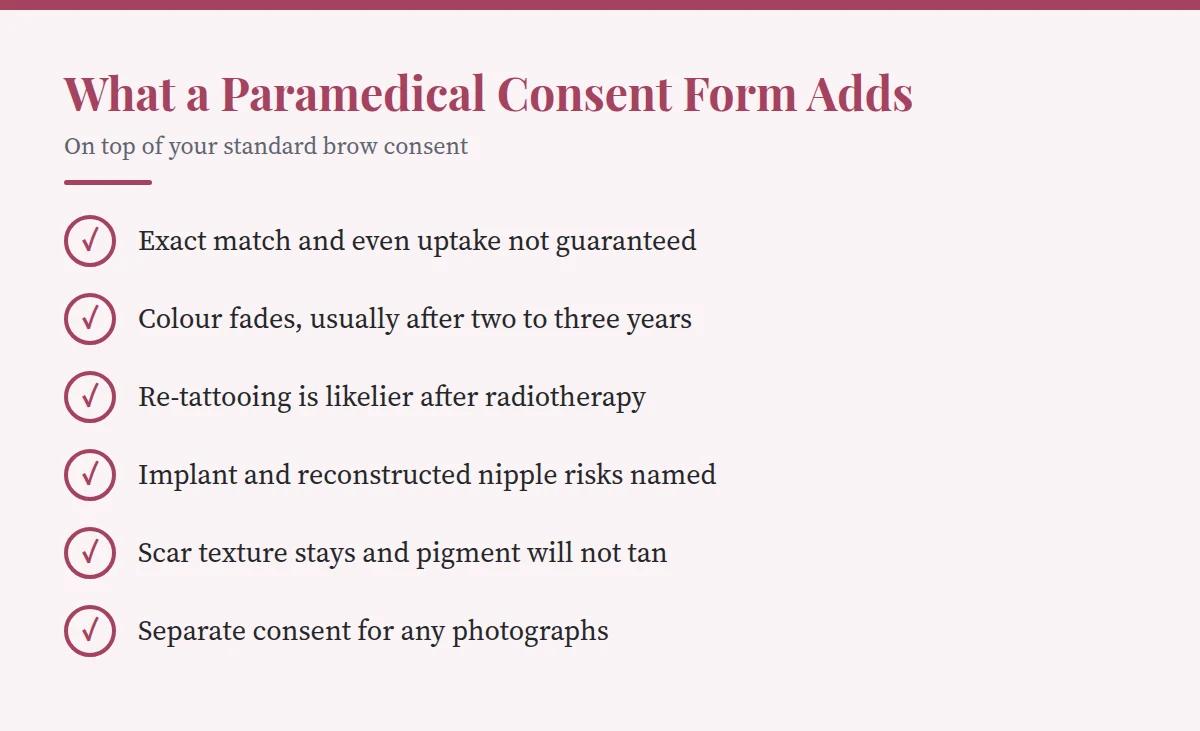
Brow consultations rarely need a doctor’s input. Paramedical ones usually should. The NHS trust’s leaflet tells patients who have had a nipple rebuilt to wait at least three months before micropigmentation, and those choosing a 3D-style tattoo instead to wait at least six months after breast reconstruction, breast-conserving surgery or radiotherapy. Ask for written clearance from the surgeon that reconstruction is complete and healed, and from the radiation oncologist if the area was treated. A camouflage candidate’s scar should be mature, flat and pale. Anything raised, red or still growing is a question for a dermatologist, and a history of keloids is a reason to refer rather than to test. Clients who have been through chemotherapy bring the additional questions covered in our guide to microblading after chemo.
Your brow consent form will not stretch to cover this. Add what the NHS leaflet warns its own patients: an exact match may not be possible, pigment can take unevenly or be rejected, and the colour fades over time, usually after two or three years. Add the higher re-tattooing rate after radiotherapy, the implant and nipple risks, and for camouflage, that texture will not change and the pigment will not tan. Photographs need their own consent, separate from treatment, stating exactly who will see them. A breast photograph in a portfolio is a much bigger decision than a brow photograph, and many clients will say no.
Building Referral Routes
Paramedical clients rarely find you through brow marketing. They arrive through breast and plastic surgeons, breast care nurses and nurse navigators, cancer support charities, dermatologists and, for alopecia, trichologists. One trichologist interviewed in the trade press put the advice simply: if you have a local trichologist, connect.
Clinicians refer to people who make them look careful. Bring healed photographs at six and twelve months rather than fresh ones, your credentials, your infection control protocol, and copies of your clearance request and consent form. Send the referrer a short note after each case. The authors of the 2024 interview study call for greater collaboration between healthcare providers and tattoo artists, and that collaboration is earned slowly, one well-documented case at a time. Start with one practice and do it properly before approaching ten.

Insurance and Who Pays
Check your own policy first. Liability cover written for brows may not name areola restoration or scar camouflage, and discovering that after a complaint is the expensive way to find out. Get the insurer’s confirmation in writing before your first paramedical client.
Then be straight with clients about theirs. The federal Women’s Health and Cancer Rights Act requires group health plans that cover mastectomies to cover “all stages of reconstruction,” but the Department of Labor’s own guide to the law never mentions nipple or areola tattooing, and whether an artist’s work qualifies varies by plan and by state. New York’s 2024 law mandates coverage only when a licensed physician or another licensed health care practitioner acting within their scope does the tattooing, which leaves tattoo artists out. The Missouri reporting found that some states require a doctor’s referral, some make patients pay up front and claim it back, and artist-performed tattoos often are not covered at all. Give clients an itemised receipt they can submit, and never promise reimbursement.
Pricing the Work, Including the Work You Give Away
Prices vary widely by market. In the Missouri story, a bilateral set of realistic areola tattoos from a medical tattoo artist cost $600 to $800. Whatever your number, build it from time rather than from your brow menu. A paramedical case carries a longer consultation, clearance letters, a longer session and, given how often areolas fade or need re-tattooing after radiotherapy, a probable second session.
Pro bono work deserves the same discipline. A year of free areola tattooing is generous, and it is also a year of consumables, appointment hours and touch-ups. Decide how many free slots you can sustain each month, write down who qualifies and how they are referred, and include the touch-up in the offer, because a free first session followed by a paid correction is not the gift it was meant to be. Partnering with a cancer support charity that screens clients and helps cover materials is one way to hold free work to exactly the same clinical standard as paid work.
The Emotional Load Nobody Quotes For
No price list includes it. In the 2024 interview study, the emotional management of artists emerged as a theme in its own right, and the authors concluded that therapeutic tattooing can be harmful as well as helpful, for the survivors and for the artists doing it. A 2026 systematic review of 16 studies, covering more than 747 tattooed cancer survivors, found the same mix of positive and negative outcomes on the client side.
In practice it looks like this. A client may be looking properly at their reconstructed chest for the first time while lying on your table. Alopecia clients, as one veteran UK artist told the same trade magazine, often arrive carrying years of self-doubt. You will hear about diagnoses, marriages and children, and some clients you grow close to will have a recurrence. Book longer appointments than the work strictly needs, cap the number of paramedical cases you take each week, and find someone to debrief with, whether a mentor or a peer group, rather than carrying every story home alone.
Paramedical work is worth doing well, and only worth doing well. Results vary significantly with the artist’s skill and the client’s skin, the pigment is semi-permanent and will fade, and an unlicensed or undertrained practitioner working on post-surgical skin is a real safety risk. Send any client with eczema, rosacea or another active skin condition in the area to a dermatologist before booking. Build the training, the paperwork and the referral relationships before the first client, and the specialism can become the most meaningful part of your practice rather than the most stressful.
Sources
- Becker and Cassisi on patient satisfaction across medical tattooing applications
- Yamamoto and colleagues for how tattooed areolas keep fading through the first year
- Levites and colleagues with a model of areola tattoo colour drifting toward skin tone
- Lusetti and colleagues on radiotherapy as a risk factor for areola re-tattooing
- Hou and Lee for the limits of medical tattooing on scarred tissue
- Määttä on what tattooing can and cannot change in stretch marks
- Liu and colleagues with a ten-patient scalp micropigmentation series
- Daly, Karl and Dunne on tattoo artists’ experience of working with cancer survivors
- Daly and colleagues for a systematic review of therapeutic tattooing outcomes for survivors
- SPCP covering the eligibility, exam and renewal rules for the CPTP credential
- New Jersey Department of Health with the state’s training rules for areola restoration and camouflage
- University Hospital Southampton NHS Foundation Trust on its patient leaflet for nipple and areola micropigmentation
- U.S. Department of Labor for what the Women’s Health and Cancer Rights Act requires plans to cover
- New York State Senate with the 2024 bill text limiting areola tattoo coverage to licensed practitioners
- KCUR on a Missouri brow artist’s move into areola tattooing and the insurance gaps
- Professional Beauty for tailoring semi-permanent makeup to alopecia clients
- Northern News with an areola tattooing award and a year of free sessions