Light Patches Around Microbladed Brows: Hypopigmentation on Brown and Black Skin, and Whether the Colour Comes Back
Published on October 15, 2026

Most of what gets written about microblading on deeper skin warns about one direction: pigment that heals too dark, or dark marks where the skin was injured. This piece is about the other direction. A pale halo around the brow after saline or laser removal. Light specks where a scab came away too early. A paler band along the arch that only shows once the rest of your face has caught some sun. On brown and black skin these patches are hard to miss, and the first question is always the same: will the colour come back?
Usually it does. A light patch left behind by injury or inflammation is called post-inflammatory hypopigmentation, and a 2011 review of the condition says most cases improve on their own within weeks or months once the cause has stopped. The exception is skin where the pigment cells were destroyed outright, which can stay pale for good. This guide covers how brow work causes light patches, why they stand out on deeper skin, what a Wood lamp exam shows, and how to tell which kind you have.
What a Light Patch Actually Is
Skin colour comes from melanocytes, pigment cells in the bottom layer of the epidermis that make melanin and pass it to the skin cells around them. A light patch means that supply has been interrupted. The American Academy of Dermatology (AAD) calls the result hypopigmentation, literally “less pigment,” and lists injuring your skin and cosmetic procedures such as laser treatments among the things that can slow pigment production down.
There are two very different versions. In one, the melanocytes are still there but making less melanin, or failing to hand it on. In the other, they have died. A 2023 review lists all three mechanisms (reduced production, blocked transfer and cell death) and suggests that people differ in how their pigment cells respond to injury: robust melanocytes tend to overproduce, which gives the familiar dark mark, while less robust ones are more easily damaged and leave a pale one. Which version you have decides the outcome. The 2011 review that says most cases improve within weeks or months also warns that the change can be permanent when the melanocytes are completely destroyed.
Nada Elbuluk, a dermatologist who founded the Skin of Color Center and Pigmentary Disorders Clinic at the University of Southern California, co-wrote a review making a point every client of colour should hear: the condition occurs in all skin tones but is more visible in skin of colour, and treatment options remain limited, partly because attention has gone to its darker counterpart.
Four Ways Brow Work Injures Pigment Cells
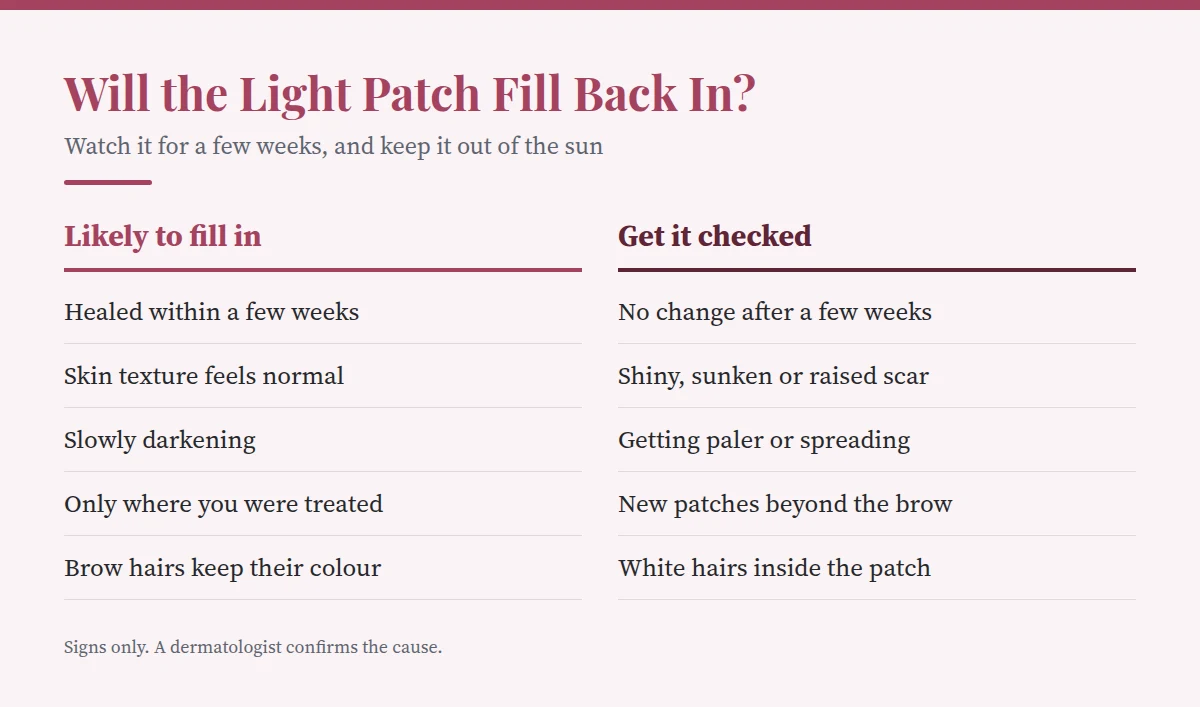
Strokes placed too deep. Microblading is meant to deposit pigment in the upper dermis. A heavy hand that cuts deeper causes more trauma and a longer, angrier healing phase, and it raises the chance of scarring. A pale line that also looks shiny, sunken or raised is more likely a scar than a simple loss of colour, and it deserves a dermatologist’s eye rather than more months of waiting.
Scabs pulled off early. A scab is a lid over a healing wound. Lifting it reopens the wound, takes pigment with it and keeps the skin inflamed for longer, and duration matters. The AAD’s guidance on light spots explains that a spot left by a wound or rash that heals within a few weeks tends to recover more quickly, while one left by a problem that lingers for a year or longer takes longer and may never fully return. Our day by day healing timeline shows why the itch peaks around day four, exactly when the scab is loose enough to come away.
Saline removal. Saline removal tattoos a concentrated salt solution over the old strokes, creating a controlled wound that draws pigment up and out as it scabs, as our guide to removing bad microblading describes. Every session wounds the same skin again, and studio saline removal has almost no published outcome data. The closest evidence covers older methods that also lighten a tattoo by injuring the skin, including salabrasion (rubbing it with salt). A 2023 review concluded that none of these non-laser methods gives satisfactory cosmetic results, because of scarring and dyspigmentation. The FDA describes wound-based methods such as dermabrasion the same way: they injure the skin above and around the pigment, results are highly variable, and the potential for scarring is greater. Some studio removers use acid rather than salt, and a German dermatologist who documented depigmentation and thickened scars after a lactic acid tattoo eraser concluded the safety data were too thin to recommend it.
Laser removal. A tattoo laser works because pigment absorbs its light, but melanin absorbs light too. In Fitzpatrick skin types IV to VI, a 2026 clinical review explains, the skin’s own melanin competes with the ink for that energy, raising the risk of hypopigmentation alongside dark marks, blisters and scarring. The review favours low-fluence Nd:YAG lasers, Q-switched or picosecond, for tattoo removal on deeper skin, delivered as a sequence of gentler sessions with strict sun protection before and after. Wavelength matters: an older review of tattoo lasers reported temporary hypopigmentation in up to half of patients treated with the Q-switched alexandrite, and much less with the Nd:YAG than with the ruby. Laser-induced patches also have a giveaway, pale spots that match the size and shape of the laser spot. The FDA’s consumer page says plainly that laser removal can leave skin lighter than the skin around it, and our comparison of Q-switched, ruby and picosecond lasers explains which wavelength suits which pigment.
Why It Shows More on Brown and Black Skin
The AAD’s guidance for people with brown or black skin starts from the obvious: anyone can develop light spots, but they are more noticeable against a deeper skin tone. A few millimetres of lost colour that vanish into fair skin draw a clear outline on deep brown skin, and brows sit in the middle of the face. Summer widens the gap, because the surrounding skin darkens in the sun while a patch with few working melanocytes cannot keep up.
On deeper skin, an injury can push pigment either way. The dark marks that clients of colour are usually warned about, covered in our guide to microblading on dark and deeper skin tones, and the light patches covered here are two outcomes of the same thing, pigment cells reacting to an injury. Hands-off healing protects against both.
The evidence is thinner for you, too. The 2026 laser review lists the lack of large trials in darker skin types as a gap, and a 2025 Polish study of eyebrow permanent makeup removal enrolled only women with Fitzpatrick skin types I to III.
Not Every Light Patch Comes From the Brow Work

A pale patch near fresh or removed brows is easy to blame on the procedure, but several conditions produce the same look, and some of them need treatment rather than patience.
- Vitiligo. The immune system destroys melanocytes, leaving fully white patches, and DermNet notes that vitiligo favours sites of injury, a response called the Koebner phenomenon. Dermatologists in Edinburgh have published a case of koebnerization triggered by microblading. The warning signs are a patch that spreads beyond where you were treated, new patches elsewhere on the face or hands, and brow hairs turning white inside the patch.
- Chemical leukoderma. An allergic reaction can be followed weeks to months later by pigment loss, a route covered in our piece on red and warm pigment reactions.
- Skin conditions. The AAD lists seborrheic dermatitis, tinea versicolor, psoriasis, eczema and lupus among the causes of light spots on brown and black skin. Seborrheic dermatitis deserves a look here, because the eyebrows are one of its usual sites.
- Medication. Some medications can lighten the skin, which is why the AAD tells patients to know the names of everything they take or apply, over-the-counter acne gels included. Steroid injections for a pigment granuloma can lighten the skin as well, and the 2023 review notes that steroid-induced lightening can take up to four months to appear.
What a Wood Lamp Exam Shows
A Wood lamp is a handheld ultraviolet lamp, and the exam is quick and painless. MedlinePlus describes it simply: you sit in a dark room while the dermatologist holds the lamp 4 to 5 inches from your skin and looks for colour changes. DermNet adds that you may be asked to close your eyes while your face is examined, and that the lamp does not give off the ultraviolet B wavelengths that cause sunburn. Ask beforehand whether to leave the area bare, because makeup, moisturiser, soaps and deodorants can glow under the lamp and blur the result, and freshly washed skin can produce a false negative.
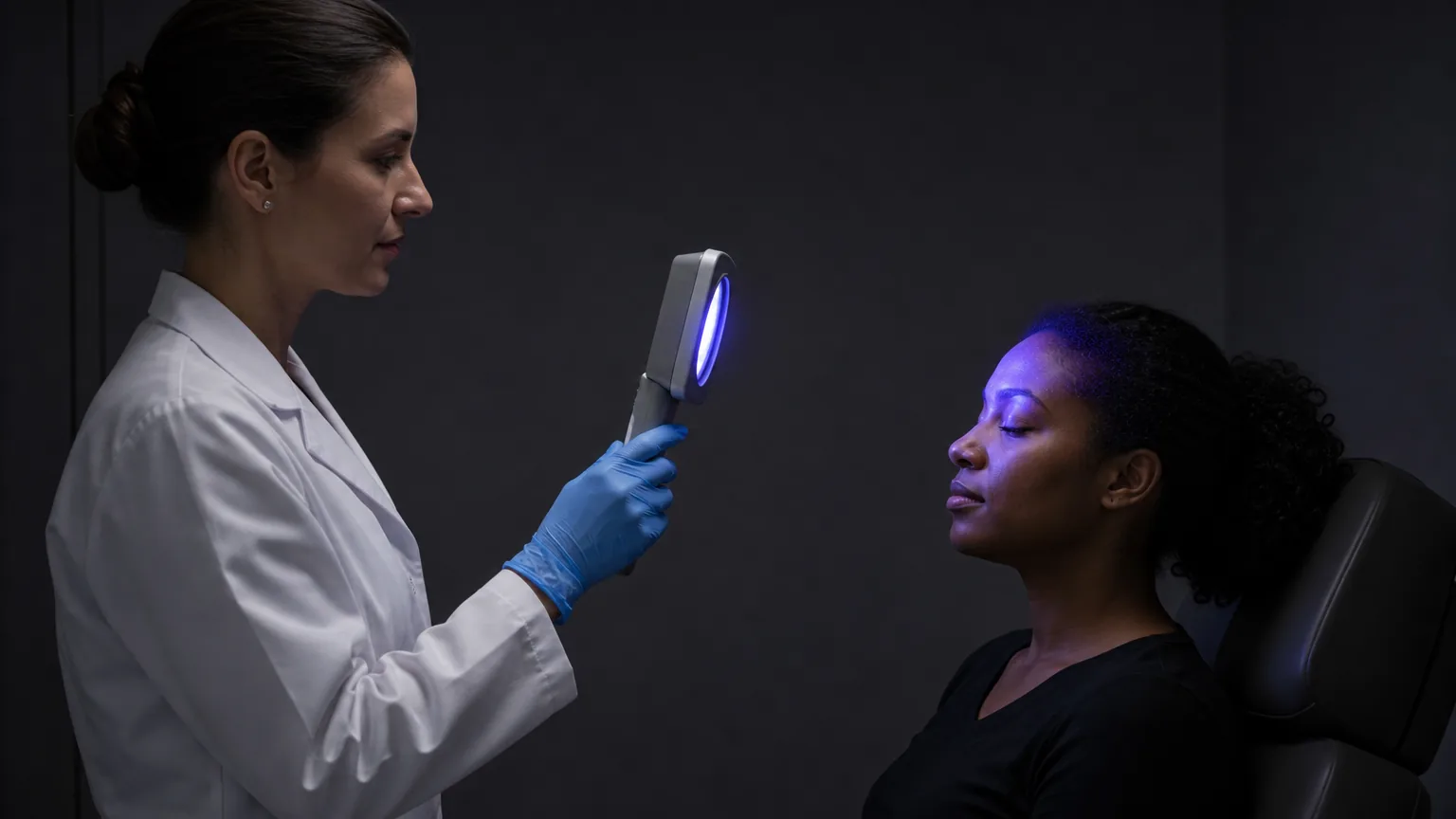
The lamp exaggerates differences in melanin, so white patches stand out far more sharply than they do in daylight. That lets a dermatologist separate complete loss of pigment from partial loss, which a 2026 diagnostic review of hypopigmented disorders puts first in the workup. Complete loss points toward vitiligo or destroyed melanocytes. Partial loss suggests some pigment cells are still working, which is the better news. The lamp also shows up fungal infections such as tinea versicolor, one of the lookalikes above. It is one clue rather than the whole answer, so expect questions about timing, products and patches elsewhere too.
Will the Colour Come Back?
The AAD’s advice on light spots, given by Elbuluk, comes down to three steps.
- Watch it for a few weeks. Look for darkening, for new or paler patches, or for no change at all. After a wound, the body works to make more pigment, and if the skin healed within a few weeks you will often see some darkening within a few more.
- Protect it from the sun. A patch that is starting to make pigment can overshoot in sunlight and turn into a dark spot. Cover up and stay in the shade, and where clothing cannot reach, use a broad-spectrum, water-resistant sunscreen of SPF 30 or higher, reapplied every two hours. On a brow that is still healing, rely on shade and a wide-brimmed hat until the skin has closed, then add sunscreen.
- Do not treat it yourself. There is no single treatment for light spots, the right one depends on the cause, and sometimes the best approach is to let your natural colour return on its own.

If you see new or worsening light spots, or no change after a few weeks, the AAD’s advice is to see a board-certified dermatologist, and its Find a Dermatologist search lets you filter for a practice focus in skin of colour. If the diagnosis turns out to be vitiligo, DermNet notes that returning colour usually starts as brown dots around the hair follicles, which hold a reserve of pigment cells, and can also creep in from the edges of the patch. White hairs inside a patch predict a poorer response to treatment, because that reserve has gone.
When the Colour Stays Away
Patches that are scarred, fully depigmented or still unchanged after many months are much less likely to fill in alone, but they are not untreatable. The 2023 review sets out the range. At one end sit silicone sheeting and massage, cheap but poorly supported by evidence. At the other is melanocyte-keratinocyte transplantation, a costly surgical technique that moves pigment cells into the patch and that very few centres offer. In between come laser treatments, grafting, microneedling and medical tattooing. Light therapy has shown promise too: in published reports, narrowband UVB and the excimer laser have each reversed hypopigmentation caused by Q-switched lasers.
Be careful with tattooing skin-tone pigment over the patch. Camouflage tattoos often fail to match, and a review of tattoo complications names colour mismatch and patient dissatisfaction as common problems when tattooing is used that way. Flesh-toned pigment has a second trap: the FDA warns that flesh-coloured and white pigments can turn black under a laser, after which the oxidised pigment can no longer be treated by laser. Get a diagnosis first and treat camouflage tattooing as a last resort. Makeup is the reversible way to even out a patch while you wait.
Weighing Removal on Brown or Black Skin
If you are still deciding, the light patch is a risk you can plan around.
- Ask for the wavelength by name. For dark pigment on deeper skin, that usually means an Nd:YAG at 1064 nm, run at conservative settings over more sessions.
- Insist on a test spot, and judge it only after it has fully healed, looking at the skin around the pigment as well as the pigment itself.
- Ask to see healed results on skin like yours, months after the final session, not the day after.
- For saline, ask how many sessions are planned and how far apart. Each one wounds the same skin, and spacing is what lets it recover.
- Keep the area out of the sun before and after. The 2026 review treats strict sun protection as part of safe laser work on deeper skin.
- Read the consent form for hypopigmentation and scarring, and ask what happens if a pale patch appears.
If the shape is fine and only the colour is wrong, also ask whether colour correction could fix it with fewer sessions on the same skin.
The Bottom Line
A light patch around your brows is usually pigment cells that have slowed down rather than disappeared, and with time, sun protection and hands off, most fill back in over weeks to months. The ones to take to a board-certified dermatologist, ideally one who sees a lot of skin of colour, are patches that are scarred, stark white, spreading, appearing in new places or unchanged after a few weeks.
If you are planning new brows or a removal course on brown or black skin, choose a licensed artist or a medically supervised clinic with healed results on skin like yours. Insist on a patch test before any pigment and a test spot before any removal, and remember that results vary with the practitioner’s skill and your skin type. Microblading is semi-permanent, not permanent, but a pale patch can outlast the pigment by years, which is why prevention is worth more than any fix. If you have eczema, rosacea or another skin condition around the brows, see a dermatologist before either procedure.
Sources
- American Academy of Dermatology on why light spots appear on brown and black skin, and when colour returns
- Vachiramon and Thadanipon reviewing postinflammatory hypopigmentation and when it becomes permanent
- Madu, Syder and Elbuluk with a review of treatments for postinflammatory hypopigmentation
- Rao and colleagues on the causes of hypopigmentation, from lasers to steroids, and how it is treated
- Dash and colleagues reviewing non-laser tattoo removal methods, salabrasion included
- Wollina for depigmentation and scarring after a lactic acid tattoo eraser
- Dreifus and colleagues on laser safety in Fitzpatrick skin types IV to VI
- Kuperman-Beade, Levine and Ashinoff comparing hypopigmentation after ruby, alexandrite and Nd:YAG tattoo lasers
- FDA on laser and wound-based tattoo removal, lighter skin, and flesh-toned pigment
- Khunger and colleagues with tattoo removal complications and colour mismatch in camouflage tattoos
- Pióro, Antoszewski and Kasielska-Trojan studying quality of life after eyebrow permanent makeup removal
- Tierney and Kavanagh reporting koebnerization triggered by microblading
- DermNet on vitiligo, the Koebner phenomenon and repigmentation from hair follicles
- DermNet for how a Wood lamp skin examination is done
- MedlinePlus describing what happens during a Wood lamp examination
- MedlinePlus on where seborrheic dermatitis appears, eyebrows included
- Ju and Bae on using a Wood lamp to separate complete pigment loss from partial