Microblading With Keloid-Prone Skin: Who Scars, Why a Test Stroke Matters, and the Gentler Options
Published on October 30, 2026

If an ear piercing once swelled into a firm lump that outgrew the hole, or a surgical scar kept spreading long after the stitches came out, you have probably been told you are keloid-prone. On a microblading health form that history usually gets one tick box, and the response it gets back ranges from a shrug to a flat refusal. The evidence sits in between. The brow is not a place where keloids tend to form, which is good news, but a brow tattoo is still hundreds of small wounds, and raised scarring after brow pigment has made it into the medical literature. This guide covers which kind of raised scar you may have had, who forms keloids, where the brow sits on the risk map, how a test stroke works and why it needs months rather than weeks, and the gentler routes to fuller brows. A dermatologist should see your old scars before anyone picks up a blade.
Keloid or Hypertrophic Scar: Which One Did You Have?
Not every raised scar is a keloid, and the difference changes how careful you need to be.
A hypertrophic scar is the more forgiving kind. The American Academy of Dermatology (AAD) explains that it appears one to two months after the injury, stays within the wound, and often becomes less noticeable with time. A keloid behaves differently. Months can pass before it shows, it then grows slowly for months or years, and it does not fade on its own. Japanese scar specialists draw the same line in their consensus guidance: hypertrophic scars do not grow outside the area of the original wound, while keloids spread sideways past its border. Shape varies with the site. On an earlobe a keloid tends to form a round, solid lump, while on the chest or shoulder it spreads out across the skin like a spilled liquid that has set hard.
People mix the two up all the time. In a US study of 40 keloid-prone patients, a short educational talk measurably improved their understanding that not every raised scar is a keloid, and that some parts of the body are far more prone than others. If you are unsure which you had, show the old scar to a dermatologist before you book anything. Both histories belong on your intake form. A keloid history is the stronger warning, but the one published case of brow scarring described below was a hypertrophic scar.
Who Forms Keloids
Keloids reflect a tendency you carry rather than a one-off accident. People of every background get them, but the AAD reports that Black people have the greatest risk, and that people of Asian, Latin American or Mediterranean descent are more likely to form them than people with lighter skin. Between a third and a half of people with a keloid have at least one blood relative who gets them. MedlinePlus adds that keloids are most common in people younger than 30, and the Japanese consensus notes that keloids and hypertrophic scars both tend to worsen in pregnancy and with high blood pressure. If you have deep skin, our guide to microblading on dark and deeper skin tones covers the pigment side of the plan.
Your own skin is the best evidence you have. The FDA’s tattoo safety advice is direct: if you tend to get keloids, you may develop the same kind of reaction to a tattoo. So before a consultation, take stock of every place your skin has been injured and how it healed. MedlinePlus lists acne, burns, chickenpox, ear and body piercings, minor scratches, cuts from surgery or injury, and vaccination sites among the triggers, and points out that some people cannot remember what started theirs. A careful artist will ask to see your old piercings and scars rather than relying on the box you ticked. Keloids are not the only skin history that changes a brow plan, either. Scleroderma and morphea harden the skin rather than overbuilding a scar, and they have their own guide to microblading with scleroderma.
Why the Brow Is Lower Risk, but Not Zero
Keloids favour particular places, and the brow is not one of them. A 2021 review pooled the published counts for the head and neck. In the studies that covered the whole region, 70 percent of 322 keloids were on the ear and another 6.5 percent were just around or behind it, while the beard area accounted for 5.6 percent. The scalp and forehead together made up 2.2 percent, and the central face just 0.3 percent, the lowest of any region. The authors concluded that this regional risk should be weighed before any elective procedure in someone prone to keloids. A 2024 study from a Tokyo plastic surgery department mapped the face and neck keloids of 113 patients and found them clustered near the angle of the jaw (41.3 percent) and to the side of the area under the chin (20 percent). The authors tied that pattern to how much the skin in those spots stretches and stiffens with everyday changes in posture. The brow sits at the lower edge of the forehead, in one of the quietest parts of that map.
Quiet is not empty, though. In 2020, plastic surgery researchers in São Paulo searched the medical literature for pathologic scarring of the eyebrows after micropigmentation and found no published reports at all. They then described their own case, a 50-year-old woman who developed hypertrophic scarring on her brows after the procedure. Their write-up notes that tattoo pigment can switch on the skin’s inflammatory response in a way that promotes abnormal scars, and concludes that brow micropigmentation may be a risk factor for pathologic scarring, with more research needed. A 2025 review of tattoo reactions comes at it from the other direction, singling out people with a predisposition to abnormal wound healing when it discusses hypertrophic scars and keloids. Even skin with no keloid history can scar when brows are overworked, a risk our microblading risks and contraindications guide covers in full.
Should Keloid-Prone Skin Be Tattooed at All?
Dermatologists do not all answer this the same way. The AAD’s prevention advice for keloid-prone people is blunt: tattoos and cosmetic procedures injure the skin, so a keloid can follow, and the surest prevention is to avoid body art and cosmetic procedures altogether. Nicolas Kluger, a dermatologist who has published widely on tattoo complications, draws the line elsewhere. In a chapter on contraindications for tattooing, he treats keloids as a strict contraindication for body piercing but not for professional tattooing, and notes that keloids in tattoos have been reported in specific situations, such as tattooed skin burned by badly performed laser hair removal, and traditional scarification.
Part of that gap is probably anatomy. Piercings mostly go through the ear, the single most keloid-prone place on the head, while a brow tattoo sits in one of the least. Neither source settles your case on its own. The decision belongs to you and a dermatologist who has examined your scars, and the AAD’s advice for people set on a procedure anyway is the template careful artists follow: start small, and watch.
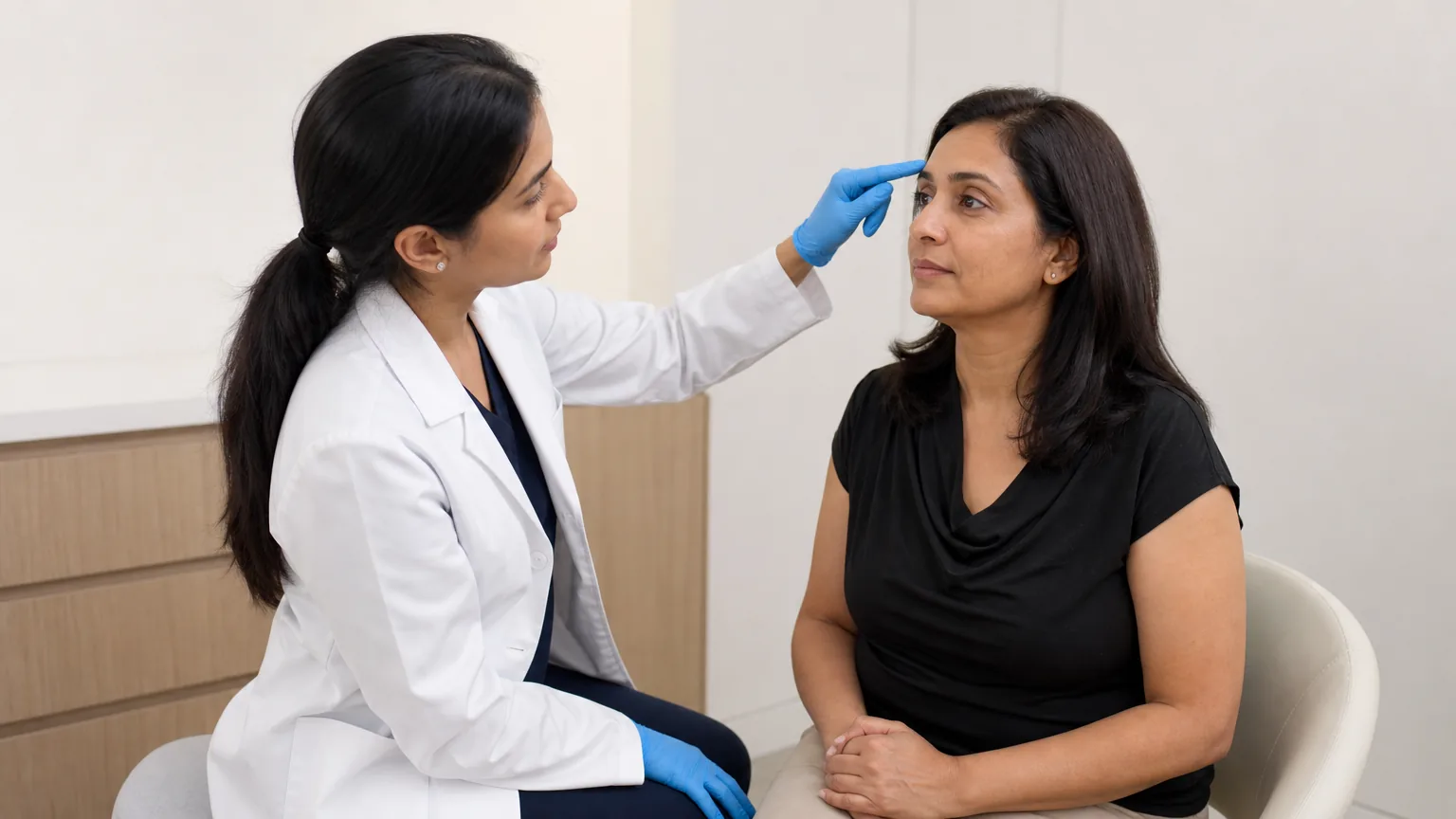
Some artists will still decline. For a business working on faces that is a reasonable policy rather than a judgement on your skin, and it beats an artist who never asked about scars at all.
The Test Stroke: Small, in the Right Place, and Watched for Months
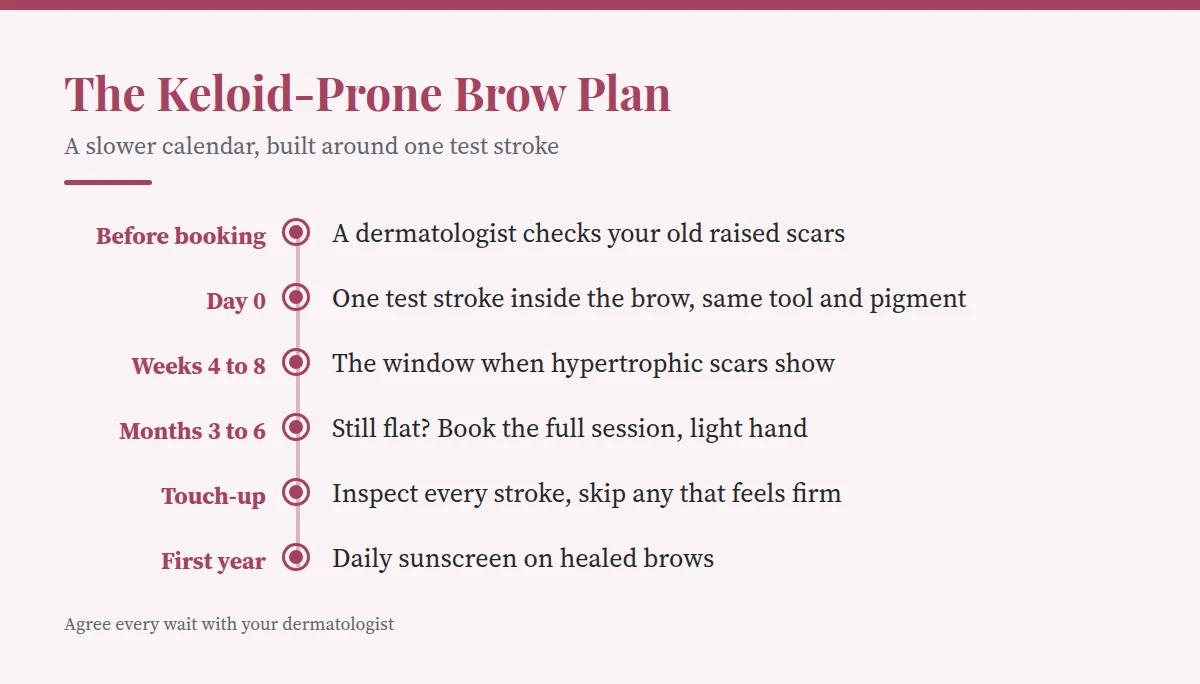
For keloid-prone people who still want a tattoo or cosmetic procedure, the AAD’s advice is to try a test spot first: start small and watch for thickening skin, which is the first sign of a keloid. It also suggests telling the dermatologist or doctor involved, who may recommend another option or a test spot of their own. For a brow, that means a test stroke, and four details decide whether it tells you anything.
Put it in the brow. Keloid risk depends heavily on where a wound sits, so test the skin you plan to treat: one or two strokes, or a small patch of shading, tucked into the fullest part of the brow where a mark will hide. The usual discreet patch test spot behind the ear is the wrong choice for anyone with a keloid history. In the head and neck review above, the ear and the skin around it accounted for roughly three quarters of all keloids, so a scratch there tests the riskiest skin on your head and tells you nothing about your brow.
Use the real thing. The test should use the tool, depth and pigment planned for the full brow, so it doubles as your pigment patch test. Keep the usual caveat in mind: a clean patch test is reassuring, not a guarantee against a pigment reaction later.
Wait months, not weeks. A standard patch test is read within days, and a touch-up follows four to eight weeks after the first session. Neither is long enough here, because hypertrophic scars take one to two months to appear and keloids can take longer. There is no published protocol for brow test strokes, so borrow the timescales dermatologists already use. The AAD’s advice for keloid-prone people after any skin injury is to use silicone gel or sheets for about six months, stopping if the wound has not grown by then, and MedlinePlus advises keeping a forming keloid covered from the sun for at least six months after an injury. As a rough guide, three months covers the window in which hypertrophic scars appear with room to spare, and six matches the AAD’s window. Agree the actual wait with your dermatologist, and photograph the test stroke every week in the same light so that slow change shows up.
Read a clean result honestly. A test stroke that stays flat lowers the odds; it does not remove them. A full brow is hundreds of strokes plus a touch-up, not one or two. Kluger, writing about test spots for a different reaction (the way psoriasis and some other skin diseases can flare at a site of injury), warns that the criteria for a pass are uncertain and that a negative result can be falsely reassuring. That caution carries over.
If the test stroke thickens, you have your answer for the full brow. The AAD says to act at the first sign: a dermatologist can start treatment such as pressure or steroid injections, and pressure only works if it begins as soon as the skin starts to thicken.
Machine Shading: Often the Gentler Route
If your dermatologist is comfortable and the test stays flat, technique still matters. Classic microblading uses a hand tool fitted with a blade of tiny stacked needles, and a review of the procedure in a dermatology journal describes the result as crisp, discrete, hair-like incisions. Powder or ombre brows, also called micro-shading, use a motorised machine to place fine dots that build into a soft, powdered look.
That difference is why many artists steer scar-prone clients toward machine shading. A scatter of fine dots is a different wound from a row of cut lines, and shading can be laid down lightly and built up over sessions rather than packed in at once. Machine hairstrokes, often sold as nano brows, are the middle path for anyone set on a strand-by-strand look. Two cautions keep this honest. No study has compared raised scars after blade strokes and machine shading, so this is reasoning from the shape of the wound rather than proof. And the pigment is the same pigment: if the inflammation it provokes helps drive a scar, as the São Paulo authors suggest, a gentler tool shrinks the injury but not that.
Whatever the tool, the artist’s hand counts as much: a light touch, as few passes as the result allows, and no reworking of a stroke that is not taking.
There is also the option of not breaking the skin at all. Brow pencil, powder and tinted gel carry no scar risk, and they are the obvious way to fill in your brows while a test stroke is under watch. Lamination and tinting do not cut the skin either, though tints can trigger allergies of their own and deserve a patch test first. If your dermatologist advises against tattooing, these are not a consolation prize. For plenty of keloid-prone people they are simply the answer.
After the Session: Use the Touch-Up as a Check
Early healing has its own raised phase. Puffy, tender strokes are normal for a day or two, and a thin scab then forms and flakes away over the days that follow. That is ordinary, and our day-by-day healing timeline shows what each week should look like. What is not ordinary is a stroke that is still raised once the flaking has finished, or one that turns firm, itchy, tender or shiny weeks later.
The touch-up lands squarely in the window when a hypertrophic scar first shows itself, so treat the appointment as an inspection as well as a top-up. Ask the artist to look at every stroke in good light and run a fingertip along the brow before any pigment goes back in, and to leave alone any stroke that feels firm, raised or ridged. That stroke needs a dermatologist, not another pass. If you would like more time, ask whether the touch-up can wait a few weeks longer. A later touch-up costs little, and re-wounding a stroke that has started to thicken could cost a lot.
Not every lump is a scar. Granulomas and allergic reactions to pigment produce firm bumps along the strokes too, often months or years later, and our guide to bumps, lumps and granulomas after microblading explains how dermatologists tell them apart, often with a small biopsy. Whatever the cause, a raised stroke deserves a prompt appointment rather than a wait-and-see.
Once the brows have healed, protect them from the sun every day. MedlinePlus notes that a keloid exposed to the sun during its first year tans darker than the skin around it, and that the darker colour may not go away. The same habit protects the pigment.

If you ever want the pigment gone, removal is another injury, so plan it with a dermatologist. The numbers are reassuring for most people: in a chart review of 1,041 patients who had at least five sessions with a Q-switched laser, three developed hypertrophic scarring and none developed keloids. That was a general group of tattoo removal patients, though, not one chosen for keloid-prone skin.
Questions to Settle Before You Book
For your dermatologist:
- Was my old raised scar a keloid or a hypertrophic scar?
- Is a brow test stroke reasonable for me, and how long should we watch it?
- Is anything else in my history, such as pregnancy plans or another skin condition, a reason to wait?
- If a stroke starts to thicken, what would you do, and how quickly can I be seen?
For your artist:
- Will you place the test stroke inside the brow, with the same tool and pigment as the full session?
- Do you offer machine shading or machine hairstrokes, and which would you choose for my skin?
- Will you inspect every stroke before the touch-up and skip any that feels firm?
- Can I see your state or local licence?
Keloid-prone skin is a reason for a slower plan, not automatically a reason to go without. Microblading is semi-permanent, results vary with the artist’s skill and your skin as much as with any technique, and it is a regulated procedure, so an unlicensed practitioner is a risk no test stroke can offset. The clients who do well are usually the ones who disclosed everything, tested in the right place, waited long enough to learn something, and chose the gentlest technique that still gives them the brows they want.
Sources
- American Academy of Dermatology on what keloids are, who gets them, and how they differ from hypertrophic scars
- American Academy of Dermatology for preventing keloids, including a test spot before a tattoo or cosmetic procedure
- MedlinePlus with keloid triggers, risk factors and sun protection
- FDA on tattoo safety, including keloids in people prone to them
- Ogawa and colleagues for the Japan Scar Workshop consensus on keloids and hypertrophic scars
- Lee and colleagues on what keloid-prone patients know about prevention
- Wang, Fort and Hom with where keloids form on the head and neck
- Cho and colleagues on face and neck keloid distribution and skin mechanics
- Motoki, Isoldi and Ferreira for hypertrophic scarring after eyebrow micropigmentation, with a systematic review
- Mohammodu and colleagues on tattoo reactions, including scarring in people prone to it
- Nicolas Kluger with contraindications for tattooing, from keloids to test spots
- Marwah and colleagues for how microblading and micro-shading place pigment
- Kirby and colleagues on scarring after Q-switched laser tattoo removal