Q-Switched, Ruby, or Picosecond: Which Laser Clears Microblading Pigment, and How Many Sessions It Takes
Published on September 23, 2026
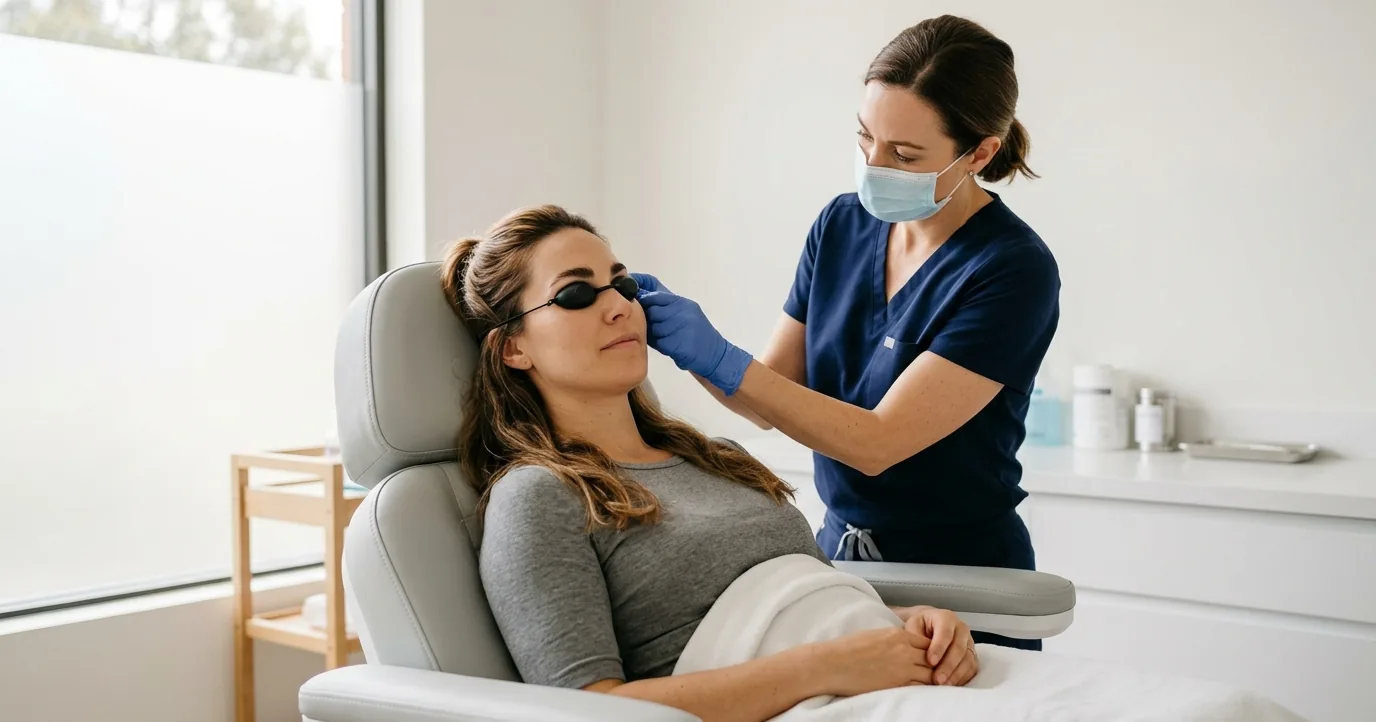
You have two quotes. One clinic advertises a picosecond laser and charges more per visit. The other uses a Q-switched Nd:YAG, the older workhorse, and costs less. The natural assumption is that the newer machine will clear your old microblading in fewer sessions. The clinical literature on cosmetic tattoos does not really back that up. It points at three things that matter more: the wavelength, the pigment actually sitting in your brows, and the person setting the dials.
This guide assumes you have already chosen laser. If you are still weighing it against saline or colour correction, start with our overview of how to remove bad microblading. What follows is the device-level detail: what pulse length changes, which wavelength suits which colour, why brow pigment misbehaves under a laser, and how many sessions the published cases took.
Nanosecond or Picosecond: What the Pulse Length Changes
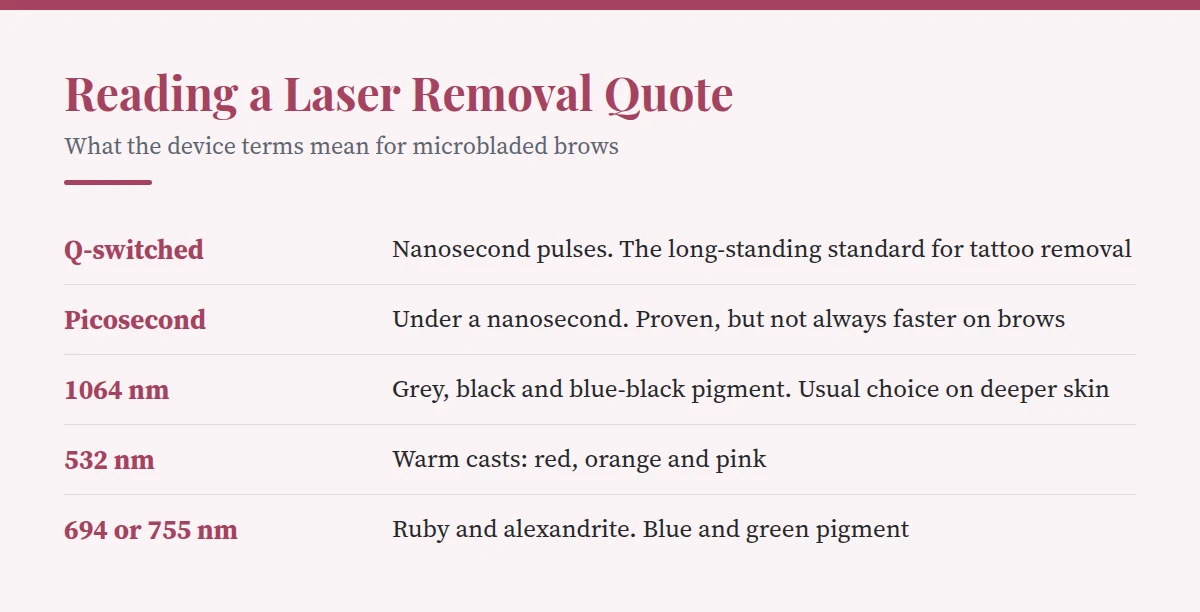
Every tattoo laser works the same way. It fires light at a wavelength the pigment absorbs and the surrounding skin mostly does not, in a pulse brief enough to shatter the particle before heat spreads into the tissue around it. A 2017 review of laser tattoo removal sums up the requirement: high energy, delivered in short pulses. Your immune system then carries the fragments off over the following weeks.
The two families differ in how brief. A Q-switched laser fires pulses measured in nanoseconds, billionths of a second. A picosecond laser’s pulses are shorter than a nanosecond and lean more on a mechanical shock wave than on heat, which is why they are described as breaking ink into finer fragments. That they work is not in doubt: a systematic review of 77 studies rated the evidence for picosecond tattoo removal at level I, the top tier.
Whether they beat a well-run Q-switched laser on brows is another matter. A stepwise guide from an Austrian private practice, noting that eyebrows are the largest group of cosmetic tattoo removals, still calls the Q-switched Nd:YAG the gold standard, and says modern picosecond lasers are referenced to it and “essentially do the same job.”
The cosmetic outcomes support both. An Italian case series used a Q-switched Nd:YAG on 20 people with lip, brow and eyeliner tattoos and reported complete removal in every case, with side effects that were mostly passing redness. A chart review of 33 patients with facial cosmetic tattoos treated by picosecond laser found an average of three sessions to a satisfactory result, with two thirds 76 to 100% cleared and the rest 51 to 75%. Different clinics, patients and definitions of success mean these cannot be read as a race. Both pulse lengths clear cosmetic pigment. Which clears yours faster depends on what follows.
Your Brow’s Colour Picks the Wavelength
Pulse length gets the marketing, but wavelength does most of the work, because a laser can only shatter pigment that absorbs its light. The FDA’s consumer guidance says the type of laser depends on the tattoo’s colours, that multicoloured work may need several lasers, and that black and dark blue clear most easily while green, red and yellow are hardest. A review of Q-switched systems sets out the standard pairing:
- 1064 nm (Nd:YAG): black and blue, so the grey, ashy or blue-black brow. Your skin’s own melanin absorbs it least, which makes it the usual choice on deeper skin tones.
- 532 nm (Nd:YAG, frequency-doubled): red, which on a brow means the warm casts: red, orange and pink.
- 694 nm (ruby) and 755 nm (alexandrite): black, blue and green, including the brow that has turned teal.
That review adds that no single laser system removes every ink. Aged brows are rarely one colour, and our pigment chemistry guide explains why they drift toward blue, red or grey.
Expect the colour to move mid-course. In the picosecond chart review, 30% of patients saw an unexpected colour change after their first 1064 nm session. The authors highlighted an orange tone that darker pigment had been masking, which then cleared with 532 nm light. A device limited to 1064 nm can take a grey brow a long way and then stall on that orange, so ask what the clinic would do next before paying for a course.
Sometimes the wavelength is the whole story. A 2026 case report describes a 38-year-old woman whose blue-green eyebrow tattoo had not responded to seven laser sessions at another clinic. Five sessions with a Q-switched 694 nm ruby laser, between March and August 2024, lightened it progressively. The report does not name the device that failed, but the lesson holds: if several sessions have not shifted the colour, ask whether the wavelength matches it before booking more.
That case came at a cost. The patient’s brow hair thinned, which was managed with a topical treatment containing 5% minoxidil, and the authors urge clinics to raise hair loss at consent. Ruby light is strongly absorbed by melanin, which also colours hair, and the Q-switched review links ruby with more pale patches and texture change than the Nd:YAG. On deeper skin that weighs more, as our guide to microblading on dark and deeper skin tones explains.
Why Flesh, White and Warm Brown Pigments Behave Worst
The black in most body tattoos is carbon, which lasers handle well. Brow pigment leans on iron oxides for its browns and warm tones, and many lighter shades are cut with titanium dioxide white. A 2018 review of cosmetic tattoo treatment names the consequence: these tattoos often contain white metallic compounds that darken when struck by a pigment-specific laser. The Italian team adds that cosmetic inks can contain unstandardised substances that change colour at high temperature. The FDA is blunter, singling out flesh-coloured tattoos, white ink and permanent makeup because the pigment can turn black when lasered, and warning that “oxidized pigment is no longer treatable by laser.”
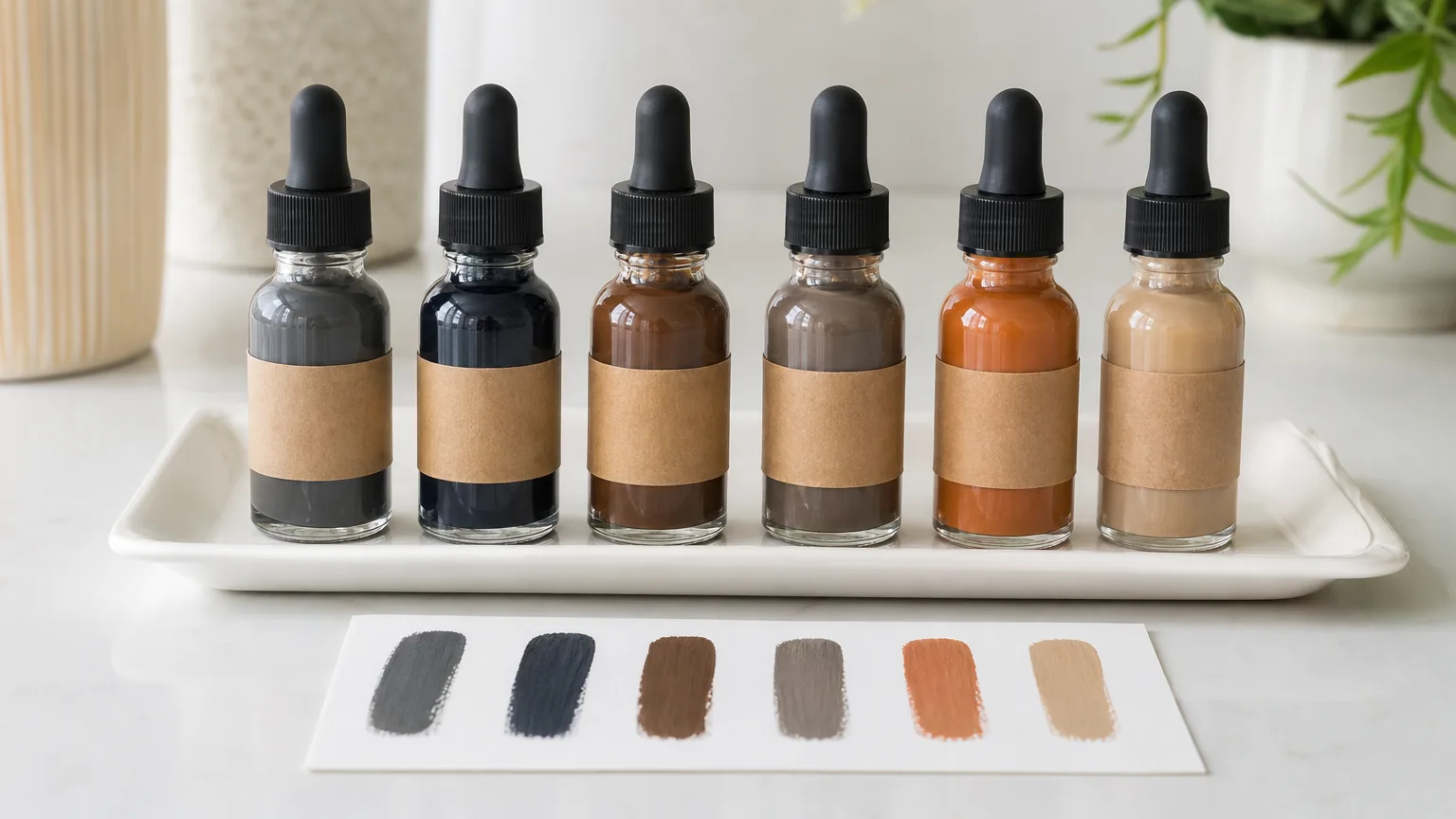
That is why the test spot is not optional. A careful clinic treats one small area first and waits, so any darkening shows up there rather than across both brows. It is removal’s version of the patch test, and it matters most if an earlier artist camouflaged your brows with skin-tone pigment, exactly the flesh-coloured, titanium-rich layer the FDA warns about.
If a test spot does darken, there is another kind of laser. McIlwee and Alster describe an ablative CO2 laser, which vaporises the skin holding the pigment rather than targeting its colour, and so cannot trigger darkening. Their eyeliner and lip liner cases improved significantly with no scarring, infection or darkening. The FDA cautions that methods removing the top layer of skin carry more potential for scarring, so this is a dermatologist’s decision.
How often does removal go wrong? A 2026 survey of Dutch dermal therapists estimated complications in about 8% of laser sessions, mostly swelling, blistering and bruising, with paradoxical darkening in roughly 0.2% across all tattoos. Complications were reported more often for permanent makeup, coloured and previously treated tattoos, tattoos under a year old, and Fitzpatrick skin types III and above. A recent, warm-toned brow that has been lasered before ticks several of those boxes at once.
How Many Sessions, and How Far Apart
The honest spread from the published work:
- Picosecond, facial cosmetic tattoos: three sessions on average to a satisfactory result, with every patient at least half cleared.
- Q-switched ruby, one blue-green brow: five sessions, after seven elsewhere that had not worked.
- Q-switched Nd:YAG, blue tattoos on skin types III to V: six to ten sessions, seven on average, two months apart. At that spacing, seven sessions take about a year.
Dark-toned brow work under the right wavelength can reach a good fade in a handful of visits. Discoloured, layered or previously treated brows take longer, and a clinic quoting a fixed number before a test spot is guessing.
Spacing is set by healing, not by the diary. The FDA describes “a few weeks” between treatments, and the published cases run from roughly monthly (the ruby case) to every two months. The laser only breaks the pigment. Your immune system carries it away, and keeps working for weeks after each visit. The fragments leave through the lymphatic system, the same route some brow pigment takes on its own after the original procedure.

Biopsies confirm that the fading is real removal. In a study of 12 patients in Egypt, researchers sampled the skin before Q-switched Nd:YAG treatment and again after six sessions, and measured the area occupied by ink particles. It had fallen significantly, matching what the photographs showed. As for what one visit achieves, the clearest figure comes from black ink: a conventional single-pass session faded tattoos by about a quarter on average, judged twelve weeks later.
More Than One Pass in a Visit
One visit achieves so little for a reason you can see in the chair. The moment the first pass lands, the treated skin turns chalky white. That whitening is a scatter of tiny gas bubbles, and it deflects the next pulse, so a standard session is one pass. Two approaches work around it.
Waiting it out. The R20 method, introduced in 2012, gives four passes 20 minutes apart, long enough for the whitening to settle. In a small split-tattoo trial of 18 tattoos, every one favoured the R20 half three months later, and the authors noted it needs no new device. A 2025 series of nine patients compared four picosecond protocols on zones of the same tattoo, and a modified R20 approach gave the most improvement and the least pigment left in the skin on biopsy.
Clearing the bubbles faster. A rapid acoustic pulse device uses acoustic shock waves to clear the whitening between passes. In a prospective trial on black ink tattoos, it allowed an average of 4.2 Q-switched Nd:YAG passes per visit. Twelve weeks later those zones had faded 44% on average against 25% for a single pass, and 22% passed 75% fading against 3%.
All three studies looked at tattoos generally, not brows. Multiple passes put more energy near the eye and through the brow hair in one sitting, and break more pigment apart at once, the mechanism behind the laser-triggered reactions in our piece on why red and warm pigments cause the most reactions. If a clinic offers multi-pass brow sessions, ask how it protects your eyes and hair, and whether it has done this on cosmetic pigment before.
What to Ask When You Compare Two Quotes
Take these to both consultations. The answers matter more than the device name on the brochure.
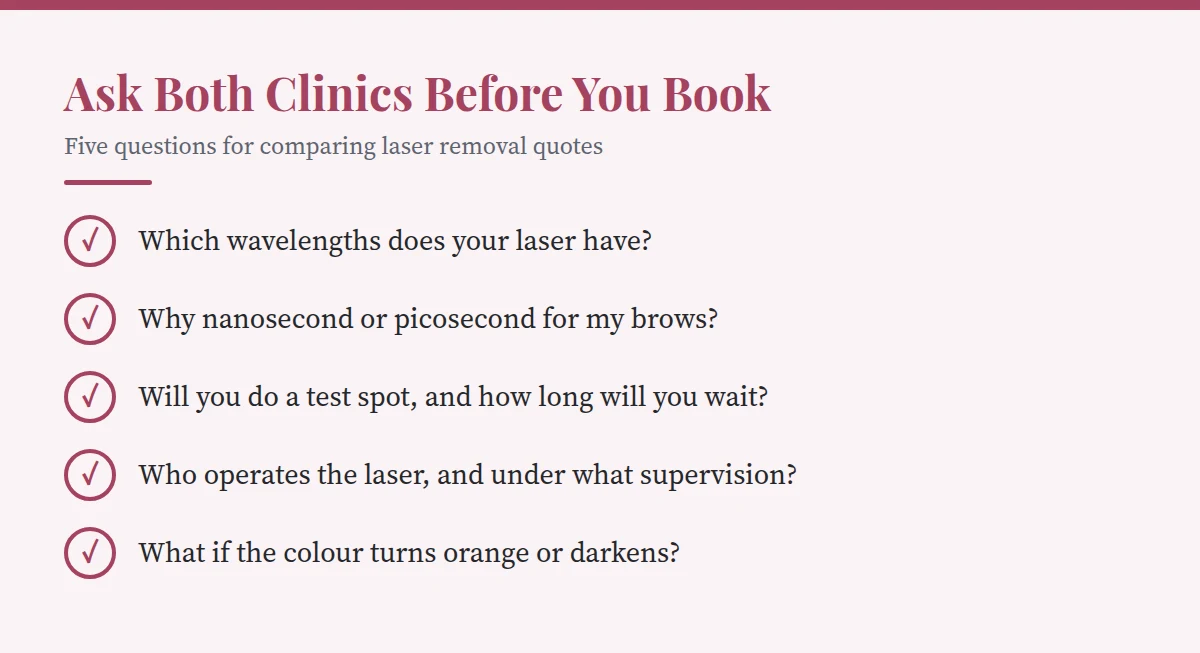
- Which wavelengths does your laser have? Match them to your brows’ current colour: 1064 nm for grey and blue-black, 532 nm for warm casts, ruby or alexandrite for blue-green.
- Nanosecond or picosecond, and why for my brows? A good answer is about your pigment and skin, not the machine’s age.
- Will you do a test spot, and how long will you wait to judge it?
- How will you set the energy? Fluence, the energy delivered per area of skin, trades speed against risk. The Austrian guide treats careful power adjustment as the core skill. For brow pigment, starting conservatively is the answer you want.
- Who operates the laser, and under what medical supervision? The FDA clears these lasers for use by, or under the supervision of, a health care professional, and state rules vary. In the Dutch survey, 87% of laser practitioners had treated clients who first went to someone untrained, and 82% of those practitioners had seen complications in such clients.
- What if the colour turns orange, darkens or stalls, and how will you protect my eyes and brow hair? Then ask how many sessions they expect, how far apart, and whether the price is per session or per package.
The Bottom Line
Pulse length is the least important number on the quote. A wavelength matched to your pigment, a test spot first, and an operator who sets the energy conservatively decide how many sessions you need and how your skin looks at the end. Either kind of clinic can be the right one. The better question is which has the wavelengths for the colour your brows have become, and the experience to use them.
A satisfactory fade is a good outcome. A blank brow is not guaranteed, and the course runs for months. If you have eczema, rosacea, keloid-prone skin or a history of tattoo reactions, see a dermatologist before the first session. If you plan new pigment afterwards, choose a licensed artist, insist on a patch test, and remember that results vary with the artist’s skill and your skin type. Microblading is sold as semi-permanent, and it does fade, but fading is not the same as disappearing. That gap is what a removal course pays for.
Sources
- Hirtler and Serup on a stepwise approach to removing cosmetic tattoos with the Nd:YAG laser
- Cannarozzo and colleagues reporting complete clearance of 20 lip, brow and eyeliner tattoos with a Q-switched Nd:YAG
- Hartman and colleagues with the picosecond chart review of 33 facial cosmetic tattoo patients and the orange tone it unmasked
- Wu and colleagues for the systematic review grading picosecond tattoo removal at level I evidence
- Naga and Alster on why tattoo lasers need high energy in short pulses
- Kuperman-Beade, Levine and Ashinoff matching Q-switched ruby, alexandrite and Nd:YAG wavelengths to ink colours
- Velázquez Arenas and colleagues describing a blue-green eyebrow tattoo lightened with a ruby laser after seven failed sessions
- McIlwee and Alster for why cosmetic tattoos darken under pigment lasers, and the ablative alternative
- Poelhekken and colleagues with practitioner-reported complication rates in laser tattoo removal
- El-Domyati and colleagues measuring ink loss by biopsy histometry after Q-switched Nd:YAG sessions
- Kossida and colleagues on the R20 method of four passes 20 minutes apart
- Suh and colleagues comparing four picosecond protocols on zones of the same tattoo
- Kaminer and colleagues for the trial of an acoustic pulse device enabling several laser passes in one session
- FDA on laser tattoo removal, the colours that resist, and pigment that turns black