Where the Pigment Actually Goes: Lymph Nodes, Blade Metal, and What the Cancer Research Shows
Published on September 20, 2026

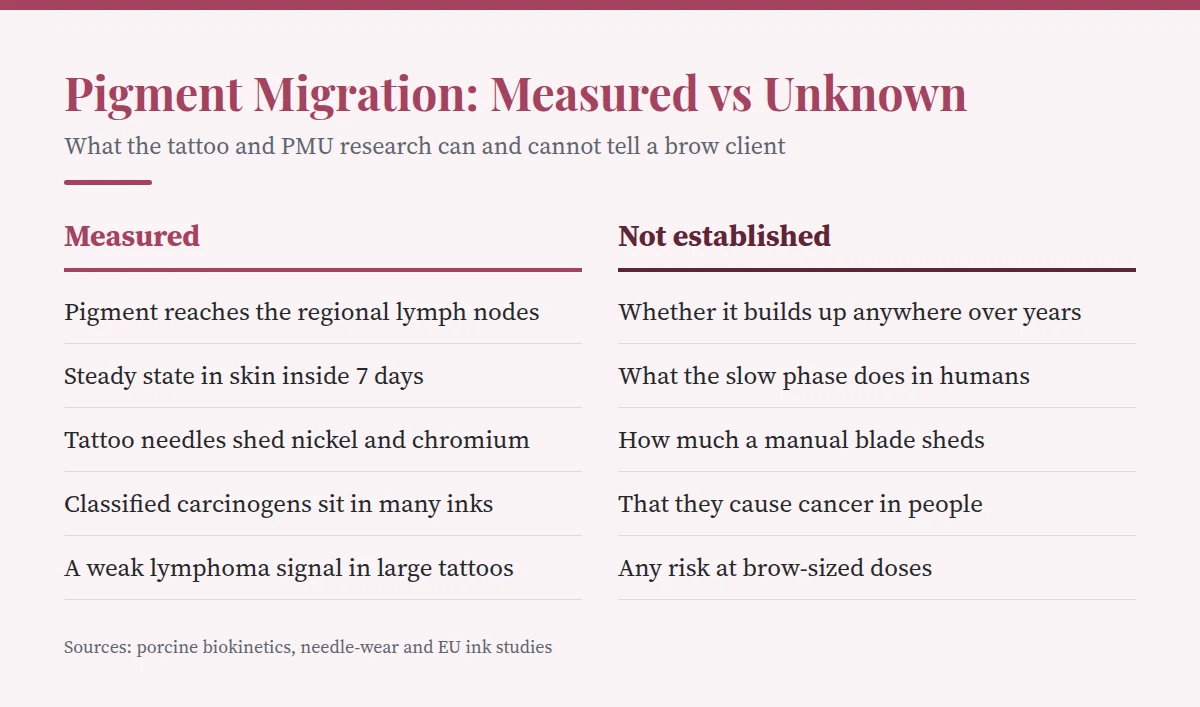
It is usually the last question of the consultation, asked quietly, often at the door. Where does the pigment go? Most clients assume the honest answer is “into your brows, and then slowly nowhere”. That is not quite what the research says. A meaningful fraction of what gets implanted leaves the brow within days, travels the lymphatic system, and settles in the nodes that drain your face. This is not fringe science or a scare headline. It is the mainstream finding, it has been measured directly in tissue, and nobody in dermatology disputes it.
What is genuinely unsettled is the part that follows: whether any of it matters for your long-term health. This article separates three things that usually get blended into one anxious paragraph. What has been measured. What is reasonably inferred from it. And what is simply not known yet, including the cancer question.
Pigment Does Not Stay Where You Put It
The clearest single piece of evidence comes from a 2024 study that tattooed pigs, whose skin is much closer to ours than the mice used in earlier work, and then tracked where the ink ended up over 28 days. Researchers measured the elements in the ink itself, then measured them again in skin, in the local lymph nodes, and in the liver, spleen, kidney and brain.
Two findings matter. First, titanium, copper, aluminium, zirconium and chromium all turned up in the regional lymph nodes at concentrations well above background, and they got there fast. Deposits in the skin were unchanged from day 7 to day 28, meaning the system reaches a steady state inside a week and then stops moving. Second, and this rarely makes the headline, the team found no significant deposits in the liver, kidney, spleen or brain. Their own conclusion was blunt: distribution to regional lymph nodes was confirmed, systemic internal organ exposure was not.
So the nodes, yes. The organs, not in that study.
How much travels is where the literature stops agreeing with itself. A 2025 review in Archives of Toxicology puts the figure at roughly 25% of implanted pigment reaching lymph nodes and then the bloodstream. A 2024 review of tattoo complications estimates 60 to 90%. Those are not small differences of opinion, and the gap tells you something useful about the maturity of this field. The direction of travel is settled. The quantity is not.
What That Pig Study Could Not See
Twenty-eight days is a month. Microblading lasts years, and the pigment sitting in your dermis is being slowly broken up by sunlight, immune cells and ordinary skin turnover for that entire time. A study that ends at day 28 tells you about the fast phase and nothing about the slow one. It also used one ink on one species, and it measured elements rather than whole pigment molecules, so it can say where the titanium went without saying what chemical form it arrived in.
None of that makes the finding weaker. It makes it narrow. A narrow result reported precisely is worth more than a broad one reported loosely, and the honest reading is that early migration to the nodes is now well established while the multi-year picture in humans is still mostly unmapped.

The Metal the Blade Leaves Behind
Here is the finding almost nobody mentions at consultation, and it has nothing to do with what is in the bottle.
Tattoo needles are stainless steel, and stainless steel is roughly 6 to 8% nickel and 15 to 20% chromium. Both are among the most common contact allergens in the general population. A 2019 study in Particle and Fibre Toxicology went looking for wear particles from the instrument itself and found them: nano and micrometre sized fragments of the tool, deposited in human skin, and translocated to lymph nodes alongside the pigment. Electron microscopy of used needles showed visible wear. The abrasion was significantly worse when the ink contained titanium dioxide white, which behaves like a very fine grit.
The clinical implication is that some of the nickel in tattooed skin never came from the ink at all. It was shaved off the tool during the procedure. For anyone with a known nickel sensitivity that reframes the risk conversation, and it connects to the broader problem that a clean patch test still cannot rule out a pigment reaction.
One caveat this site owes you: that study examined machine tattoo needles. A microblading blade is also stainless steel and also drags through the dermis, so the same wear mechanism plainly applies, but nobody has yet quantified it for manual blades specifically. That is an inference, and it deserves to be labelled as one. For the fuller comparison of what the two tools do to skin, our piece on whether microblading is really a tattoo covers the mechanics.
How Much of This Is Actually in a Set of Brows
Scale is the most reassuring thing in this entire subject, and it gets skipped constantly because the research is written about tattoos.
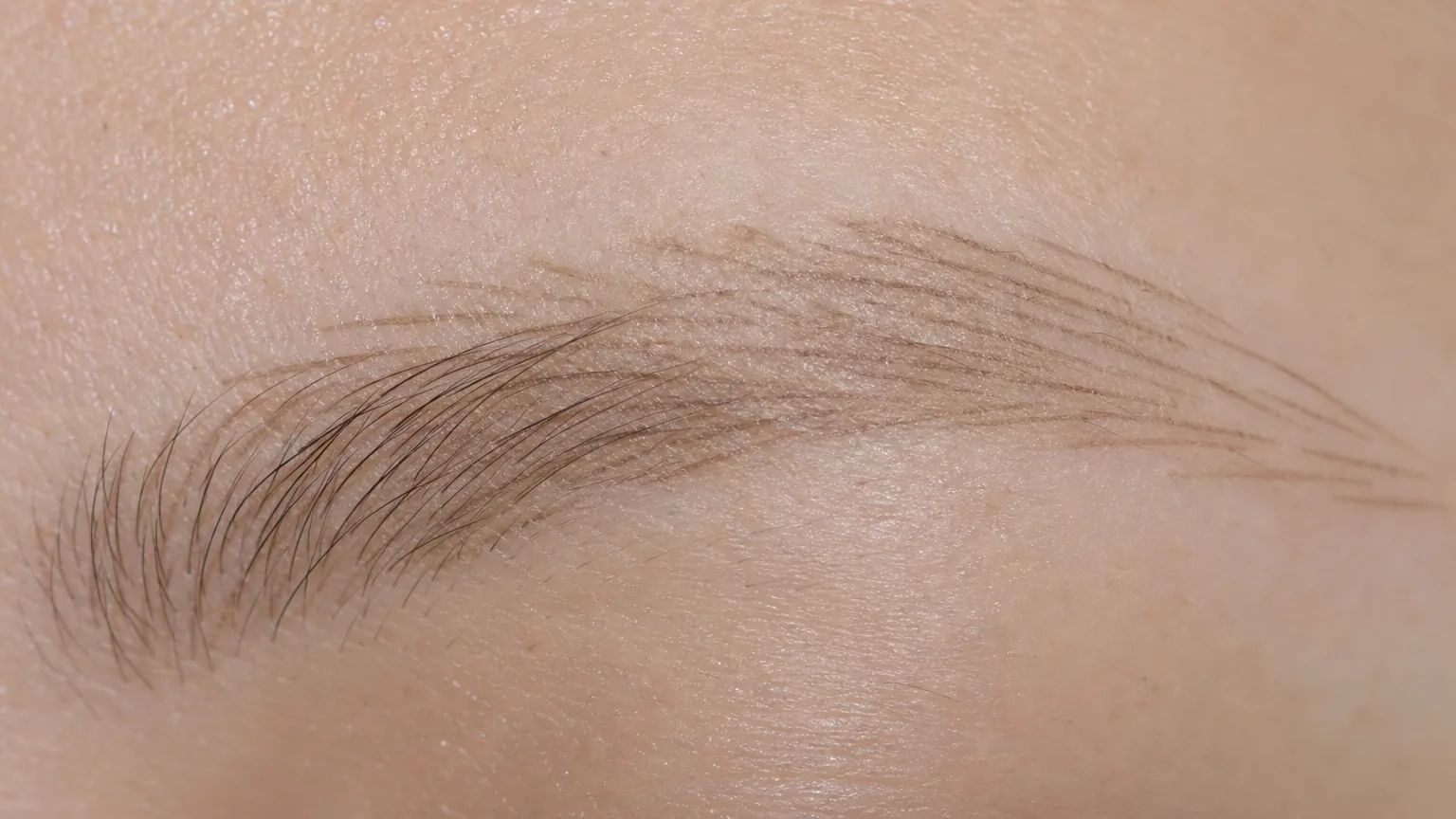
The complications review estimates roughly 14 milligrams of ink per square centimetre of tattooed skin. A full sleeve covers several hundred square centimetres. A set of microbladed brows covers a few, and the technique implants thin broken lines rather than packed saturated colour. Whatever the systemic dose from body art turns out to be, brow work sits at a small fraction of it.
That is a genuine argument rather than a comforting one, and it needs a qualifier. Dose accumulates across sessions. The initial appointment, the perfecting visit, and a colour boost every year or two are each another deposit. Somebody fifteen years into annual top-ups has had considerably more pigment put in than the total implanted on day one.
The Cancer Question, Honestly
Three separate things get compressed into this question, so take them one at a time.
Ink contains substances that are classified carcinogens. This is established. Reviews of tattoo ink chemistry document heavy metals, polycyclic aromatic hydrocarbons and primary aromatic amines, sometimes above permissible limits. A 2025 analysis of 41 inks sold in the EU, tested after the REACH restrictions came into force in 2022, found exceedances of European limits for nickel in 24 samples, arsenic in 20, hexavalent chromium in 16 and lead in 5. Several products carried a modelled lifetime cancer risk above the conventional threshold for nickel. Tightened regulation has not yet produced a compliant market.
Those substances demonstrably reach lymph nodes. Also established, per everything above.
Whether that causes cancer in people is where the evidence thins out, and it has moved recently. For years the honest answer was that nobody had looked properly. Two population studies have since looked, both at decorative tattoos rather than permanent makeup.
A team at Lund University matched every lymphoma case diagnosed in Swedes aged 20 to 60 between 2007 and 2017 against three controls each, close to 12,000 people in total. Tattooed individuals had a 21% higher adjusted rate of lymphoma, but the confidence interval ran from 0.99 to 1.48, so the result did not quite exclude chance. Risk was highest in the first two years after a first tattoo and, awkwardly for a causal story, did not rise with the total area of tattooed skin. The authors’ own word was “suggested”, followed by a call for urgent further research.
A Danish twin study published in 2025 used the national twin registry to control for genetics and shared upbringing. It found a higher hazard of skin cancer among tattooed people, and for tattoos larger than the palm of a hand, raised hazards of both skin cancer and lymphoma. When the analysis narrowed to the 14 twin pairs where one twin was tattooed and the other was not, the effect lost statistical significance, which is what you would expect either from a hidden confounder or from very small numbers.
Two things follow for a brow client specifically. Neither study examined permanent makeup, so the pigment, the depth and the volume were all unlike yours. And where a dose signal showed up at all, it showed up in large tattoos. A set of brows is smaller than a palm by a wide margin. That is not proof of safety. It does mean the finding most often quoted in headlines is the one least applicable to a brow.

Set against that, two risk assessments come out the other way. A dedicated assessment of nickel in tattoo ink concluded that skin sensitisation and non-cancer systemic toxicity are not expected at realistic exposures. An earlier analysis found hexavalent chromium above the legal limit in 90% of inks tested, yet still calculated systemic exposure low enough to present no appreciable risk. Contamination and harm are not the same measurement. When three European dermatology and laser societies issued a joint statement on cancer risk around laser tattoo removal in 2023, it was because the question is live, not because it had been answered.
What You Can Actually Do With This
Not much of this is under your control, and pretending otherwise would be dishonest. A few things are.
Ask what pigment line is being used and whether it complies with current EU restrictions, then ask to see the bottle. An artist who cannot tell you what is going into your face is telling you something. Treat every extra session as an extra dose rather than a free refresh, and skip cosmetic top-ups you do not actually need. If you have a known nickel or chromium allergy, raise the needle-wear finding specifically, because it is not on most consent forms. And if a doctor is ever investigating a swollen node in your head or neck, mention the brow work, because pigment reaching regional nodes is a documented finding rather than a theoretical one.

The Bottom Line
Some of this does not stay in your brows. That much is measured, it happens within a week, and it goes to your lymph nodes rather than your organs, at least across the first month in the best animal model available. The blade adds nickel and chromium of its own. The ingredient list includes things nobody would choose to have injected. And the step from all of that to a cancer risk in a real person has not been made: the two studies that went looking found a signal too weak, too inconsistent on dose, and too far from brow-sized work to carry the weight the headlines gave it.
If you want a cosmetic brow, that is a reasonable trade to accept with your eyes open. What it should not be is a surprise fifteen years from now. For the wider risk picture before you book, start with our complete safety guide to microblading risks and contraindications, and for what the pigment still sitting in your skin does over time, our guide to microblading pigment chemistry picks up where this one stops.
Sources
- Cambiaso-Daniel and colleagues on the 28-day porcine study tracking ink elements to lymph nodes but not to liver, kidney, spleen or brain
- Schreiver and colleagues for nickel and chromium wear particles shed by the needle and found in skin and lymph nodes
- Czaczkowska and colleagues reviewing the ink components implicated in carcinogenesis and the share of pigment reaching the nodes
- Dodig and colleagues with the complications review estimating how much ink is implanted per square centimetre and where it goes
- Nielsen, Jerkeman and Jöud on the Swedish case-control study of tattoos and malignant lymphoma
- Clemmensen and co-authors for the Danish twin study of tattoo ink, lymphoma and skin cancer
- Ćwiełąg-Drabek and colleagues testing 41 EU inks after REACH and finding heavy metal limits still exceeded
- Evans and co-authors calculating that nickel in tattoo ink is not expected to cause sensitisation or systemic toxicity
- Bocca, Senofonte and Petrucci finding hexavalent chromium above the legal limit in 90% of inks yet no appreciable systemic risk
- Kluger and co-authors for the joint EADV, ESLD and French laser society statement on removal and cancer risk
- Komane and colleagues covering dermal-to-lymphatic transport in microblading and semi-permanent makeup specifically
- EUR-Lex for the EU regulation restricting hazardous substances in tattoo inks and permanent make-up
- FDA stating that no colour additive is approved for injection into the skin