Nobody Approves Your Brow Pigment: FDA Rules, the EU Banned List, and How to Read a Compliance Claim
Published on October 21, 2026

“Is it FDA approved?” sounds like the right question to ask about a brow pigment, and a bottle stamped “EU compliant” sounds like a good answer. Neither works the way it sounds. No regulator in the United States, the European Union or Switzerland reviews a bottle of brow pigment before it goes on sale. What differs is what each system bans, what it makes the label say, and who checks once the pigment is already in studios. Those differences are why the same bottle can be sold without objection in Ohio and be banned from every studio in Germany, and why the small print deserves more of your attention than the shade name.
This guide walks through the three systems, then through the paperwork: what a REACH or EU compliance claim actually certifies, what an ingredient list is allowed to leave out, and which claims mean very little.
In the US, Brow Pigment Is a Cosmetic Nobody Reviews First
The FDA treats the inks used for tattoos, permanent makeup included, as cosmetics, and cosmetics need no FDA approval before they are sold. A 2025 Swiss review comparing the three systems sums up the American position: FDA supervision, but no specific premarket controls for tattoo ink products.
There is a twist that pigment marketing tends to skip. The colourants inside the ink are colour additives, and federal law does require those to be approved before use. FDA’s own fact sheet says that although a number of colour additives are approved for cosmetics, none is approved for injection into the skin, and that using an unapproved one makes an ink adulterated. Read literally, that describes every tattoo and brow pigment on the US market. The fact sheet then explains that the agency has traditionally not exercised that authority over tattoo pigments, citing competing public health priorities and a previous lack of evidence of safety problems. Some pigments in circulation, it adds, are industrial grade colours suitable for printers’ ink or car paint.
Iron oxides, the backbone of many brow shades, show how narrow the approvals are. Federal rules list them as safe for colouring cosmetics generally, the eye area included. That covers your eyeshadow. It does not cover the same powder implanted in the dermis.
The Modernization of Cosmetics Regulation Act of 2022 (MoCRA) did give the companies behind the bottle real duties. They must keep records showing each product’s safety is adequately substantiated, report serious adverse events to FDA within 15 business days, register their facilities and list their products. The small business exemption from registration does not apply to injected products, so even a tiny pigment house has to file. FDA can now order a recall when a company refuses to carry one out voluntarily.
None of that is a review before sale. FDA acts on problems it hears about, as it did in 2003 and 2004, when it learned of more than 150 reactions to certain permanent makeup shades and the company selling them recalled the inks. The studio and the artist’s licence are left to state and local rules. All of this applies to brow pigment exactly as it does to body ink, because microblading is a tattoo in FDA’s eyes.
In the EU, Pigment Is a Chemical With a Long Restricted List
Europe took the other road and regulates the ink as a chemical mixture under REACH, the EU’s chemicals law. Commission Regulation (EU) 2020/2081 added a tattoo entry to REACH’s list of restrictions, and its definition of tattooing names micro-blading outright, alongside permanent make-up, cosmetic tattooing and micropigmentation. Since 4 January 2022, a mixture that contains restricted substances above set limits may not be sold for tattooing or used for it.
The list is built from categories: substances classified as carcinogens, mutagens or reproductive toxicants, skin sensitisers, skin corrosives or irritants and eye irritants, plus substances banned or restricted in EU cosmetics, plus an appendix of named metals, aromatic amines and colourants. Germany’s Federal Institute for Risk Assessment (BfR) counts around 4,200 substances in all. The limits are tiny. A classified carcinogen is capped at 0.00005 percent by weight, half a part per million, and nickel at 0.0005 percent. The appendix also caps 44 named colourants, mostly azo reds, oranges and yellows, at 0.1 percent.

Pigment Blue 15:3 and Pigment Green 7, both common in tattoo inks, were given until 4 January 2023, and the route to their ban is worth knowing. They are on the EU cosmetics banned list only for use in hair dyes, and BfR notes that the listing did not follow a negative health assessment: industry simply never submitted safety dossiers for them as hair dyes. Its own review found comparatively low toxicity but data too thin for a risk assessment, and warned that less studied substances could take their place.
For brows the two bans matter less than for body art. Brow shades are browns, and BfR describes permanent makeup inks as built primarily on iron oxides and carbon black. The bans matter wherever a blue or green turns up in a formula.
What Europe still lacks is an approval step. BfR’s 2022 guidance says there are no binding criteria for carrying out a safety assessment of tattoo inks, and makers and distributors are responsible for the safety of what they sell. National authorities check products already on the market and report dangerous ones through the EU’s rapid alert system.
Switzerland Regulates Ink Under Its Food Law
Switzerland is outside the EU and runs its own rules, which the 2025 review describes as strict requirements rooted in food legislation, designed to keep inks sterile and harmless. Guidance from the canton of Lucerne’s food control service, written for tattoo and permanent makeup studios and, it says, equally usable for microblading, sets out what that means. Swiss law works from an approved list: only colourants listed in Annex IV of the EU Cosmetics Regulation may be used. Substances that are carcinogenic, mutagenic or toxic to reproduction are banned, inks may not be perfumed, and preservatives are limited to those allowed in leave-on cosmetics. Labels carry EU-style information plus a best-before date and storage conditions.
Switzerland also puts the studio on the hook. Under the self-control duty in food law, the studio must make sure every ink it uses complies, and Lucerne tells artists to get certificates of analysis from their suppliers. Cantonal laboratories test the market as well. In a 2022 campaign in eastern Switzerland, 10 of 34 tattoo and permanent makeup inks (29 percent) were rejected for exceeding limits or containing banned ingredients, and about half of the samples contained nickel without the required warning.
Why One Bottle Can Be Sold in One Market and Banned in the Next
Set side by side, the gaps are plain. A blue or green ink built on Green 7 or Blue 15:3 can still be sold in the US without objection, because FDA does not enforce its colour additive rules against tattoo pigments. Since January 2023 the same bottle may not be used in any EU studio. A bottle that lacks the statement “Mixture for use in tattoos or permanent make-up” may not be used for tattooing in the EU at all. And in both the EU and Switzerland the rules bind the artist who uses the ink, not only the company that sells it.
The supply chain ignores the borders. In a 2025 analysis of 41 inks bought in the EU after the restriction took effect, 88 percent were made in the United States. If you are booking brows overseas, our guide to microblading abroad covers what else changes when you cross one.
What “REACH Compliant” and “EU Compliant” Actually Certify
They certify the maker’s own view of its chemistry. Nothing in the restriction requires a pigment to be tested or approved by an authority before sale, so “REACH compliant” is a declaration that the formula stays under the limits above, checked only if an inspector later tests it. It says nothing about microbes, because the restriction does not cover sterility. Nor does it predict whether you will react to an ingredient that is not on the restricted list.
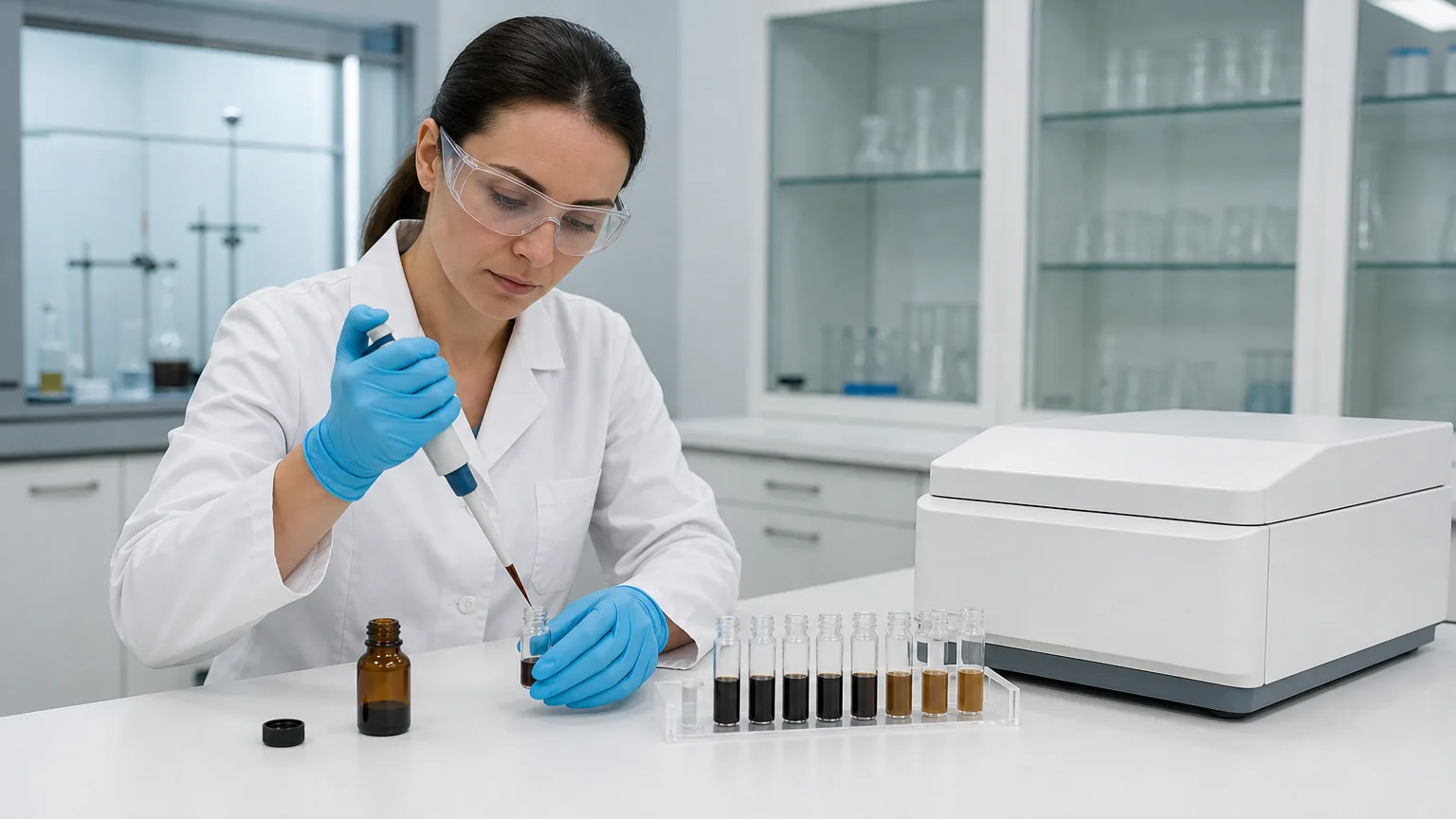
Testing shows how far a claim and a bottle can drift apart. When Binghamton University chemists analysed ten blue and green inks from five manufacturers sold in Europe, all claiming REACH compliance, nine were not compliant and four contained banned material. Most had labelling errors such as unlisted polyethylene glycol and propylene glycol. Part of the trouble is that Pigment Blue 15 comes in several crystal forms and only 15:3 is named in the ban. The team found that Raman spectroscopy, the standard method for identifying pigments, could not reliably tell the forms apart, and called the ban unenforceable as written.
The 2025 test of 41 EU-bought inks found legal limits exceeded for nickel in 24 samples, arsenic in 20 and hexavalent chromium in 16. For some products, the only statement of EU compliance was on the maker’s website, not the packaging. Just five of the samples were sold purely as permanent makeup inks, so the figures describe the market more than brow pigment in particular.
So ask what stands behind the claim: which batch was tested, by which laboratory, against which regulation, and when. A certificate of analysis that matches the lot number on the bottle is evidence. A logo on a website is marketing.
What an Ingredient List Is Allowed to Leave Out
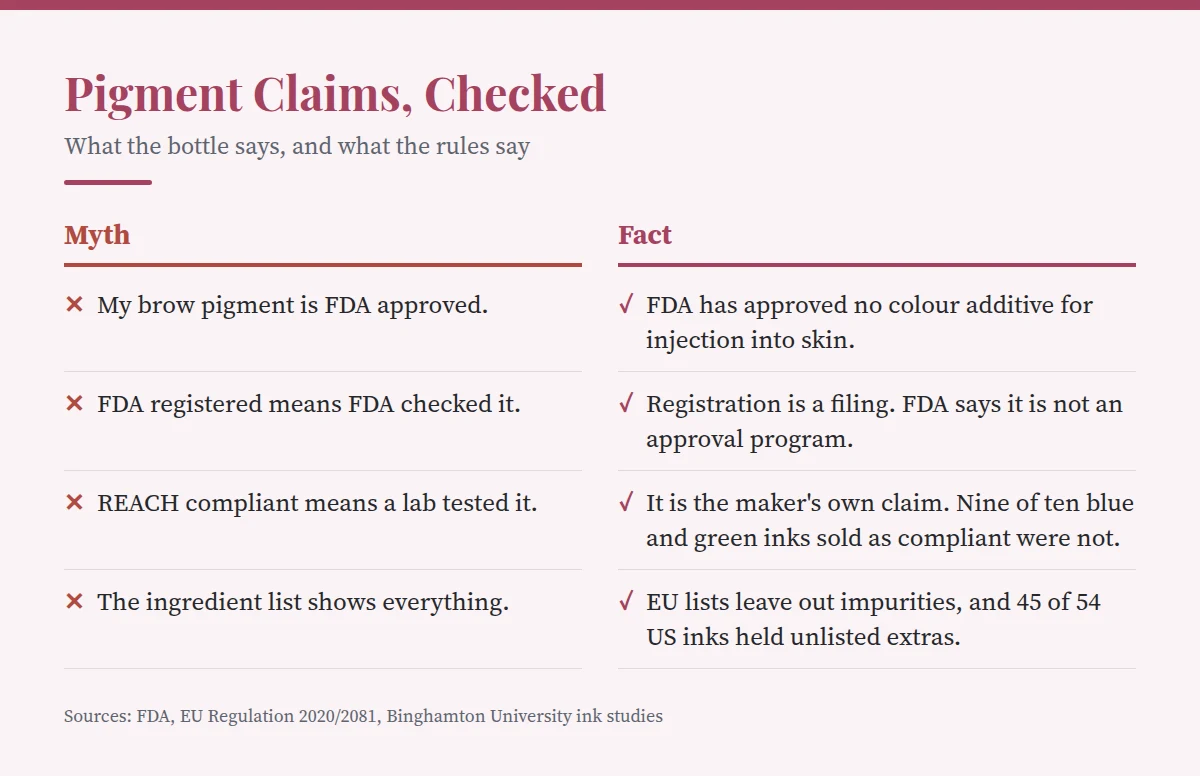
In the EU the label must list every ingredient in descending order by weight or volume at the time of formulation, using standard cosmetic ingredient names where they exist, and must carry a batch number. The same rule sets the biggest limit on what you will read: impurities are not ingredients. Trace metals that arrive with a pigment will not appear, except that a mixture containing nickel or chromium (VI) below the legal limit has to say so in a warning. An EU artist is also required to give you the label information before the procedure.
US ingredient lists have their own gaps. The labelling rules let colour additives be grouped at the end in any order, let a company that FDA has granted trade secret status write “and other ingredients”, and do not require incidental ingredients present at insignificant levels, such as processing aids or components carried in by another ingredient. Lists can also simply be wrong: the same Binghamton team tested 54 inks from nine brands common in the US and found unlisted additives or pigments in 45 of them. Our guide to red and warm pigment reactions explains why that matters most if you have ever reacted to a pigment before.
Claims That Mean Less Than They Sound
“FDA approved.” Not possible for a pigment meant to go into skin, since FDA has approved no colour additive for injection. A bottle or website that says otherwise either misunderstands the law or is counting on you to.
“FDA registered.” Registration is a filing that MoCRA requires of nearly every cosmetics maker. FDA says registration and product listing are “neither a cosmetic approval program nor a promotional tool”, that a registration number does not indicate approval, and that it issues no certificates or letters confirming either one.
“REACH compliant” or “EU compliant.” A self-declaration about chemistry, explained above. Worth more when a batch test backs it, and silent on sterility and allergy either way.
“Sterile.” The word carries legal weight in the US, but it remains the maker’s own statement, and FDA testing has found microbes in sealed bottles labelled sterile, as our guide to contaminated pigment explains.
“Organic,” “natural,” “vegan.” In pigment chemistry, organic means carbon-based synthetic colourants, the family linked to most pigment allergies, which is not what the word suggests on a cosmetics shelf. Vegan describes what was left out of a formula, not what is in it. None of the regulations above gives any of these words a safety meaning.
Before the Pigment Goes In
- Ask which brand and shade the artist plans to use, and look at the bottle itself.
- Find the lot or batch number and the maker’s details. Since December 2024, US cosmetic labels must include a way to reach the company with adverse event reports. Photograph the label.
- Read the ingredient list. In the EU, look for “Mixture for use in tattoos or permanent make-up”, and ask before going ahead if Pigment Green 7 (CI 74260) or any Pigment Blue 15 appears.
- If compliance comes up, ask for the test report for that batch rather than a general certificate.
- Patch test with that exact pigment, knowing a clean patch test cannot rule out a reaction later.
- Book a licensed artist. The licence is what makes a studio answerable to a health department.
The Bottom Line
Nobody approves brow pigment before it reaches the studio, whether that studio is in Ohio, Berlin or Zurich. The US responds after harm, the EU limits what may be in the bottle and makes the label tell you, and Switzerland makes the studio check. A compliance claim is the start of a conversation with your artist, not the end of one. Results still depend on the artist’s skill and your own skin, microblading is a regulated procedure that unlicensed practitioners turn into a genuine safety risk, and even well-documented pigment is semi-permanent, not permanent. If you have eczema, rosacea or another skin condition around your brows, see a dermatologist before you book.
Sources
- FDA on tattoo inks as cosmetics and why no colour additive is approved for injection
- FDA for what cosmetic facility registration and product listing do and do not mean
- 21 U.S.C. § 364d on the safety substantiation records a cosmetics company must keep
- 21 U.S.C. § 364a setting the 15 business day deadline for serious adverse event reports
- 21 U.S.C. § 364g with FDA’s power to order a cosmetic recall
- 21 U.S.C. § 364h on why injected products get no small business exemption
- 21 U.S.C. § 364e for the adverse event contact every cosmetic label must carry
- 21 CFR 701.3 on what a US cosmetic ingredient list may group, withhold or omit
- 21 CFR 73.2250 listing iron oxides as colour additives for cosmetics, the eye area included
- EUR-Lex with the EU regulation restricting substances in tattoo inks and permanent make-up
- BfR answering frequently asked questions about tattoo inks and the EU restriction
- BfR on the risk assessment of Pigment Blue 15:3 and Pigment Green 7 (in German)
- T. D. Szucs comparing tattoo ink regulation in Switzerland, the EU and the USA
- Canton of Lucerne food control with its self-check guide for tattoo and permanent makeup inks (in German)
- Canton of Zurich cantonal laboratory reporting the 2022 eastern Swiss tattoo ink campaign (in German)
- Moseman, Noble, Sanders, Guo and Swierk testing blue and green inks sold in Europe as REACH compliant
- Binghamton University on why the Pigment Blue 15 ban is hard to enforce
- Moseman, Ahmed, Ruhren and Swierk analysing 54 tattoo inks on the US market against their labels
- Ćwieląg-Drabek, Furman and Gut-Pietrasz measuring heavy metals in 41 inks sold in the EU after REACH
Further reading
- Is microblading a tattoo? Depth, pigment, fading, and removal
- Getting microblading abroad: price, flying home, and the touch-up
- Contaminated microblading pigment: bacteria in sealed bottles
- Red and warm pigments cause the most reactions
- Microblading pigment chemistry: why brows turn blue, red, or grey