Is Microblading a Tattoo? Depth, Pigment, Fading, and Removal Compared to Body Ink
Published on September 16, 2026

Plenty of people who would never walk into a tattoo shop will happily book microblading, because “semi-permanent” sounds like a different kind of decision. A New York brow salon owner described the contradiction to Allure: clients say they would never get a body tattoo, and the unspoken reply is, “You know you’re tattooing your face right now.”
The reply is correct. Microblading is a tattoo in law and in mechanism: the FDA lists it among the types of tattoo, the pigment is implanted in the dermis just as body ink is, and in Oregon, for one, the brow artist holds the same license as a body tattooer. What changes everything downstream is the location, the small amount of pigment, and the hand blade. Here is how those three differences play out in depth, fading, complications, and removal, and what each of the two words actually commits you to.
Legally, Microblading Is Tattooing
The FDA’s consumer page on tattoos and permanent makeup lists the common types of tattoo as body art, permanent makeup, and microblading, and states plainly that permanent makeup is a type of tattoo. The inks for all of them are regulated as cosmetics, and the practice itself is left to state and local rules. There is no gentler federal category for brows.
State rules are where that framing gets concrete. Oregon issues one tattoo license to artistic, cosmetic, and medical tattooers alike. So when the Oregon Health Authority said in a March 2026 practice clarification that licensed tattoo artists may not apply over-the-counter numbing creams and sprays, it landed on permanent makeup artists as squarely as on body tattooers, and OPB reported cosmetic tattooers cancelling eyeliner and lip appointments. Japan goes further and treats permanent makeup as a medical procedure reserved for doctors and nurses.
Even the trade’s vocabulary gives it away. Describing microblading to CBC News in 2016, a Prince Edward Island aesthetician called it drawing a brow hair by hair “with a fine, fine, fine blade, dipping into tattoo ink for every stroke.” So treat “semi-permanent” as a description of how the result behaves, not a loophole. An artist who says microblading is not really a tattoo, so the rules for skin-piercing work do not apply, is giving you a good reason to book elsewhere. Unlicensed practitioners are a genuine infection and scarring risk, and a licensed one is someone you can hold accountable, as our guide to recourse after botched microblading explains.
Depth: Both Live in the Dermis, Just Not Equally
A popular explanation says microblading only touches the epidermis, the outer layer of skin, while a real tattoo reaches the dermis beneath. It does not survive a look at how skin works. The epidermis constantly renews and sheds, so pigment left there flakes away with the healing scabs. Whatever is still visible a year later sits in the dermis. Dermatologists describe permanent makeup and body tattoos in the same terms, as pigment deposited in the dermis, and the FDA describes tattoo inks as injected into the dermal layer.
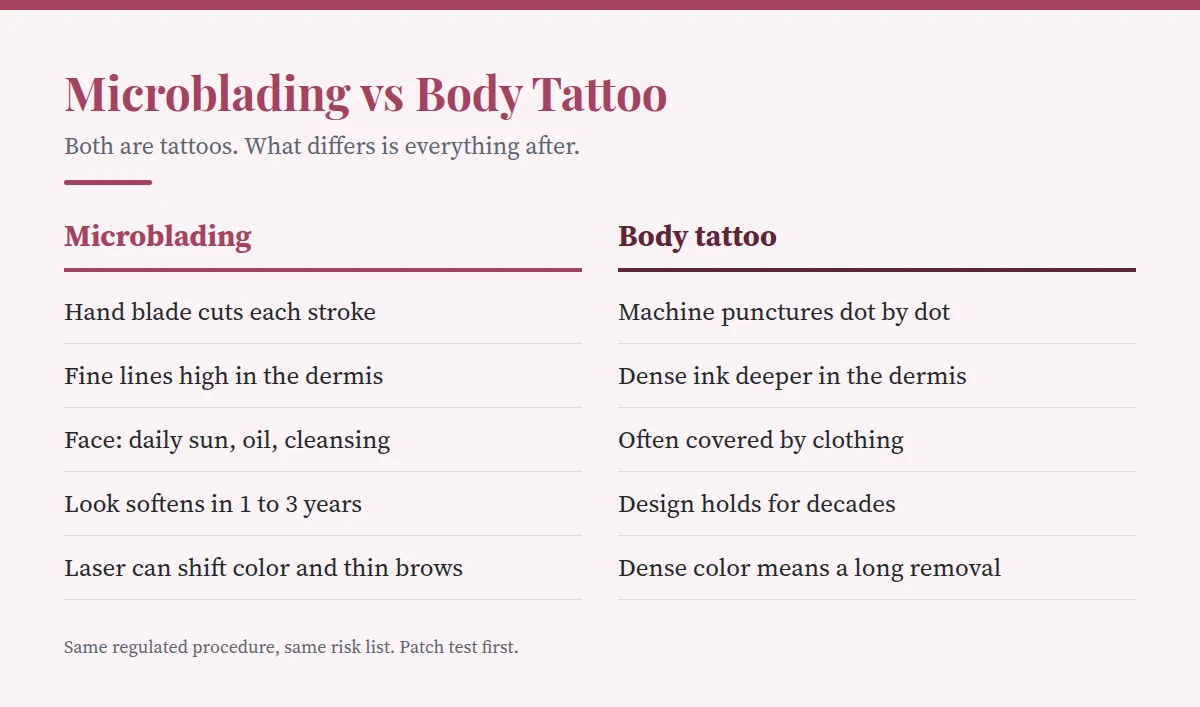
The real difference is one of degree. Microblading aims for a narrow band just below the junction of epidermis and dermis and lays down thin lines rather than solid color, while a body tattoo sits deeper and far more densely. CBC’s report put it in studio terms: a tattoo gun “injects ink deeply,” while the blade places pigment under just the first few layers of skin. That shallow, sparse placement is what lets microblading fade.
It is also where a hand tool can miss in either direction. Too shallow and strokes shed during healing. Too deep and the stroke starts behaving like body ink: it blurs, spreads, and outstays its welcome. A 2022 review of cosmetic tattoo complications lists that family of late problems, from color fading and color shift to “blowout,” where pigment escapes into the surrounding skin.
The Tool: A Hand Blade Cuts Where a Machine Punctures
A body tattoo is made with an electric machine that punctures the skin in rapid repetition, placing ink dot by dot. Microblading uses a handheld tool whose fine needles sit in a row to form a blade, and the artist draws each hair stroke as a shallow cut. A review of how tattoo and permanent makeup inks are made describes the skin as “carved” with the needle blade, the ink applied to the fresh wound and massaged into the cuts. With no motor setting the rhythm, depth comes down to hand pressure, blade angle, and how firmly the skin is stretched.
Two consequences follow. The first is load: fine strokes with bare skin between them hold far less pigment than a solidly shaded body tattoo covering the same area, and that small dose is a large part of why the result softens within a few years. The second is scarring. A cut is a different wound from a puncture, and the same complications review singles out fibrosis and scarring “especially after microblading.” Scarred skin takes new strokes less cleanly, so each round can make the next one harder to do well.
Pigments: Close Relatives, Different Living Conditions
Permanent makeup inks descend from tattoo inks, and the chemistry overlaps heavily. When researchers catalogued 974 permanent makeup inks sold in the United States, they found 79 distinct pigments, averaging four per product: 20 inorganic, built on elements such as carbon, iron, and chromium, and 59 organic. Brow browns are commonly built on iron oxides, often blended with carbon black and organic pigments, while black body ink is usually carbon based.
Brow pigment is not a more tightly controlled product, either. The FDA notes that no color additive is approved for injection into the skin, so read words like “mineral,” “organic,” and “free of heavy metals” with care. The ink formulation review found online claims about special pigments that never age to red, blue, or green mixing facts with fiction.
What really separates brow pigment from body ink is where it lives. A tattoo on a back or thigh spends much of its life under clothing. Brow pigment sits on one of the most sun-exposed patches of skin you have, in an area dense with oil glands that is washed daily and often treated with retinoids and acids. Blended pigments rarely fade as a single unit, so that exposure can pull a shade’s warm and cool components apart, which is how brows drift toward grey, blue, or red. Oil matters as much as sun: the same New York salon owner told Allure that clients with oily skin or large pores get turned away, because they “won’t heal with the crisp strokes you need.”
Why Body Ink Stays and Microblading Fades
A body tattoo lasts for decades because of the immune system, not in spite of it. Macrophages, the scavenger cells of the dermis, swallow pigment particles and hold them. A 2018 study in mice showed that when those cells die, the pigment is released and recaptured by new macrophages, cycle after cycle, without the tattoo disappearing. Persistence depends on the cells renewing, not on any one cell living forever.

Nothing about that process switches off for brows. The difference is the margin each tattoo starts with. A bold body design holds so much pigment that each year’s small losses barely register. A microbladed hair stroke is a fine line carrying a little pigment close to the surface, in skin that sees sun daily, so the same slow clearance takes a far bigger share, and a thin line shows loss long before a solid shape would. Once strokes thin or blur, the brow reads as faded even with pigment still in the skin, which is why the one to three years artists quote describes the look rather than the ink.
That is the catch in “semi-permanent.” The look fades; the pigment does not necessarily leave. Faint residue often lingers for years, and strokes placed too deep can hold on like body ink, as our look at microblading years later shows.
The Complication List Is the Tattoo List
Because microblading is a tattoo, it inherits the tattoo risk list in full. The FDA’s version covers infections, allergic reactions, granulomas, keloids, a raised chance of sunburn or redness, swelling and burning, MRI complications, and removal problems. The face changes which items are likeliest and how they show up. It does not shorten the list.
Allergy. Of the 79 pigments in that US ink catalogue, 10 had documented links to allergic contact dermatitis, and the researchers warned that patch tests to these ingredients can come back negative. That is not a reason to skip the patch test. It is a reason to test with the exact pigment and aftercare products your artist plans to use, and to read a clear result as reassurance rather than a guarantee.
Granulomas and sarcoidosis. A granuloma is a nodule the body builds around material it reads as foreign, and pigment qualifies. In the first published case of cutaneous sarcoidosis linked to microblading, a patient sought care a year and a half after the procedure for itchy red plaques confined to the treated brows. Steroid injections and a prescription ointment cleared them. A firm bump in a healed brow deserves a doctor’s look, and our guide to bumps, lumps, and granulomas after microblading explains what to watch for.
Infection. Ink itself can carry microbes into the skin, and the FDA has logged a string of recalls of tattoo inks contaminated with bacteria. Under clean clinical conditions the rate is low: a Japanese clinic that surveyed 1,352 eyebrow and eyeliner clients found infection reported in 0.2 percent, with itching the most common complaint after brow work at 8.2 percent. The survey ran a median of 15 days after treatment, though, so it cannot speak to reactions that surface months later.
MRI. Some people with cosmetic tattoos feel burning in the treated area during a scan. It is uncommon, and our guide to getting an MRI with microblading explains the iron oxide chemistry behind it and why it rarely stops a scan.
If you have eczema, rosacea, psoriasis, or any history of sarcoidosis, see a dermatologist before booking, since each raises the stakes on at least one item above.
Removal: Less Ink Helps, Cosmetic Ink Complicates
Removal is where the comparison splits most sharply. Laser is the usual route for both kinds of tattoo, and the small pigment load in a brow works in your favor. In a review of 33 patients who had facial cosmetic tattoos treated with a picosecond laser, it took an average of three sessions to reach a satisfactory result, and about two thirds had 76 to 100 percent of the tattoo cleared. Dense, professionally shaded body work is usually a much longer project.
Cosmetic ink brings problems body ink mostly does not. In that same review, 30 percent of patients saw the tattoo change color after the first treatment, and the authors highlighted an orange tone unmasked by the laser that needed a second wavelength. Brow pigments containing iron oxide or titanium dioxide can also darken under the laser, a risk our guide to removing bad microblading covers alongside saline lightening. Then there is the brow hair itself, which matters on a face in a way it never does on a forearm. A 2026 case report on removing an eyebrow tattoo with a Q-switched ruby laser recorded thinning of the brow hair and urged practitioners to raise that risk before treatment starts.
What Each Word Actually Buys You
“Tattoo” commits you to what every tattoo involves: a wound in the dermis, a regulated procedure that belongs with a licensed artist, the full complication list, and pigment that may never entirely leave.
“Semi-permanent” buys you a look that softens over a few years rather than decades, so a dated brow shape is not with you for life, and a pigment load small enough that removal is usually shorter than it is for body ink. It also comes with maintenance appointments, a faster fade on oily or sun-exposed skin, and no promise that the brow will disappear on schedule.
Either way, the tattoo rules apply. Patch test before any pigment goes in, including a color boost years after your first session, since sensitivities can develop over time. Book a licensed artist working under your state’s rules, and see a dermatologist first if you have eczema, rosacea, or another skin condition around the brows. Expect results to vary widely with the artist’s skill and your skin type. Microblading is semi-permanent, which makes it neither permanent nor temporary.
Sources
- U.S. Food and Drug Administration on tattoo types, ink regulation, recalls, and health risks
- OPB for Oregon’s single tattoo license and its 2026 numbing clarification
- CBC News with how microblading’s blade differs from a tattoo gun
- Allure about the clients who forget cosmetic tattooing is tattooing
- Kaatz, Elsner, and Bauer on where tattoo and permanent makeup pigment is deposited
- Tomita and colleagues for complications among 1,352 eyebrow and eyeliner clients in Japan
- M. Dirks explaining how tattoo and permanent makeup inks are formulated
- Rigali, Cozzi, and Liszewski identifying the pigments inside 974 permanent makeup inks
- J. Serup with the technical and clinical complications of cosmetic tattooing
- Baranska and colleagues on how skin macrophages keep a tattoo in place
- Spurr, Hanna, and Colantonio documenting cutaneous sarcoidosis after microblading
- Hartman and colleagues reviewing picosecond laser removal of facial cosmetic tattoos
- Velázquez Arenas and colleagues covering brow hair thinning after ruby laser tattoo removal