Botox, Fillers, Lasers, and Facials: How to Sequence Cosmetic Treatments Around Microblading
Published on August 30, 2026

Almost nobody gets microblading in isolation. The same client booking brows this month has Botox on a twelve-week cycle, a filler appointment whenever the budget allows, half an IPL package still unused, and a facial every six weeks. Each of those appointments comes with its own aftercare sheet, and not one of them mentions the others. The result is a calendar collision that quietly costs people money: a brow mapped to a face that changes shape a week later, or a thousand dollars of hairstrokes faded by a peel nobody thought to move.
This is a scheduling guide rather than a design guide. It covers the wait in both directions for every treatment that commonly shares a client’s calendar with brows and explains which order protects both investments.
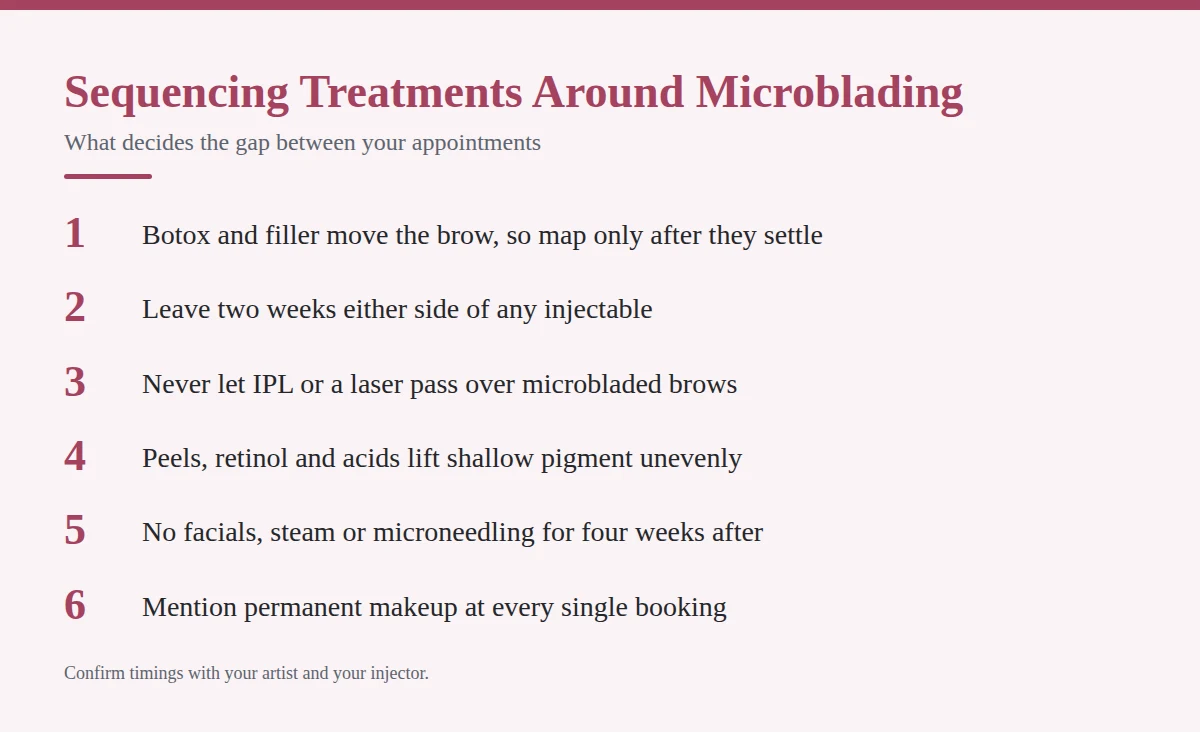
Two Facts That Explain Every Wait Time
Everything below follows from two things.
The first is that microblading is mapped, not just drawn. Before a blade touches skin, your artist measures your face at rest and builds the shape around where your brow actually sits. Anything that moves the brow after that mapping is finished (Botox releasing the muscles that pull it down, filler restoring volume at the temple or brow bone) leaves you with a shape designed for a face you no longer have.
The second is that pigment sits shallow. Microblading deposits pigment in the upper dermis, considerably shallower than body tattoo ink, which is exactly why it fades in one to three years instead of lasting forever. Every treatment on this list that exfoliates, resurfaces, or speeds up cell turnover will lift some of that pigment, and it will not lift it evenly.
Hold those two ideas and most of the timing advice below stops needing to be memorized.
Botox: Two Weeks Minimum, and the Question Nobody Asks
The standard advice is to wait at least two weeks after Botox before microblading. The toxin does not reach full effect immediately: onset takes a few days and the result settles over roughly ten to fourteen days. Book brows a week after injections and your artist maps a brow that is still on its way up.
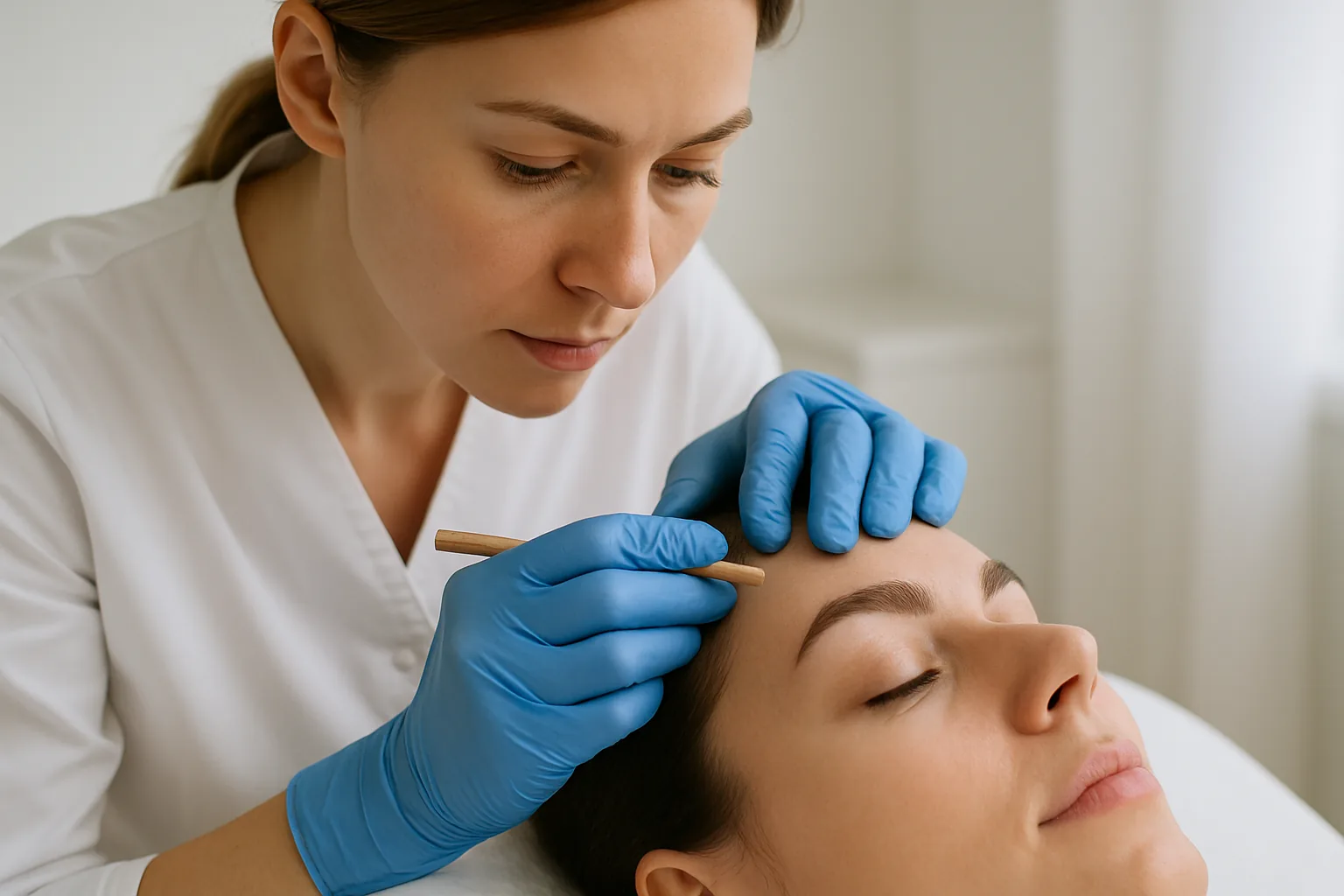
The other direction is easier. Most artists and injectors ask for two weeks after microblading before Botox, mainly so the needles go into healed skin rather than fresh wounds, and so the brow has settled before anything shifts it. If both are on your calendar and you have no strong reason to pick an order, microblading first and Botox second is the friendlier sequence.
Then there is the question almost nobody asks at the consultation: what happens when the Botox wears off? Some practices argue for waiting three to four months after your last facial Botox before microblading, on the grounds that Botox temporarily changes where your brows sit and semi-permanent pigment does not. Map to a lifted brow, let the toxin fade over three or four months, and the strokes drift back down with the muscle.
That is more conservative than most artists follow, but the point underneath it is real, and the practical resolution is simple. If Botox is a permanent fixture of your routine, get microbladed two or more weeks into a cycle and keep the cycle running, because your brows will then be mapped to the face you actually wear. If Botox was a one-off, or you are thinking about stopping, map on your baseline brow instead. What you should not do is map to a face you are about to abandon.
Filler: Two Weeks, and Watch the Upper Third
Filler follows the same logic through a different mechanism. Hyaluronic acid fillers place volume immediately and then settle over one to two weeks as swelling resolves and the product integrates. Two weeks is the standard buffer before permanent makeup.
What matters for brows is location. Cheek and lip filler sit far enough away that they will not change your brow map. Temple, forehead, and brow bone filler are a different story. Restoring volume at the temple or along the supraorbital ridge lifts and repositions the brow tail, which is precisely the part of the shape your artist spends the longest getting right. If temple filler is anywhere on your wish list, do it first and let it settle, then map. Adding it six months after your brows can leave a tail that reads too low against a newly supported ridge.
Lasers and IPL: The One That Can Turn Your Brows Black
This is the category where the stakes stop being scheduling and start being damage.
Brow pigments commonly contain iron oxides and titanium dioxide. When laser or intense pulsed light energy strikes those compounds, the heat can chemically reduce them and flip the pigment instantly and stubbornly to black or grey. Dermatologic Surgery describes this paradoxical darkening as a known hazard of lasering cosmetic tattoos, and it is the same effect covered in our guide to removing bad microblading, where a test spot is mandatory before any full pass.
The practical rules:
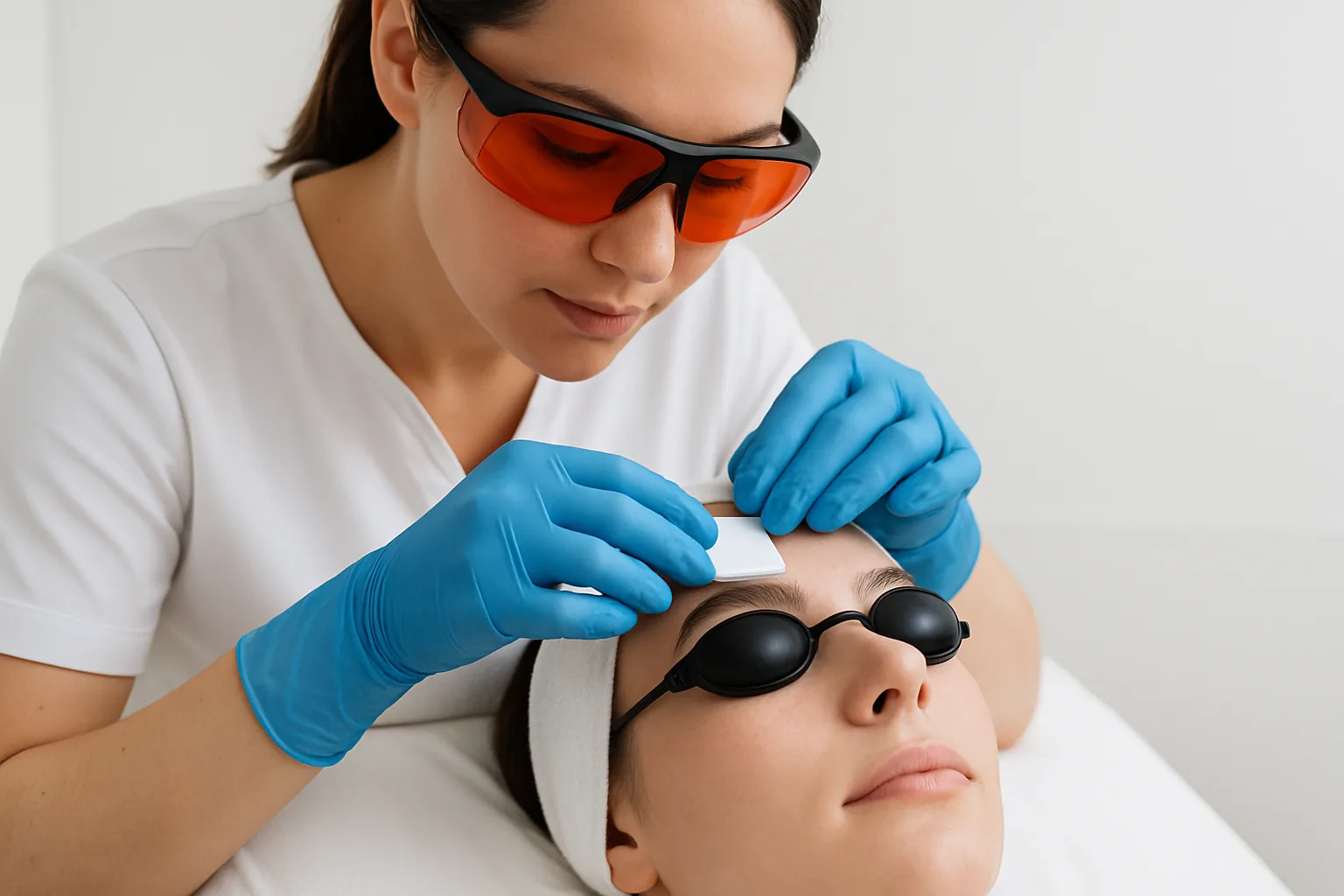
- Never let IPL or a resurfacing laser pass directly over microbladed brows unless darkening is the outcome you want. Standard guidance for IPL over permanent makeup is to shield the area.
- Ask about proximity, not just contact. Light energy scatters into neighbouring skin. Treating redness right up to the brow line is close enough to risk oxidizing the pigment.
- Tell the laser technician you have permanent makeup before they map the treatment area, not afterwards. A brow shield takes ten seconds to place and cannot be applied retroactively.
- Laser hair removal on the forehead or between the brows is the sleeper risk in this group, because the entire point of the treatment is to fire energy at pigment sitting near your brows.
Ordering barely matters here, since the brows are shielded either way. What matters is that every practitioner in the chain knows the pigment is there. Then give fresh microblading at least four weeks before any facial laser work, shielded or not, so your skin is not healing from two things at once.
Peels, Retinoids, and Everything That Exfoliates
Chemical peels, glycolic and salicylic acids, AHAs, and retinol all do the same job: they speed up cell turnover. On healthy skin that is the entire point. Over pigment sitting in the upper dermis, it is a fade accelerator, and daily retinol use is widely reported to roughly halve how long microblading lasts.
Before microblading: stop retinoids and acids on the brow area for at least two weeks, and schedule peels, microdermabrasion, and other intense exfoliation three to four weeks out. Recently resurfaced skin is thinner and bleeds more readily during the procedure, and more bleeding means worse pigment retention. Isotretinoin (Accutane) is a different order of magnitude and usually calls for a six- to twelve-month gap on a doctor’s guidance, as covered in our risks and contraindications guide.
After microblading: wait four weeks before a peel, and keep acids and retinol off the brow area permanently if you want to keep the strokes. You do not have to give up your actives. You have to give up applying them to a two-inch strip of your face, which most people manage by routing their fingertips around the brows rather than changing product.
Microneedling, Dermaplaning, and Facials
Microneedling should never run directly over microbladed brows. The needles disturb pigment that is barely deep enough to stay put in the first place, and the result is uneven dispersion rather than a clean, gradual fade. Microneedling elsewhere on the face is fine once the brows have fully healed, roughly four to six weeks out.
Dermaplaning is a blade drawn across the skin to remove dead cells and vellus hair. It exfoliates, so the same rule applies: not over the brows, and not inside the healing window. Most estheticians will happily work around the area if asked. Put that request in your booking notes rather than raising it once you are on the table.
Facials are the most commonly forgotten collision, because they feel gentle. A hydrating facial away from the brow area is harmless once you are healed. Steam, extractions, and any exfoliating step near the brows are not, and a facial inside the first four weeks after microblading is one of the more expensive mistakes on this list. The full healing picture lives in our aftercare guide.
Lash Lifts, Tints, and Same-Day Stacking
Lash work is the one category where people genuinely try to stack services into a single appointment, and it is where studios disagree with each other.
The case for lashes first is mechanical. A lash technician rests their hands and tools on the brow bone and forehead for an hour, and that is not the kind of pressure you want on brows tattooed twenty minutes earlier. The case for brows first is that lash adhesive and lift solution have no business anywhere near open microblading channels.
Both concerns are legitimate, which is a decent argument for not doing them on the same day at all. If your studio offers a combined booking, ask specifically how they keep the two aftercare routines apart: lash extensions must stay dry for the first 24 to 48 hours, while brows need cleansing and ointment on a schedule, and those instructions actively fight each other. A week between appointments solves the whole problem for the price of a second trip.
Lash lifts and tints on their own carry lower risk, but keep the solutions off the brow skin and leave at least two weeks after microblading.
The Calendar, in One Place
Working outward from a microblading appointment:
- Botox: 2 weeks before, or 2 weeks after
- Filler at the temple, forehead, or brow bone: 2 weeks before
- Chemical peel or microdermabrasion: 3 to 4 weeks before, 4 weeks after
- Retinol and acid serums on the brow area: stop 2 weeks before, keep off permanently
- Facial laser or IPL: brows shielded always, and 4 weeks after microblading before any facial laser work
- Microneedling and dermaplaning: never over the brows, 4 to 6 weeks after for the rest of the face
- Facials, steam, and extractions: 4 weeks after
- Lash lift, tint, or extensions: 1 to 2 weeks either side, not the same day
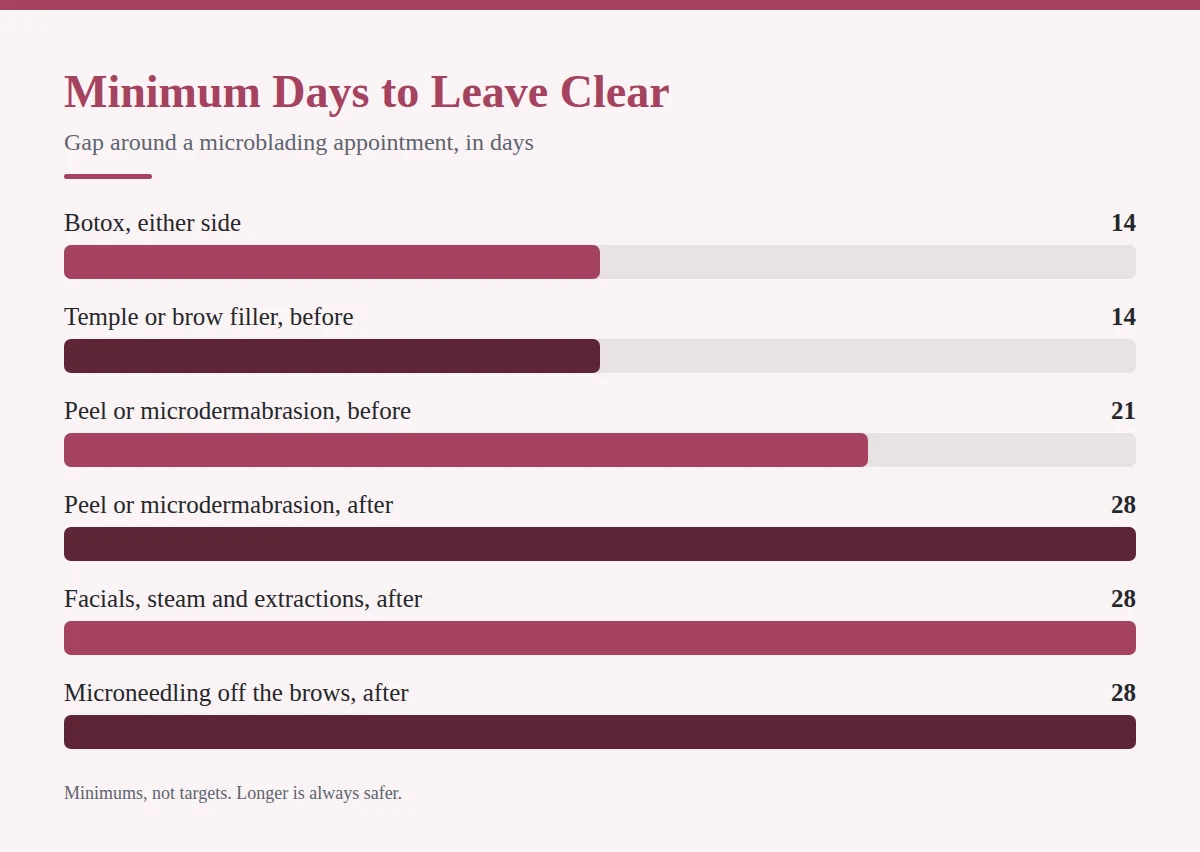
Working backward from a fixed date is the harder version of the same arithmetic, because the perfecting session has to fit inside the window too. Our wedding brow timeline runs that calculation through for a wedding, and the method transfers to any deadline.
Say It Out Loud at Every Booking
The failure mode in all of this is not ignorance. It is that your injector, your laser tech, your esthetician, and your brow artist each know their own aftercare rules perfectly well and have no idea what the others have booked. Nobody is coordinating your face, and none of the intake forms ask.
So do it yourself. Keep the dates in one place, mention permanent makeup at every cosmetic booking whether or not the form asks for it, and tell your brow artist about anything scheduled in the eight weeks either side of your appointment. Where cosmetic timing overlaps with medical treatment, that is a conversation for your doctor rather than your artist, and our guide to microblading after chemo shows how much longer those timelines run.
The usual caveats apply here as everywhere in this field. Results vary enormously with artist skill and skin type, patch testing comes before any pigment goes in, and anyone with eczema, rosacea, or another active skin condition should get a dermatologist’s read before stacking procedures. But of all the variables that decide whether microblading still looks good in two years, the order of your appointments is the cheapest one to control. It costs nothing but a shared calendar.
Further reading (sources)
- Donaldson Plastic Surgery on why brow position makes the Botox order matter
- Santa Monica Skin for the two-week gap between microblading and injectables
- RealSelf with what IPL does to permanent makeup even when it is not treated directly
- Dermatologic Surgery on why cosmetic tattoo pigments darken under the laser
- PMUHub for the exfoliants and actives that speed up brow fading
- RealSelf with whether microneedling lifts pigment out of microbladed brows
- Chic Lash Boutique on stacking lash extensions and brow work in one sitting