Microblading in the UK: Wales's Special Procedures Licence, England's Crackdown, and What Changes for Brow Clients
Published on November 3, 2026
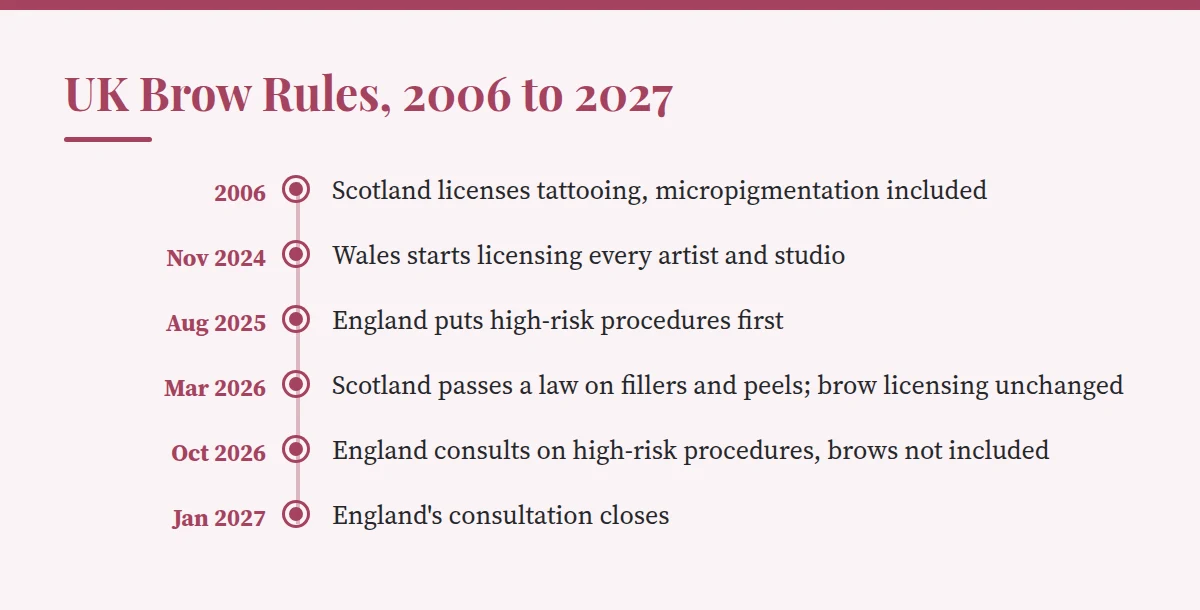
Since 29 November 2024, microblading artists working in Wales have needed a personal licence from their council, and the room they work in has needed an approval certificate of its own. Cross into England and the same artist needs only a council registration, which the law says the council shall grant on application, with no question asked about training. Then in August 2025 the UK government set out how it would crack down on unsafe cosmetic procedures in England, and brow clients reasonably wondered whether that meant them.
For now, mostly it does not. This guide covers what each part of the UK requires of the person holding the blade, what a Welsh licence changes about your appointment, how to check an artist in each country, and what no licence anywhere in the UK checks for you. It describes the rules as of November 2026. It is general information rather than legal advice, and England’s plans are still out for consultation.
Wales: A Licence for the Artist and an Approval for the Room
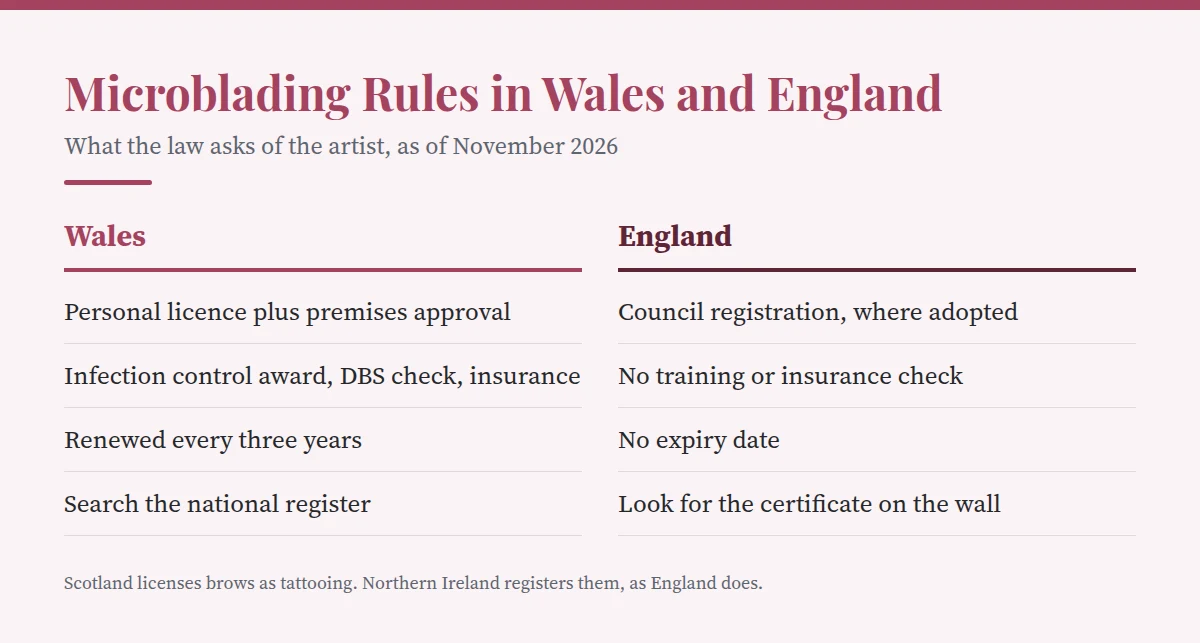
Wales was the first part of the UK to make licensing compulsory. Under Part 4 of the Public Health (Wales) Act 2017, four “special procedures” now need a licence: acupuncture, body piercing, electrolysis and tattooing, and the Welsh Government states plainly that tattooing includes semi-permanent make-up and microblading. The legal definition covers any colouring “designed to leave a semi-permanent or permanent mark”, so the argument that brows are not really a tattoo goes nowhere in Wales (or anywhere else, as our explainer on whether microblading is a tattoo shows).
To get a licence, an artist must pass a regulated Level 2 award in infection prevention and control for special procedures, produce a basic Disclosure and Barring Service certificate no more than three months old, prove their identity, declare insurance covering the work and where it happens, and pass an interview at their place of work, where a council officer asks about infection control, first aid and the licence conditions. The licence lasts three years and then has to be renewed. Separately, whoever runs the studio, or the vehicle for mobile work, needs an approval certificate for it.
When the scheme opened, the BBC put the numbers at more than 4,000 practitioners and over 2,000 premises. Businesses registered under the old system could keep working while councils processed them, but that transition has now closed. The Welsh Government says anyone who missed it must apply as a new starter and faces enforcement if they carry on practising, and performing a special procedure without a licence is a criminal offence carrying an unlimited fine.
The rule also follows artists over the border. Someone licensed under another UK scheme who wants to work in Wales, at a guest spot for instance, needs a Welsh licence as well, and a temporary licence exists for a single event lasting no more than seven days.
What a Welsh Licence Changes in the Chair
The licence comes with mandatory conditions, and several of them are things you will notice from the client’s side of the appointment.
A signed consultation, kept for three years. Before any work, the artist must take a relevant medical history, including heart disease, epilepsy, diabetes, conditions that weaken immunity, allergies, pregnancy and prescribed medication such as anticoagulants. The Welsh template form also asks about psoriasis, eczema and raised keloid scars, the last of which our guide to keloid-prone skin covers in depth. You and the artist both sign it, and the artist keeps it for three years along with any doctor’s letters. Our walkthrough of a microblading intake and consent form shows what the same paperwork looks like in places where nobody requires it.
A doctor’s letter when something is flagged. If the consultation turns up a contraindication, the artist must not go ahead unless satisfied the procedure can still be done safely. If they have concerns about your health, they must wait for advice from your GP or a consultant and keep a copy on file. The guidance adds a caveat worth knowing before you book: doctors are not obliged to write these letters and may refuse.
No numbing cream from the artist. A licence holder must not supply or apply a topical anaesthetic before, during or after the procedure. You may numb your own skin beforehand, but only with a product approved and authorised by the Medicines and Healthcare products Regulatory Agency (MHRA), and the artist must not start if they cannot confirm that it is. Bring the box and the leaflet. Of all the conditions, this is the one most likely to change how a brow appointment runs.

Your pigment on record. The brand, colour code and batch code of every pigment used on you must go into your record at the time of the procedure. If you ever react, that is exactly what a dermatologist or an investigator will want to know.
Aftercare in writing, and adults only. Aftercare advice has to be given out loud and in writing, with the artist’s contact details on it. The guidance treats semi-permanent make-up as off limits for anyone under 18 and tells artists to ask for proof of age where there is any doubt. It also bars work on anyone who is, or appears to be, intoxicated.
How to Check a Welsh Artist Before You Book
Wales is the only part of the UK with a single national register of who may do this work. The Welsh Government links it from its licensing scheme page, and it lists licence holders alongside approved premises and vehicles. Search for the artist and for the studio, because both need to be on it.
In person, look for two documents. Licence holders must display their licence at their main place of work, or wear the photocard version on a lanyard when they work elsewhere, and an approved studio or vehicle must display its approval certificate. If an artist cannot show you either and the register has never heard of them, book someone else and tell the council.
England: Registration, Not a Licence
England has no licence for microblading. What it has is older and thinner: Part VIII of the Local Government (Miscellaneous Provisions) Act 1982, which since 2004 has covered “semi-permanent skin-colouring”, defined as “the insertion of semi-permanent colouring into a person’s skin”. Where a council has adopted these provisions, both the artist and the premises must be registered with it, and working unregistered is an offence.
Registration is not an exam. When someone applies, the Act says the council “shall register the applicant” and the premises. Its teeth are byelaws, which a council may make about the cleanliness of the premises and the people working in them and about cleaning and sterilising instruments. Nothing in the Act asks about training, qualifications or insurance, and the registration has no expiry date. The certificate and a copy of the byelaws must be prominently displayed where the artist works, so that is what to look for on the wall.
An English registration tells you that a council knows the business exists and expects it to be clean. It tells you nothing about whether the person holding the blade has done this before.
England’s Crackdown, and Where Brows Sit in It
The power to go further has existed since 2022, when section 180 of the Health and Care Act gave the health secretary authority to license non-surgical cosmetic procedures. A 2023 consultation sketched a scheme with three risk tiers, and brows were in it. The lowest-risk green tier, which any practitioner meeting agreed standards could perform under a licence, listed “micropigmentation (semi-permanent make up), including microblading and nanoblading”.
The government’s response, published in August 2025 after more than 11,800 replies, reordered the work. The highest-risk procedures would come first, such as fillers used to augment the breasts, buttocks or genitals, which would be restricted to regulated healthcare professionals working for providers registered with the Care Quality Commission. Licensing for lower-risk procedures would keep being developed, with no date attached. The replies also showed that brows were not settled. Some organisations wanted micropigmentation moved up into the amber tier, and one argued that because semi-permanent skin-colouring is already registered under the 1982 Act, either it should come out of the new scheme or every registered procedure should come in with it.
The follow-up consultation, which that response promised for early 2026, was published on 21 October 2026 and closes on 13 January 2027. It covers only the high-risk list: cosmetic surgery, fillers anywhere other than the face, deep chemical peels, dermal microcoring, intravenous procedures, non-resorbable facial fillers, subcision, blood procedures such as platelet-rich plasma, some laser treatments, and cosmetic procedures that involve an anaesthetic given as a separate injection. Semi-permanent make-up, micropigmentation and microblading do not appear in it. On everything else, the document says only that licensing of high street treatments “will subsequently go further”.
For a brow client in England, then, nothing has changed yet. Your artist needs the same council registration as before. A licence for brows is at least one more consultation and a set of regulations away, and which tier brows would land in is still an open question.
Scotland and Northern Ireland
Scotland has licensed brow work for two decades with little fuss. Since 2006, a business offering tattooing has needed a skin piercing and tattooing licence from the council under the Civic Government (Scotland) Act 1982, and tattooing there means inserting any colouring “designed to leave a semi permanent or permanent mark including micropigmentation”. Edinburgh’s guidance for applicants applies that to artists who travel to their clients as well as those working from premises, so ask to see the licence either way.
In March 2026 the Scottish Parliament passed the Non-surgical Procedures and Functions of Medical Reviewers (Scotland) Act, which received Royal Assent on 12 May. It targets injectables, chemical peels, ablative lasers, deeper microneedling and similar treatments, bars them for under-18s and confines them to permitted premises, and its definitions expressly leave tattooing out. Those bans are not in force yet: only preparatory parts, such as the definitions and the powers to make regulations, took effect on 22 July 2026.
Northern Ireland works much like England. Councils register and inspect businesses offering semi-permanent skin colouring under a 1985 order. Belfast, for one, inspects the premises against its byelaws before registering the business, and expects the registration certificate to be on display.
Why Prices Are Going Up
The Welsh scheme puts real costs on the artist’s side of the chair. The BBC reported a practitioner licence at £203 and a premises approval at £385. A Newport tattoo studio owner told the BBC she pays for both, on top of insurance and the extra course, will have to do it all again every three years, and expected prices to rise to cover it. Wales’s deputy chief medical officer said the fees had been set “at a very modest level” and called three-yearly renewal a “reasonable compromise”.
Spread across a busy artist’s diary, that is a small sum per client. For someone doing a handful of brows a month around another job, it is not. England has no equivalent bill yet. Its consultation response lists a fees model among the details still to be designed for licensing, alongside training standards, insurance and qualifications, so a cost will arrive whenever licensing does.
What No UK Licence Checks
Even the Welsh licence, the strictest in the UK, is a floor rather than a quality mark. Look again at what it requires: infection control training, a criminal record check, insurance, identity and an interview. None of those tests brow mapping, stroke depth or colour choice, and an English registration asks for none of them at all. A licence makes it less likely you leave with an infection. It does not make it likely you leave with good brows, because results still depend heavily on the artist’s skill and on your skin. Healed photos of the artist’s own work, at least a few months old, remain the best evidence, and our questions to ask before booking cover how to read them.
No licence looks inside the pigment bottle, either. In December 2025 the UK government decided to restrict hazardous substances in tattoo and permanent make-up inks in Great Britain, and its draft amendment names microblading and micropigmentation explicitly. None of its limits applies yet: once the rule takes effect, suppliers get two years and artists three to comply. The EU already has limits of its own, which our guide to how brow pigment is regulated explains. Until the British limits bite, the batch code a Welsh artist records is what lets a reaction be traced back to a bottle, and outside Wales it is worth asking your artist to write it down for you.
Before You Book, Wherever You Live
- Wales: search the national register for the artist and the premises, look for the displayed licence and approval certificate, and expect a signed consultation. Numb yourself beforehand with an MHRA-authorised product, or go without.
- England: ask to see the council registration certificate and byelaws, then ask about training and insurance yourself, because the registration did not.
- Scotland: ask to see the council’s skin piercing and tattooing licence, including from an artist who comes to you.
- Northern Ireland: look for the council registration certificate.
- Everywhere: ask for a patch test ahead of the appointment, see healed work, watch single-use tools come out of sealed packaging, and get the pigment brand and batch in writing. If you have eczema, rosacea or another skin condition around the brows, see a dermatologist before you book. And remember that microblading is semi-permanent: whatever licence the artist holds, the result fades over the following years and will need topping up.
Wales has shown what licensing brows looks like, and Scotland has quietly done it since 2006. England is still deciding whether brows belong in its scheme at all, and until it decides, the checks that matter most there are the ones you make yourself. Wherever a licence exists, an artist working without one is a safety risk worth walking away from, whatever the price.
Sources
- Welsh Government on the licensing scheme, its display rules and the national register
- Welsh Government with its guidance for tattooing and semi-permanent make-up licence holders
- BBC News on licence fees and what Welsh artists expect to happen to prices
- Local Government (Miscellaneous Provisions) Act 1982, Part VIII, for England’s registration of semi-permanent skin-colouring
- Department of Health and Social Care on the 2025 response that put high-risk procedures first
- Department of Health and Social Care with its October 2026 consultation on high-risk procedures
- City of Edinburgh Council for who needs a skin piercing and tattooing licence in Scotland
- Non-surgical Procedures and Functions of Medical Reviewers (Scotland) Act 2026, setting out the Act’s restricted procedures and its tattooing carve-out
- Belfast City Council on registering and inspecting cosmetic businesses in Northern Ireland
- Department for Environment, Food and Rural Affairs with the draft restriction on hazardous substances in tattoo and PMU inks