Microblading With Scleroderma: Systemic Sclerosis, Morphea, and the Brow Lost to En Coup de Sabre
Published on October 28, 2026

Scleroderma means “hard skin”, and on most microblading health forms it shares a single tick box with every other autoimmune condition. That box hides two very different diseases. Systemic sclerosis is a whole-body illness of the skin, the small blood vessels and sometimes the internal organs, and it can tighten the face. Localized scleroderma, usually called morphea, stays in the skin and the tissue just beneath it, and its linear form on the forehead, known as en coup de sabre, can carve a sunken, hairless band straight through one brow. That second form is the one most likely to take a brow away outright, and the reason many people with scleroderma first wonder about microblading. This guide covers what each disease does to the skin you want pigment in, why an active band gets a refusal, how medication and circulation change the plan, and what your dermatologist or rheumatologist should sign off before anyone picks up a blade.
Two Diseases That Share a Name
Almost every answer in this article depends on which form you have, so start there.
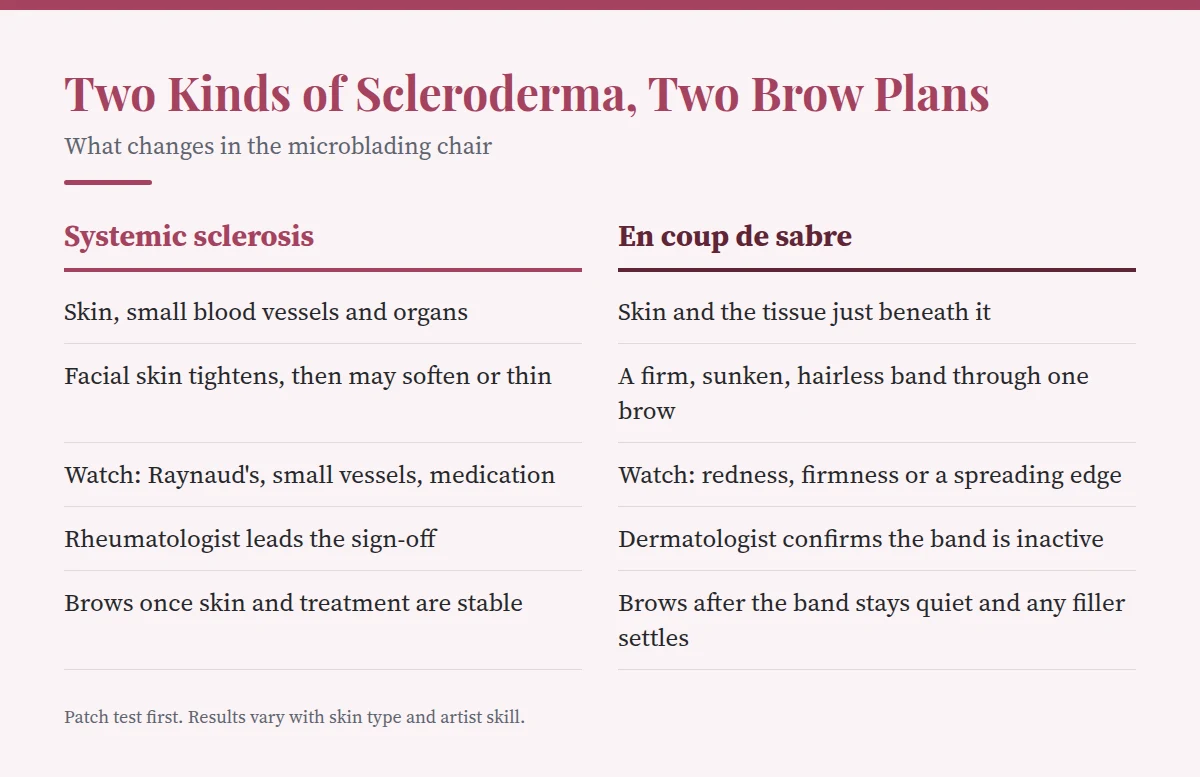
Localized scleroderma appears as firm oval plaques (morphea) or as a line of thickened, discoloured skin that usually runs down an arm or leg and, less often, down the forehead and face. It is more common in children than in adults. A 2024 German dermatology guideline is explicit that it does not involve the internal organs and does not turn into systemic sclerosis, which is worth knowing if a band on your forehead has always left you anxious about what comes next.
Systemic sclerosis is the more serious relative. It damages blood vessels and can involve the lungs, heart, kidneys and gut. The limited form tends to affect the skin of the fingers, hands, lower arms, lower legs and face, while the diffuse form spreads further and faster. Scleroderma usually appears between 30 and 50 and is more common in women, and NIAMS notes that it tends to start earlier and involve more skin in African Americans.
The two also come with different doctors. Most people with scleroderma are looked after by a rheumatologist, and dermatologists play a bigger role in the localized form. That is why the sign-off you need, covered at the end of this guide, depends on your diagnosis.
En Coup de Sabre: The Band Through the Brow
En coup de sabre is French for “stroke of a sabre”, and the name fits. It is a form of linear morphea that usually runs down the forehead or front of the scalp on one side, sometimes continuing onto the nose, cheek or upper lip. The skin inside the line is typically firm, shiny and darker than its surroundings, sits lower than the rest of the forehead, and loses its hair, including any brow it crosses. Biopsies of the hairless band show dense scarring and fewer hair follicles, and the loss behaves like the other scarring alopecias. Unlike the patchy loss of alopecia areata, covered in our guide to microblading for medical brow loss, there is usually no regrowth to wait for. That is exactly why a band through the brow makes sense as a reason for cosmetic work: the missing section will not refill on its own.
Most cases begin early. A Mayo Clinic review puts the average age of onset around 10, and roughly two thirds of linear morphea starts before the age of 18. The same review describes the en coup de sabre and hemifacial atrophy spectrum as slowly progressive but self-limiting, typically burning out within 2 to 10 years. So the usual client is an adult with an old, quiet band and a brow that has been broken for most of their life.
Quiet is not the same as finished, though. In a Texas registry of 27 adults whose morphea began in childhood, 24 had developed new or enlarged lesions over the years, with recurrences 6 to 18 years after the disease first appeared. Seven linked a flare to something specific, including trauma, stopping or tapering treatment, and pregnancy. The registry drew on a specialist referral clinic, which makes it likely to overstate how often this happens, and the authors say so. It still means an old band deserves a recent dermatology look rather than an assumption.
Active or Burnt Out: Why an Active Band Gets a Refusal
Whether a morphea band is still active is the most important question here, and it is one for a dermatologist rather than an artist with good lighting. Specialists score activity on specific signs: redness, how thick and firm the skin is, and whether lesions are new or spreading at the edge. Damage, the permanent part, is scored separately as thinning, loss of the fat beneath, and lighter or darker colour. NIAMS describes morphea patches as waxy with a reddish or bruise-like edge, and notes that the disease usually settles but can leave darkened skin behind. A soft, brown, sunken band with no coloured rim is the burnt-out picture. A pink or violet edge, new firmness, or a line that has crept further in the past year is not.
An active band should be refused for three reasons, and they compound.
Injury may trigger more disease. In a study of 329 people with morphea, 16 percent had their first lesions at sites of earlier skin trauma or friction, most often previous surgery or rubbing from clothing, with penetrating injuries and injections also on the list. The authors concluded that, if other studies confirm it, elective procedures might be best avoided in these patients. A microblading appointment is hundreds of small, deliberate cuts in exactly the skin in question.
Pigment hides the evidence. The redness and the advancing edge that your dermatologist watches to judge whether treatment is working are exactly what a dense band of brow pigment would cover.
An active band is still moving. Strokes placed along today’s edge end up in the wrong place if the band widens or deepens next year.
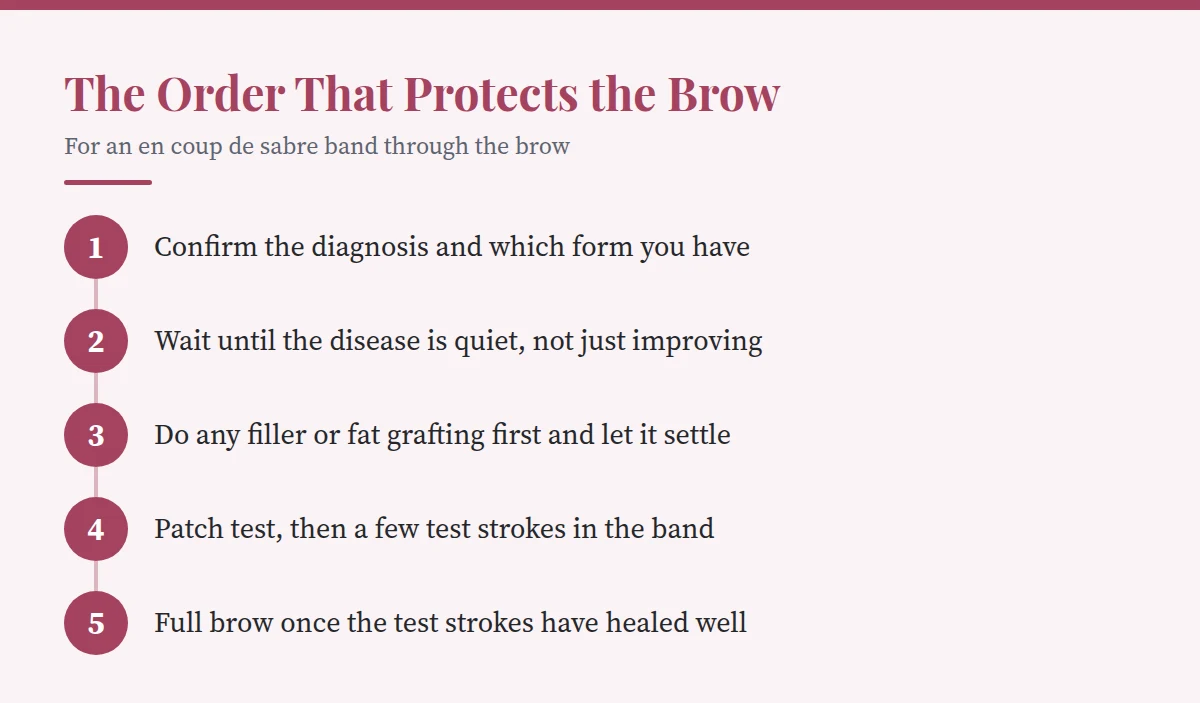
There is no published waiting period for microblading over morphea, so borrow the standard specialists apply to their own work. For progressive hemifacial atrophy, which sits on the same spectrum as en coup de sabre and often appears alongside it, most experts recommend delaying reconstructive procedures until the disease has stopped progressing, partly so the work is not redone as the defect changes. Quiet, not merely improving, is the same bar our guide to microblading with seborrheic dermatitis, eczema or rosacea sets for flaky brows. Ask your dermatologist to confirm in writing that the band is inactive, and keep dated photographs of it. Doctors follow these conditions by photograph too.
What Systemic Sclerosis Changes Around the Brows
For a brow artist, what systemic sclerosis changes is mainly the canvas. As facial skin thickens and tightens it can narrow the mouth opening, and reviews of cosmetic treatment in this group also describe thin lips, hard plaques and areas of thinned, atrophic skin. Four things follow for a brow.
Tight skin is harder to design for. An artist maps a brow around how the forehead moves and where the brow sits when the face is relaxed. When forehead skin is bound down, that movement shrinks, and a brow drawn to look natural on a mobile face can look fixed and heavy on a still one. Softer, slightly lighter designs usually age better here.
The canvas changes over time. Skin thickening in the diffuse form often eases. In a European registry of 1,257 people with diffuse disease, about one in five showed a meaningful softening of their skin score within a year. That is good news for the person and a planning problem for the brow, because work mapped during an early, tight phase may sit differently once the forehead relaxes. The sensible window is after your skin has been stable for a while, which your rheumatologist can judge from your skin scores.
Telangiectasias are common. These small, permanently widened blood vessels turn up on the face and hands of many people with systemic sclerosis. A blade drawn through them bleeds more, and blood pushes pigment back out of the channel, one of the classic routes to patchy retention. An artist should work around any in the brow zone rather than through them, and your dermatologist can say whether yours are worth treating first.
Tattoos can react in a scleroderma-like way. A recently published case describes a woman with known systemic sclerosis whose red tattoo healed abnormally and then thickened. The biopsy matched a morphea-like reaction, and she needed a strong steroid cream and mycophenolate to settle it. The handful of earlier reports were mostly in people with no connective tissue disease. Warm brown brow pigments often contain organic reds, as our article on red and warm pigment reactions explains, so ask exactly what is in the bottle and have a patch test read late rather than at 48 hours. Even then, a clean patch test is reassuring rather than a guarantee.
Raynaud’s, Small Vessels and Healing
Raynaud’s phenomenon is one of the most familiar symptoms of systemic sclerosis: fingers or toes that turn white, blue or red and feel numb or painful in the cold or under stress. It is the visible sign of a disease that injures small blood vessels, and the same vascular damage is behind the finger ulcers that are common in the condition.

The first practical point is comfort. A brow appointment means an hour or two lying still, often in a cool room. NIAMS advises people with scleroderma to keep warm, dress in layers, wear gloves and avoid cold rooms, so ask for the room to be warmed, bring a cardigan, and treat a blanket as reasonable rather than fussy. Stress is a trigger too, which is one more reason to book with an artist who explains each step before doing it. Smoking narrows the same vessels, and NIAMS lists quitting among its first recommendations.
The second point is healing, where the evidence is more reassuring than people expect. Poor healing in systemic sclerosis concentrates where circulation is worst, mostly the fingers. In a Swedish series of 41 hand and forearm operations in people with the disease, the 27 planned operations produced just one minor wound problem, while urgent operations on skin that had already broken down or lost its blood supply healed far less reliably. The face is not usually where circulation fails first, so for most clients the brow questions are skin texture and medication rather than a body that cannot heal. If you have had slow-healing sores on your face, or your rheumatologist is concerned about your circulation, say so, because the plan changes.
Immunosuppressants and Timing
Many people with either disease take drugs that damp the immune system. Small morphea plaques are usually treated with creams, but for linear or more severe morphea the usual choice is methotrexate, often with a course of steroids during the active phase, and mycophenolate or abatacept as second-line options. For systemic sclerosis, the current European recommendations name mycophenolate, rituximab and tocilizumab among the treatments for skin and lung involvement.
Being on one of these is not automatically a no. A dermatology chapter on contraindications for tattooing points out that systematically advising people on mild immunosuppressive treatment against a tattoo is not supported, while it remains reasonable to delay when the disease itself is active. The level of immunosuppression, the disease and any other conditions all count, which is why the answer comes from your prescriber rather than your artist. Two rules hold regardless: never pause or skip a prescribed drug to make yourself a better candidate, and ask your doctor whether one point in your dosing schedule suits a procedure better than another. Our guide to microblading with an autoimmune condition covers how these drug classes affect infection risk and healing in more detail.
Morphea treatment has a rhythm worth planning around. European consensus for childhood localized scleroderma, which is when most bands begin, recommends continuing methotrexate for at least 12 months after a good response before tapering, and suggests considering stopping only once the disease has been in remission and off steroids for at least a year. Flares can follow stopping, so the week of your last dose is not the moment to book either. Let the band show it is staying quiet off treatment first.
Contour First, Brows Second
A burnt-out band often leaves a groove, and many people with en coup de sabre treat the groove before anything else. Hyaluronic acid filler and fat grafting are the usual options for mild to moderate volume loss, with surgery for larger defects, and the Mayo Clinic review also lists eyebrow repair and hair transplantation among the procedures used to improve the result. A 2026 systematic review of hyaluronic acid filler in systemic sclerosis and morphea found 19 small studies, with the forehead among the most commonly treated areas. Results were generally good, side effects were mild, no flares were reported, and inactive lesions responded better than inflamed ones. The evidence is still case reports and small series, so treat it as encouraging rather than settled.
If you are planning contour work, do it first. Restoring volume changes the shape of the forehead, the way light falls across it, and sometimes where the brow on that side rests, so a brow tattooed beforehand can end up sitting wrong. Let the filler or graft settle, then map. Our guide to sequencing cosmetic treatments around microblading gives the general waiting periods for filler, and the doctor who does a fat graft should set the wait after one.
Mapping a Brow Across a Band
Once the medical questions are answered, the artistry becomes the hard part.
Design from the unaffected side. For most en coup de sabre clients the brow on the other side is intact and becomes the template for height, arch and tail. Perfect symmetry is not always possible when the bone or soft tissue beneath one brow differs from the other, and a good artist will show you where the compromise sits before committing to anything.
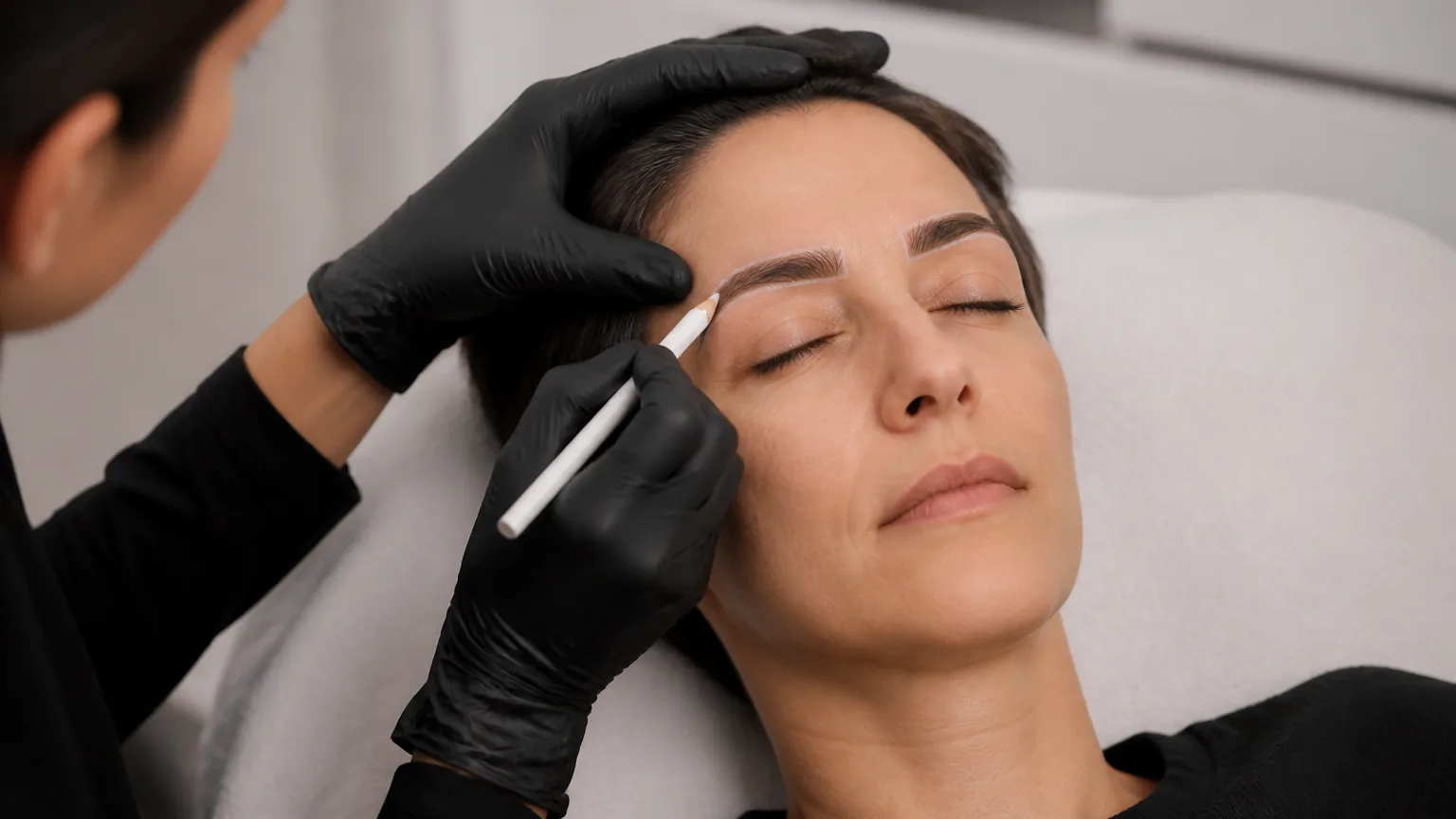
Expect the band to take pigment differently from the rest of the brow. Firm, sclerotic skin resists a blade in some places, and thin, atrophic skin lets it go too deep in others, which is how pigment spreads into a blurred patch. The band’s own colour, often darker, changes how a shade reads once healed. That is why many artists working on scarred or sclerotic skin choose soft machine shading over crisp blade strokes, and why a few test strokes in the band, healed and reviewed at six to eight weeks, are worth more than any promise. Brow makeup remains a perfectly good choice while you decide.
What the Medical Sign-Off Should Say
“My doctor says it’s fine” is not clearance. Ask for a letter, in writing and before you book rather than on the day, that covers:
- The diagnosis: systemic sclerosis or localized scleroderma, and which subtype.
- Activity: whether the disease is active now and how long it has been quiet, and for a morphea band, that a dermatologist has examined it recently.
- Medication: what you take, whether a course is ending, and any preferred timing within your dosing schedule.
- Trauma to the brow and forehead: an explicit view on whether hundreds of small cuts there are acceptable for your disease.
- Circulation and healing, for systemic sclerosis: how severe your Raynaud’s is, any history of ulcers or slow healing, and telangiectasias near the brows.
- Planned contour work, with its timing, so the brow can follow it.

If the band reaches your eyelid or lashes, ask whether your eye doctor should weigh in as well. Consensus guidance recommends eye screening for children whose localized scleroderma affects the face or scalp, because the disease can involve the eyelid and lashes directly.
Then take the letter to your artist, and expect a good one to read it. They should patch test, offer test strokes on a band, keep the room warm, and be honest about results: semi-permanent, more variable on altered skin, and more likely than average to need a third session. Results always depend on the artist’s skill as much as your skin. Microblading is a regulated procedure, so check the artist’s licence before anything else; an unlicensed practitioner is a risk no medical letter can fix.
Scleroderma does not rule microblading out, and for someone with an old en coup de sabre band a restored brow can be one of the most meaningful things cosmetic tattooing does. It just comes with an order: a clear diagnosis, a quiet disease, any contour work, and the brow last. Skip a step and the brow you commit to may end up on skin that is still changing.
Sources
- MedlinePlus on the two main types of scleroderma and their symptoms
- NIAMS for what morphea and linear scleroderma look like, and who gets each form
- NIAMS with scleroderma treatment, the specialists involved, and keeping warm with Raynaud’s
- Kreuter and colleagues on the German guideline for diagnosing and treating localized scleroderma
- Tolkachjov and colleagues for en coup de sabre, hemifacial atrophy, and when reconstruction is timed
- Pierre-Louis and colleagues on what biopsies of en coup de sabre hair loss show
- Saxton-Daniels and Jacobe with long-term outcomes in adults whose morphea began in childhood
- Zulian and colleagues for consensus recommendations on childhood localized scleroderma
- Grabell and colleagues on morphea lesions that first appeared at sites of skin trauma
- Wyss and colleagues for how often skin thickening softens in diffuse systemic sclerosis
- Wells and colleagues on telangiectasias on the face and hands in systemic sclerosis
- Hobayan and colleagues with a morphea-like reaction in a tattoo on a woman with systemic sclerosis
- Hughes and Herrick on digital ulcers as a sign of vascular disease in systemic sclerosis
- Tägil and colleagues for wound healing after hand surgery in systemic sclerosis
- Del Galdo and colleagues with the 2023 European recommendations for treating systemic sclerosis
- Nicolas Kluger on contraindications for tattooing, including immunosuppressive treatment
- Gkouvi and colleagues for a systematic review of hyaluronic acid filler in scleroderma and morphea