Microblading With Acne-Prone Skin: Breakouts in the Brow Line, the Isotretinoin Wait, and the Acne Products That Fade Brows
Published on September 29, 2026
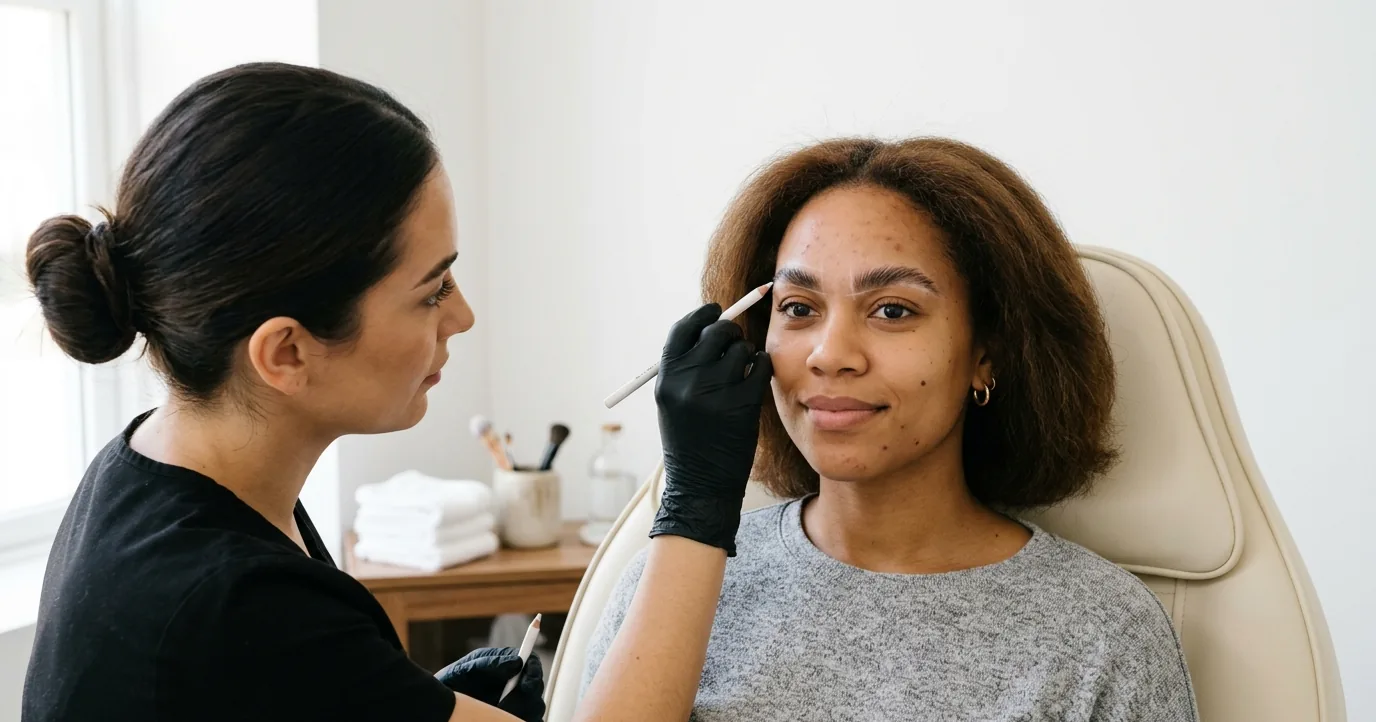
Most microblading advice gives acne a single line: postpone until your skin clears. That works for one stray spot the week before an appointment. It is less use when you are thirty, you have broken out along your forehead and jaw for a decade, and your bathroom shelf holds a prescription retinoid, a benzoyl peroxide wash and a course of doxycycline, or your dermatologist has just mentioned isotretinoin.
MedlinePlus notes that acne is common in young adults as well as teenagers, and the American Academy of Dermatology (AAD) says women get adult acne more often than men do. Acne-prone skin can be microbladed. What changes is the planning: when a breakout means moving the date, how long to wait after isotretinoin, which parts of your routine must stay off your brows for good, and how to keep the blade from leaving the kind of dark marks acne so often leaves behind. None of it means giving up treatment that is working.
Why Acne Treatment and Fresh Brows Pull in Opposite Directions
Microblading is a controlled wound. A hand tool cuts fine strokes into the skin and leaves pigment in the papillary dermis, just beneath the surface, as a dermatology review of the technique by Marwah and colleagues describes. For the first weeks that pigment is held by skin that is still knitting together, and the same review notes that areas with pinpoint bleeding during the procedure lose pigment.
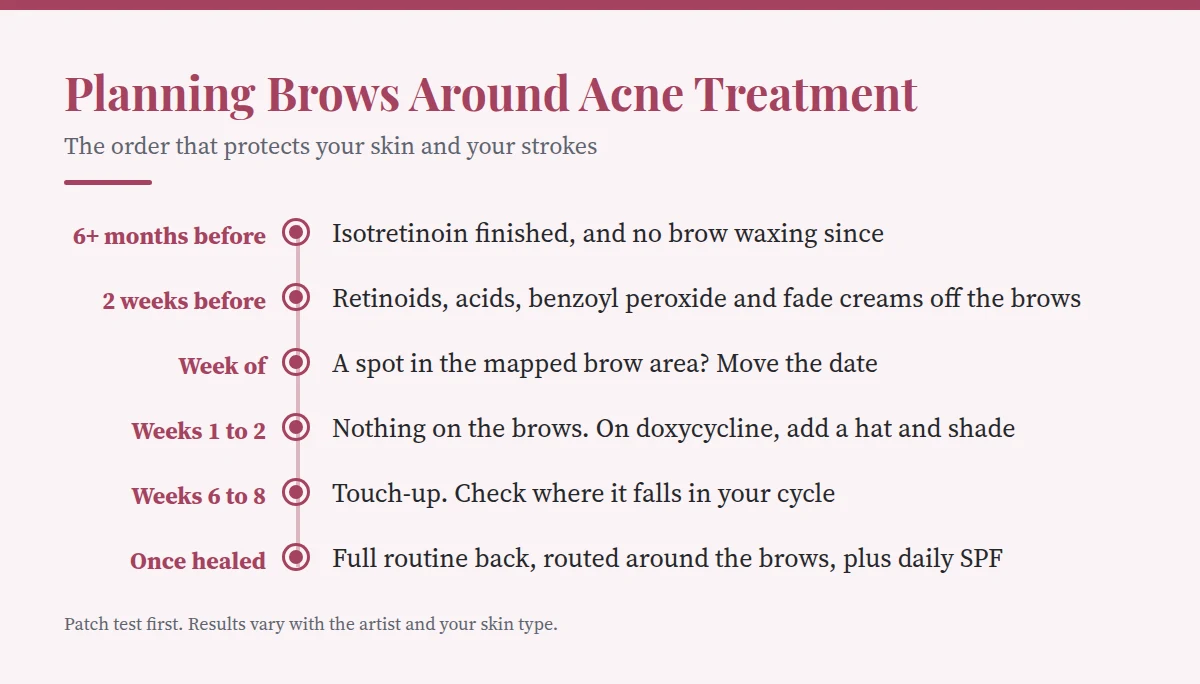
Most acne treatment works against that wound. Retinoids speed up the skin’s renewal. Salicylic acid loosens the surface layer to unclog pores. Benzoyl peroxide kills acne bacteria and can dry and peel the skin along the way. Isotretinoin, the strongest of them, lists skin fragility and abnormal wound healing among its reported side effects. Each is doing its job; it is just the wrong job for skin that needs to hold on to pigment.
Acne-prone skin is often oily too, and oil tends to blur fine strokes over time, which is why some artists steer oily, breakout-prone clients toward powder or combination brows (our skin type pairing guide explains the trade-offs). Whatever the technique, results vary with the artist’s skill and your skin type.
A Breakout in the Brow Line Means a New Date
If there is an active spot inside the area being mapped (a red bump, a whitehead, a tender lump under the skin), that brow does not get worked on that day. This is not artist fussiness. The Arkansas Department of Health’s rules for permanent cosmetic and tattoo studios require skin “free from rash, pimples, infection or recent scar tissue,” and Kentucky’s tattoo regulation bars work on skin with pimples unless a licensed medical provider has cleared it in writing.
A pimple is a clogged, inflamed hair follicle, so blading through one means cutting into inflamed skin exactly where you want pigment to heal cleanly. Swelling also changes the surface the artist is drawing on, and a stroke that looks right over a raised bump can sit wrong once it goes down.
Where the spot sits matters. One in the arch or tail means rebooking. One at your hairline, well clear of the mapped shape, is something many artists will work around, but mention it when you confirm. Rebook far enough out for the spot to flatten completely, usually a week or two for an ordinary pimple and longer for a deep, painful one. Meanwhile:
- Don’t pop it. The AAD warns that picking, popping or squeezing acne raises the risk of a scar, and scarred skin takes pigment unevenly.
- Don’t blitz it with spot treatment the night before. You would trade a pimple for a patch of irritated, peeling skin.
- Don’t wait out a “pimple” that behaves oddly. A bump in the brow that never comes to a head, bleeds, or keeps returning to the same place needs a doctor before an artist, as our guide to microblading over a mole or skin lesion explains.
If your breakouts follow your cycle, book around it. The AAD lists hormone swings around periods among the common drivers of adult acne, along with stress. Book the first session for the part of the month when your skin is usually calmest, and check where the touch-up, six to eight weeks later, falls in your cycle too.
The Isotretinoin Wait, and Where Six Months Comes From
Isotretinoin (the drug many people still call Accutane) is the one acne treatment that changes the calendar rather than the routine. Expect an artist to want at least six months between your last dose and your first session. Some ask for a year.
The six months comes from the drug’s own prescribing information, which tells patients to avoid wax epilation and skin resurfacing such as dermabrasion and laser “during isotretinoin therapy and for at least 6 months thereafter due to the possibility of scarring.” The label also lists skin fragility and abnormal wound healing, including delayed healing, among reported side effects. Tattooing is not on its list. Brow artists apply the rule by analogy, because microblading wounds the same skin.
The evidence behind the rule is thinner than its confidence suggests. In 2017 a panel of dermatologists and surgeons led by Spring reviewed 32 publications covering 1,485 procedures and pointed out that the belief rests on three small case series from the mid-1980s. They found insufficient evidence to justify delaying superficial chemical peels, laser hair removal, skin surgery or fractional lasers around isotretinoin, though they still advised against mechanical dermabrasion and fully ablative laser.
Tattooing was not part of that review, and the one published tattoo case leans toward caution. Kluger and Comte described a 19-year-old woman tattooed while taking 20 mg of isotretinoin, without telling her dermatologist or her tattoo artist. The session went smoothly; the healing did not. The tattoo healed poorly with no sign of infection, got there eventually with a proper moisturiser, and left a result she was unhappy with. One case proves little, and the authors called for surveys to find out whether the effect is real. A brow is an unforgiving place to become the second case.
So treat six months as the floor. The drug’s Medication Guide tells patients to ask their healthcare provider when they can have cosmetic procedures; if your dermatologist gives you a different timeline, get it in writing, and accept that your artist may still hold to their own policy. Two more points:
- No waxing, either. The label rules out wax epilation during the course and for six months after, so any brow tidy before your appointment is a job for tweezers.
- Don’t squeeze a session in just before you start. A normal course runs 15 to 20 weeks, according to the label. If the drug starts while your brows are still healing, you are repeating the case above. If it starts before the touch-up, that touch-up waits until six months after your last dose, the better part of a year after your first session.
If your dermatologist recommends isotretinoin, the acne comes first. Acne severe enough to need it can scar, and brows can wait.
The Everyday Routine That Quietly Fades Brows
Most acne-prone clients are on some version of the routine the AAD recommends for mild acne: a retinoid plus benzoyl peroxide, or salicylic acid, much of it sold without a prescription, including adapalene 0.1% gel. Each has its own reason to stay off your brows.
Retinoids (adapalene, tretinoin, tazarotene, retinol). Artists have long warned that retinoids fade brows, and one small animal study tested what a retinoid does to fresh tattoo pigment. Solis and colleagues tattooed five guinea pigs and, starting six hours later, gave each a different treatment (or none) for a week. The tattoo treated with plain petrolatum looked normal at 28 days. The one treated with tretinoin gel had faded, with moderate clearance of pigment under the microscope. One animal per treatment, on body tattoos, cannot tell you how much a nightly retinoid fades a healed brow over years. It does show that tretinoin on fresh pigment moves it, and fresh pigment is exactly what a healing brow holds.
Benzoyl peroxide. Federal labelling rules require over-the-counter benzoyl peroxide products to warn users to “avoid contact with hair and dyed fabrics, which may be bleached by this product.” Your brow hairs lie directly over the strokes, within reach of a wash worked across the forehead. Whether it can bleach pigment under the skin has not been studied. The same rules warn of irritation, meaning redness, burning, peeling or swelling, which is more likely when you layer acne products.
Salicylic acid and other acids. Salicylic acid works by loosening dead cells at the surface. Over a brow, that is an exfoliant working above shallow pigment, on the same keep-off list as glycolic acid and peels. Our guide to sequencing cosmetic treatments around microblading sets out the waits for peels and facials.
Dark-spot creams. The Marwah review names hydroquinone, the classic fade cream for acne marks, alongside retinol, chemical peels, exfoliating serums and scrubs as things microbladed brows need protecting from.
The schedule is simple. Before the appointment, stop all of these on the brow area for at least two weeks, longer if your artist asks. During healing, nothing goes on the brows at all, spot treatments included; acne-prone skin often breaks out along the brow line while it heals, and our guide to whiteheads, milia and pimples during healing covers what to do instead.
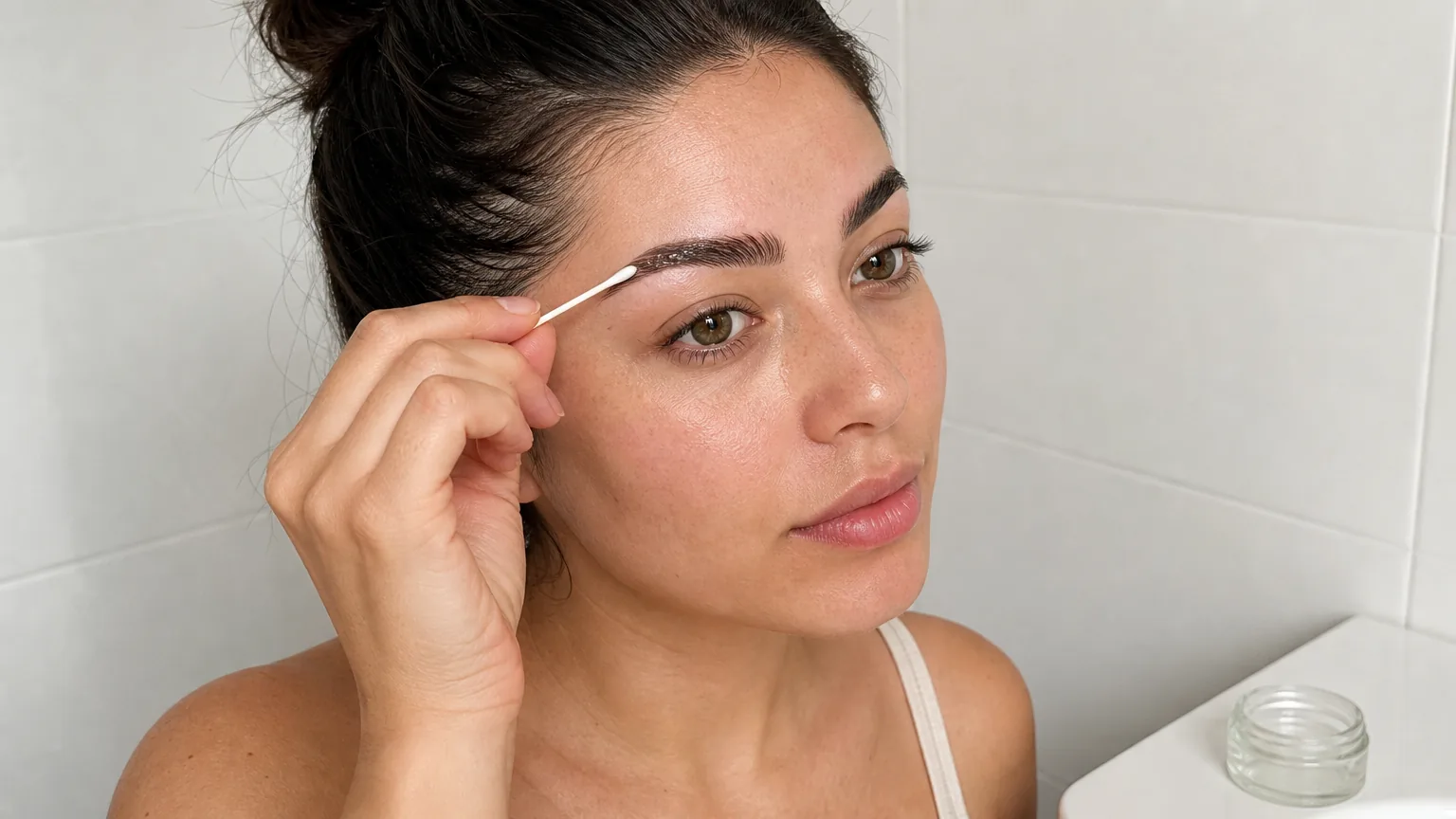
Once healed, return to your full routine everywhere except the brows. Marwah and colleagues suggest a layer of petroleum jelly over microbladed brows before retinol, acids or peels go on, so the brow is shielded if your fingers stray. Keep it to a thin film on the brow itself, since a heavy layer can clog follicles on acne-prone skin, and rinse benzoyl peroxide washes off without working the lather into your brows.
Doxycycline and the Healing Window
Doxycycline is a tetracycline antibiotic that MedlinePlus says treats acne by killing bacteria in clogged pores and lowering skin oil. For microblading, the issue is not the wound but the sun. MedlinePlus tells people taking it to avoid unnecessary or prolonged sunlight and to wear protective clothing, sunglasses and sunscreen, and a systematic review by Goetze and colleagues describes reactions ranging from sunburn-like burning and redness to widespread photodermatitis. The trigger seems to be mainly long-wave UVA, so protection has to cover UVA as well as the burning rays.
That collides with healing, because sunscreen stays off a fresh brow until it has healed. The protection has to be physical: a brimmed hat, shade, and no long stretches outdoors at midday for the first couple of weeks. Wash the hat often, since the AAD notes that caps worn unwashed collect sweat, dirt and oil that can make acne flare. Once healed, the brows get broad-spectrum sunscreen every day. A burn on a healing brow is inflammation stacked on a wound, the last thing acne-prone skin or its new pigment needs.

Don’t stop an antibiotic to make an appointment work. Tell your artist you are taking it, and if the course ends soon, ask your prescriber whether to book once it finishes.
Dark Marks: The Plan for Skin of Colour
For people with skin of colour, acne often leaves dark spots or patches that the AAD says can last much longer than the acne itself, and acne left to become moderate or severe raises the risk of both dark patches and keloids, a type of raised scar. Skin that darkens after every pimple is showing you how it responds to inflammation, and microblading causes inflammation by design.
Three things lower the risk. Get the acne under control before the brows; the AAD’s case for treating acne early doubles as brow advice. Patch test, and watch how the test spot heals as well as whether you react to the pigment. Then protect the healed brows from the sun every day, which our guide to microblading on dark and deeper skin tones covers along with keloid risk and pigment choice.
The AAD’s advice on peels and lasers is worth borrowing: see a dermatologist first if you have darkly pigmented skin, since even at-home versions can leave permanent dark marks and light spots, and ask how many people with skin of colour the doctor has treated. Ask a brow artist the same question, and ask to see healed results on skin like yours. If acne has ever left you with raised, thickened scars, say so at the consultation; that is a separate conversation, and sometimes a reason not to go ahead.
What a Good Consultation Covers
A careful artist asks about all of this before touching your brows; Marwah and colleagues list retinol creams, exfoliants, isotretinoin, chemical peels, oily skin and a tendency to keloids among the history to take first. If nobody asks, that tells you something about the studio. Microblading is a regulated procedure, and an unlicensed practitioner is a real safety risk, not least because these questions may never come up.
Bring a list of every product that touches your face and every prescription, with the date of your last isotretinoin dose if you have ever taken it. If your acne is active and untreated, or you also have rosacea or eczema, see a dermatologist before you book.
The Bottom Line
Acne-prone skin and microblading can coexist. The order is what protects both: acne under control first, isotretinoin at least six months behind you, actives off the brows two weeks before, a patch test before any pigment goes in, a new date if a spot appears in the brow line, shade through healing if you take doxycycline, then your full routine everywhere but the brows. Microblading is semi-permanent, not permanent, so routing around your brows is a habit you keep for as long as you want the strokes.
Sources
- American Academy of Dermatology on clearing acne in darker skin tones, and the dark marks and keloids it can leave
- AAD for what drives adult acne, from hormones around periods to stress
- MedlinePlus with an overview of acne in teenagers and young adults
- MedlinePlus on doxycycline for acne and its sunlight warning
- DailyMed for the isotretinoin prescribing information and its six-month procedure warning
- Spring and colleagues on the evidence behind delaying procedures after isotretinoin
- Kluger and Comte with a tattoo that healed poorly during isotretinoin treatment
- Solis and colleagues on tretinoin fading fresh tattoos in an animal model
- Goetze, Hiernickel and Elsner for a systematic review of doxycycline phototoxicity
- Marwah, Kerure and Marwah with a dermatology review of microblading technique and pre-procedure care
- Code of Federal Regulations on the warnings required on acne products, benzoyl peroxide included
- Arkansas Department of Health for the state’s rules for permanent cosmetic and tattoo studios
- Kentucky Administrative Regulations with the state’s tattoo rule on skin with pimples or infection
Further reading
- Microblading by skin type: the pairing guide for oily, dry, mature, and sensitive skin
- Whiteheads, milia, and pimples during microblading healing
- How to sequence Botox, fillers, lasers, and facials around microblading
- Microblading on dark and deeper skin tones
- Microblading over a mole or near a skin lesion