Eyebrow Embroidery, Feathering, 6D Brows, Cosmetic Tattoo: Decoding the Names Studios Use for Microblading
Published on October 12, 2026
Look for microblading in Singapore and the menus say eyebrow embroidery. In Australia the same service is sold as feathering. An Ontario studio describes itself as a cosmetic tattoo studio, England’s health department writes semi-permanent make up, and in Japan the procedure is called art makeup and happens in medical clinics. Marketing copy adds 3D and 6D brows, and medical journals often file the whole family under micropigmentation. A first-time client who researches only one of those names misses most of what has been written under the others: the healed results, the complaints, and the rules.
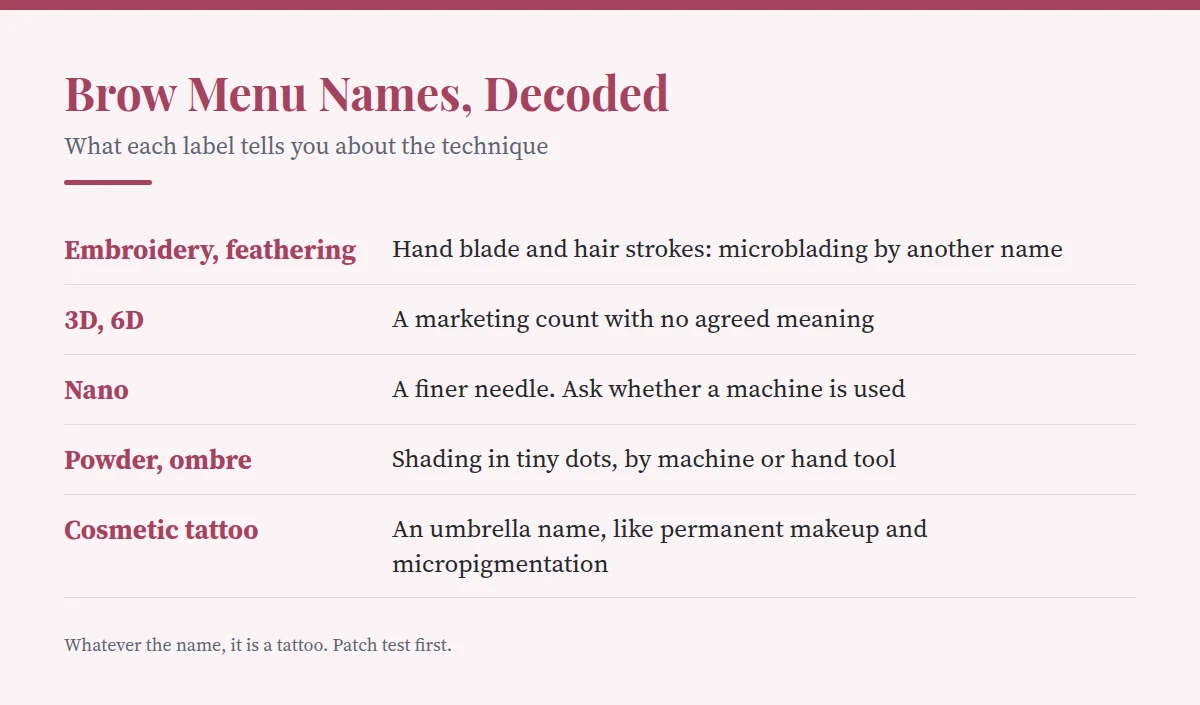
Underneath the labels there are really only two variables. One is the tool: a handheld blade that cuts fine lines into the skin, or a machine that punctures it with a needle. The other is the pattern the tool leaves: hair strokes, soft shading built from tiny dots, or both in one brow. Some names tell you one of those things, a few tell you both, and some tell you nothing beyond the fact that pigment is going into your skin. This guide sorts the common names into those groups, so you can turn any studio menu into a technique you can actually research.
Names That Mean a Hand Blade and Hair Strokes
Eyebrow embroidery. This is the everyday name in Singapore and Malaysia, and it is microblading by another name. A 2018 first-person account in Refinery29 listed the aliases in a single sentence: cosmetic tattooing, semi-permanent makeup, pigment embroidery, 3-D eyebrow embroidery, and microblading. Nothing is sewn; the embroidery is the pattern of fine strokes. Medical writing treats the words as synonyms too. A 2023 case report opens by describing eyebrow micropigmentation as “also known as eyebrow microblading or embroidery,” and Hong Kong’s Consumer Council, in its tips for clients, groups “microblading, shading, tattooing and embroidering” together as services for the eyebrows.
The gentler name tends to travel with gentler claims. The same Refinery29 piece told readers that embroidery needs “no tattoo gun, no ink, and no bleeding or downtime.” Only the first part holds. There is no machine, but the FDA lists microblading inks among the common types of tattoo, the blade makes real cuts in the skin, and the strokes take weeks to heal.
Feathering, feather touch, microfeathering. These are the Australian names for the same hand technique. The Australian beauty site BeautyCrew describes eyebrow feathering as a procedure that “uses a precise blade to create the look of individual hairs” and lists microfeathering, feather touch brows and feather tattoo eyebrows as other names for it. England’s government borrows the word as well, describing microblading as hair strokes made “with the microfeathering technique mimicking natural hairs.”
One trap: in fashion magazines, “feathered” or “feathery” brows usually means a grooming style, hairs brushed up and set in place, with no pigment at all. Vogue Scandinavia’s guide to the feathery brow is a lesson in pencil and clear gel. The same word can mean a tattoo on an Australian menu and a tube of brow gel in a magazine.
Hairstroke. This word now points both ways. A dermatology chapter by Hvas and Serup describes microblading as tattooing “hairstrokes” by hand, with a special blade whose tiny cuts are filled with pigment. In current studio marketing, though, hairstroke brows often means machine work, which belongs in a later group.
The D Numbers: What 3D and 6D Brows Actually Mean
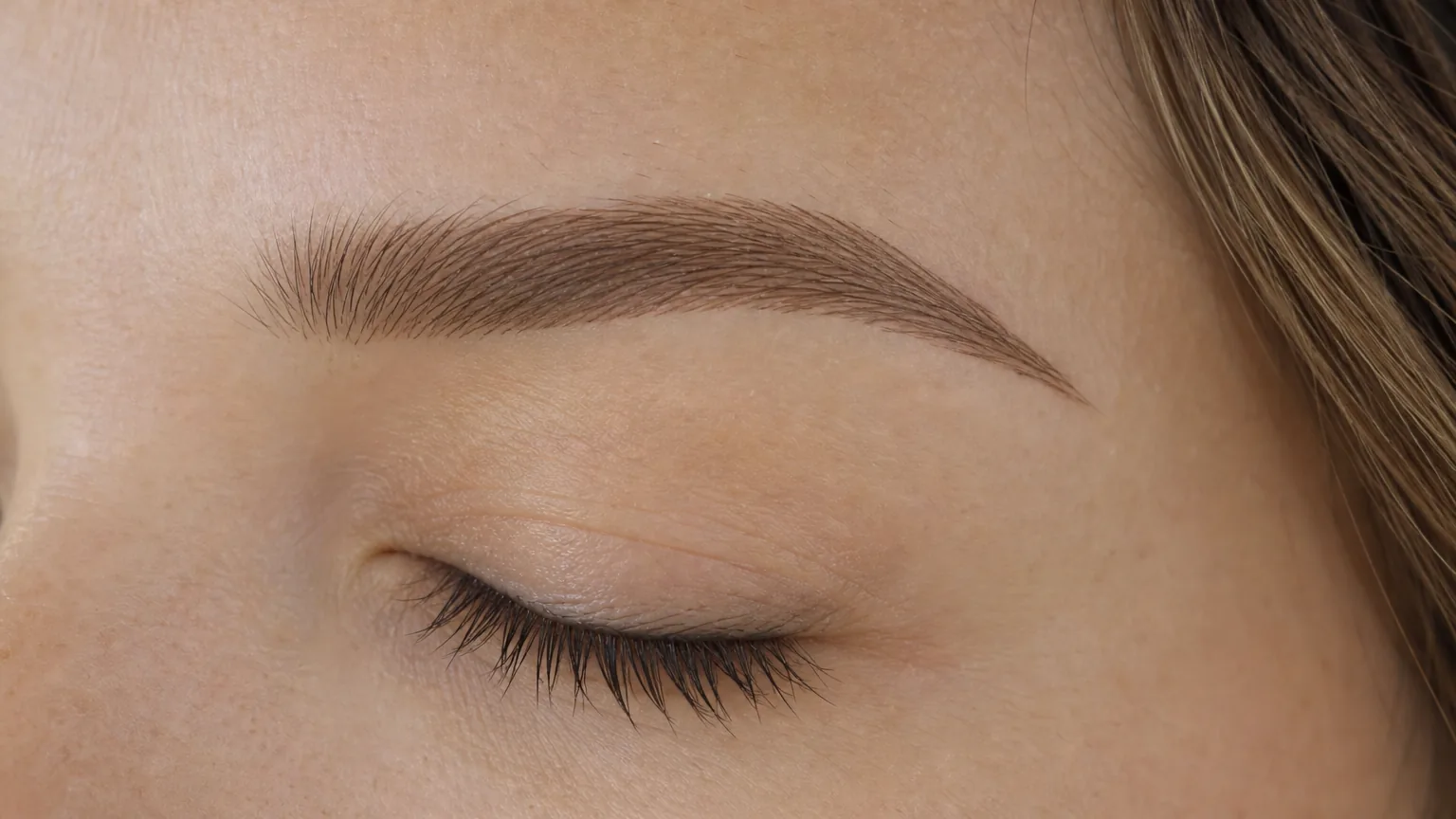
The D count is where names stop describing technique at all. In a 2016 CBC News report from Prince Edward Island, one aesthetician described tattooing a custom colour at the first appointment, then filling in with a different shade a few weeks later “for a 3D look.” That is roughly what 3D promises: strokes layered in more than one tone, so a flat drawing reads as having depth. It says nothing about the tool, the blade or the pattern.
The higher numbers have no agreed meaning. None of the regulators behind this guide, from the FDA to England’s licensing consultation to Hong Kong’s Consumer Council, uses a D count at all. Because nobody defines it, one studio’s 6D can be another studio’s 3D at a higher price. Read the number as a description of the look the studio wants to sell, then ask what tool and pattern sit behind it.
Names That Mean a Machine, or Might
Nano brows. Usually machine work. A 2021 Hypebae explainer says nano brows “are applied using a single-needle tattoo machine,” and quotes a cosmetic tattoo artist contrasting the “rows of tiny punctures” a single needle leaves with the “paper-cut-like split” of microblading. But nano strictly describes the needle, not the method. England’s consultation lists nanoblading as microblading’s approach “with the use of a finer nano-needle,” and mentions no machine. When a menu says nano, ask whether a machine is involved. Our guide to hairstroke brows covers the machine version in detail.
Powder, ombre, microshading. These names describe the pattern rather than the tool: soft shading built from tiny dots of pigment, which heals to look like brow powder rather than individual hairs. The tool varies. England’s consultation describes ombre powder brows as made with “a digital machine or handheld tool used to insert tiny dots of pigment.”
Combo and hybrid. Hair strokes and shading in the same brow. Hvas and Serup discuss exactly this pairing: microblading combined with “conventional machine-driven needle tattooing for background shading.” Ask which part of the brow gets which technique, because the healed look depends on the split.
Umbrella Names: Cosmetic Tattoo, Permanent Makeup, Micropigmentation
The broadest labels name the category, not the technique, and they follow geography and setting more than method. Each one covers everything above, plus lips and eyeliner.
Permanent makeup is the usual American umbrella, and the FDA leaves no room for doubt about what it is: “Permanent makeup is a type of tattoo.” The agency’s list of common tattoo types names microblading inks outright.
Cosmetic tattoo is the umbrella you will meet in Canada and Australia. When a new studio opened in Sault Ste. Marie, Ontario, in 2019, local news introduced it as a “permanent makeup and cosmetic tattoo studio,” with microblading, microshading and machine powder brows on one menu. In New South Wales the label carries legal weight. The state’s Tattoo Parlours Act licenses body art tattooing and defines it so that it “does not include a cosmetic tattooing procedure.” Brow studios still register with their council and are inspected under the state’s skin penetration rules, and one council’s list of those procedures names microblading, feathering and semi-permanent makeup as three separate entries.
Semi-permanent make-up is the British umbrella, and England’s Department of Health and Social Care uses it interchangeably with micropigmentation. Its 2023 consultation on licensing non-surgical cosmetic procedures proposed covering “micropigmentation (semi-permanent make up), including microblading and nanoblading” in its lowest-risk tier. The “semi” describes how the result behaves, a look that fades over a few years. It is not a different procedure.
Micropigmentation is the clinical word. Dermatology and plastic surgery papers use it for brows; a Brazilian case report and review defines it as “cosmetic eyebrow definition and reshaping.” In hospitals it also covers work well away from the brow, which England’s consultation groups as advanced micropigmentation: the eye area, areolas, scars and vitiligo. If you are reading research rather than menus, this is the term to search, and our guide to areola restoration and scar camouflage shows how the medical side of the field works.
Art makeup, often written artmake, is the Japanese name, and in Japan it signals something no other label here does: a medical procedure. A 2021 study from a Tokyo clinic notes that Japan is one of the few countries that treats permanent makeup this way, and only doctors and nurses may perform it. South Korea, where only licensed doctors could legally tattoo for more than three decades, went the other way in 2025. Its new law defines tattooing and semi-permanent makeup together and will license both through a national exam once it takes effect. Our guide to getting microblading abroad covers what that means for travellers.
Every umbrella leads back to the same fact: pigment placed in the skin with a blade or a needle is a tattoo, whatever the sign says. Our comparison of microblading and body tattoos explains what that means for depth, fading and removal.
Names That Sound Similar but Put No Pigment in Your Skin
Some menu items share vocabulary with the tattoo family and are a different kind of treatment entirely.
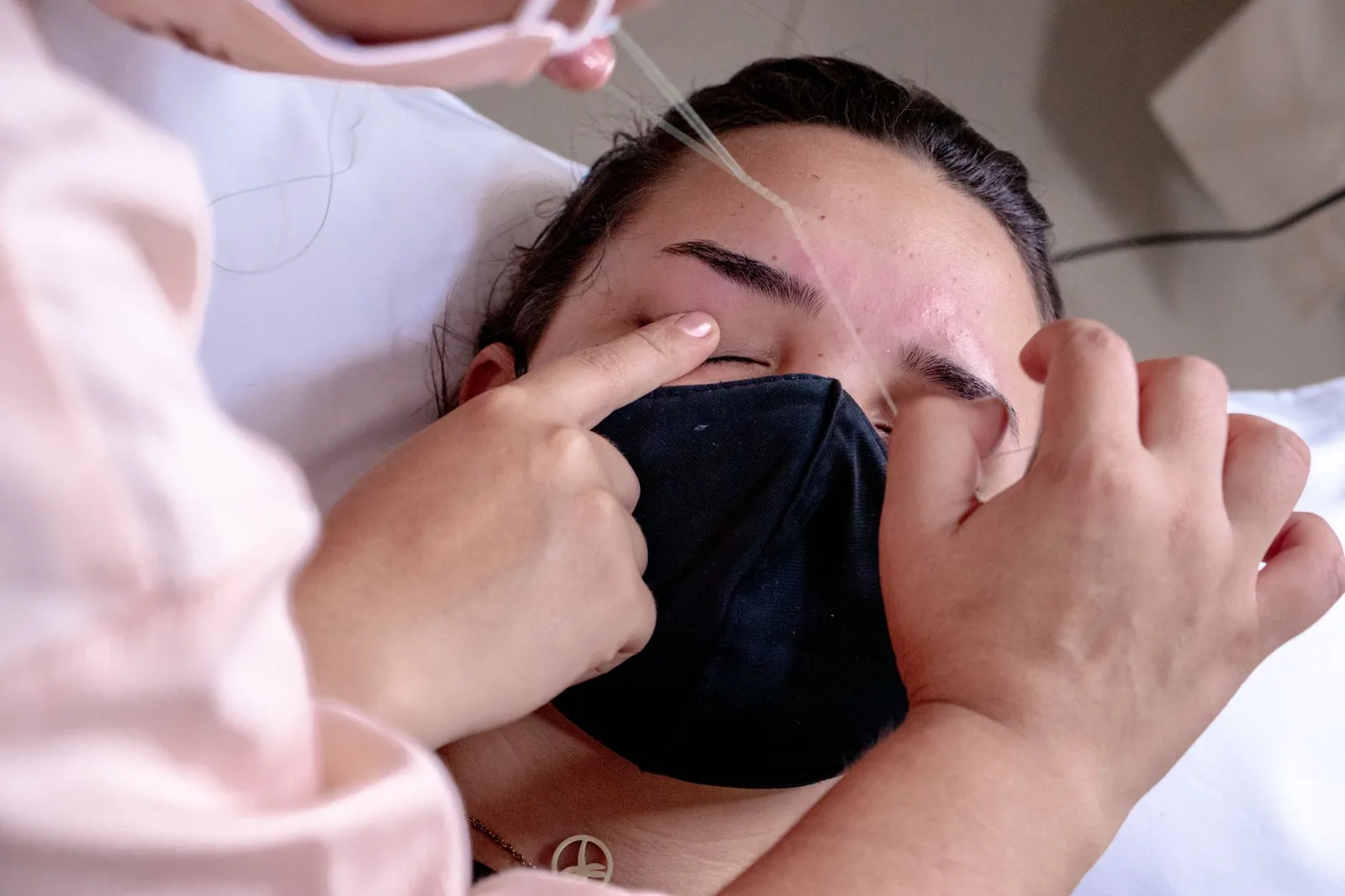
Threading removes hair with a twisted loop of cotton thread rolled across the skin. Nothing is implanted. Despite the sewing-box name it is closer to the opposite of embroidery, and once you have microbladed brows it comes with its own waiting periods, covered in our guide to waxing, threading and tweezing around microblading.
Tinting and henna brows dye the hairs and stain the surface of the skin, and fade within weeks. Lamination is a perm for the brow hairs that sets them in a brushed-up shape. None of the three involves a blade or a needle.
The overlap reaches medical journals too. A 2023 case report about a chronic granulomatous reaction that developed after microblading carries the words “semi-permanent eyebrow tint” in its title. When the name matters, on an allergy history, an MRI safety form or a referral for removal, describe what was done: a cosmetic tattoo of the eyebrows, the technique, and the pigment brand if you have it.
How to Translate a Studio Menu Before You Book
Whatever a listing calls itself, five questions turn it into something you can research:
- Hand blade or machine? Ask to see the tool. A microblade is a handle with a row of fine needles set in a line; a machine is a powered pen fitted with a needle cartridge.
- Strokes, shading, or both? If both, ask where each one goes.
- Can I see healed photos of this exact service? Ask for results a year or more out, on skin like yours. Fresh photos show the drawing, not what your skin will keep.
- Which pigment, and can we patch test it first?
- What licence or registration do you hold here? Whatever the menu calls the service, it falls under the local rules for tattooing or skin penetration, and in Japan it belongs in a medical clinic.
Then research the answer, not the label. “Hand blade, hair strokes” means you should be reading about microblading, whatever the sign says. “Machine, tiny dots” points you to powder brows, and “machine, single needle, strokes” to machine hairstroke work. Add the local name to those searches and you will find the reviews and complaints written in the language of the place you are booking.

No name changes the basics. Patch test with the exact pigment before any of these procedures, because a gentler label does not mean a gentler ink. Results vary widely with the artist’s skill and your skin type, so judge healed work rather than adjectives. Book only a licensed practitioner working under your local rules; an unlicensed one is a genuine infection and scarring risk whatever the menu promises. See a dermatologist first if you have eczema, rosacea or another skin condition around the brows. And whatever the D count, the result is semi-permanent: it softens over a few years, needs touch-ups to stay crisp, and is not guaranteed to disappear completely.
Sources
- Refinery29 on eyebrow embroidery and its aliases in Singapore and Malaysia
- Suleman and colleagues with a granuloma after microblading, filed under “eyebrow tint”
- Consumer Council (Hong Kong) for what to check before eyebrow tattooing or embroidering
- U.S. Food and Drug Administration on permanent makeup and microblading inks as tattoos
- BeautyCrew explaining feathering, feather touch and microfeathering
- Department of Health and Social Care on England’s proposed licensing of micropigmentation, microblading and nanoblading
- Vogue Scandinavia with the feathery brow as a pencil and gel look
- Hvas and Serup describing hand-drawn hairstroke tattooing and machine background shading
- CBC News for a second shade layered “for a 3D look”
- Hypebae on nano brows and the single-needle machine
- SooToday with an Ontario cosmetic tattoo studio’s brow menu
- NSW Legislation for the Tattoo Parlours Act’s cosmetic tattooing carve-out
- Campbelltown City Council listing microblading, feathering and semi-permanent makeup as skin penetration
- Motoki, Isoldi, and Ferreira on scarring after eyebrow micropigmentation
- Tomita and colleagues for permanent makeup as a doctors and nurses procedure in Japan
- The Korea Herald covering the act that puts semi-permanent makeup under a tattooist licence
Further reading
- Hairstroke brows: the 2026 guide to microblading’s successor
- Is microblading a tattoo? Depth, pigment, fading, and removal
- From brows to paramedical PMU: areola restoration and scar camouflage
- Getting microblading abroad: price, flying home, and the touch-up
- Waxing, threading, and tweezing around microbladed brows