Waxing, Threading, Tweezing, and Laser Hair Removal Around Microbladed Brows: What Is Safe and When
Published on October 7, 2026

Microblading gives you brow strokes that last a year or more. It does nothing to stop your own brow hair from growing. A few weeks after the appointment, strays start turning up under the arch and between the brows, and sooner or later every client asks the same thing: how do I get rid of these without damaging the work I paid for?
The answer depends on two things: how far along your healing is, and what the tool actually touches. Tweezers touch one hair. Wax grips the skin. Thread rolls across it, a blade scrapes it, and a hair removal laser fires light at pigment, which is exactly what your strokes are made of. This guide covers when each method becomes safe after microblading, and which ones should stay off the brows for good.
What Each Hair Removal Tool Actually Touches
Permanent makeup is a type of tattoo, as the FDA puts it, with the ink placed in the dermis rather than on the surface. In microblading that ink sits shallow: in their dermatology review of the technique, Marwah and colleagues place it in the papillary dermis, the layer just beneath the outer skin. Your brow hairs grow up through that same patch of skin. Every way of removing them has to reach the hair through the surface or across it, and how much skin a method disturbs decides how risky it is for your strokes.
- Tweezers pull a single hair from its follicle and barely touch the skin around it.
- Threading rolls a twisted loop of cotton thread across the skin to catch rows of hairs, while the skin is held taut.
- Wax cannot grip the hair without gripping the skin too, and the pull that removes the hair tugs the skin with it.
- Dermaplaning blades and brow razors cut hair at the surface and scrape away dead skin as they go.
- Laser hair removal finds the follicle by its pigment. Tattoo ink is pigment too.
The further down that list a method sits, the more skin it disturbs for every hair it removes, and the longer it should wait before going anywhere near your brows.
The First Six Weeks: Hands Off, Then One Tool at a Time
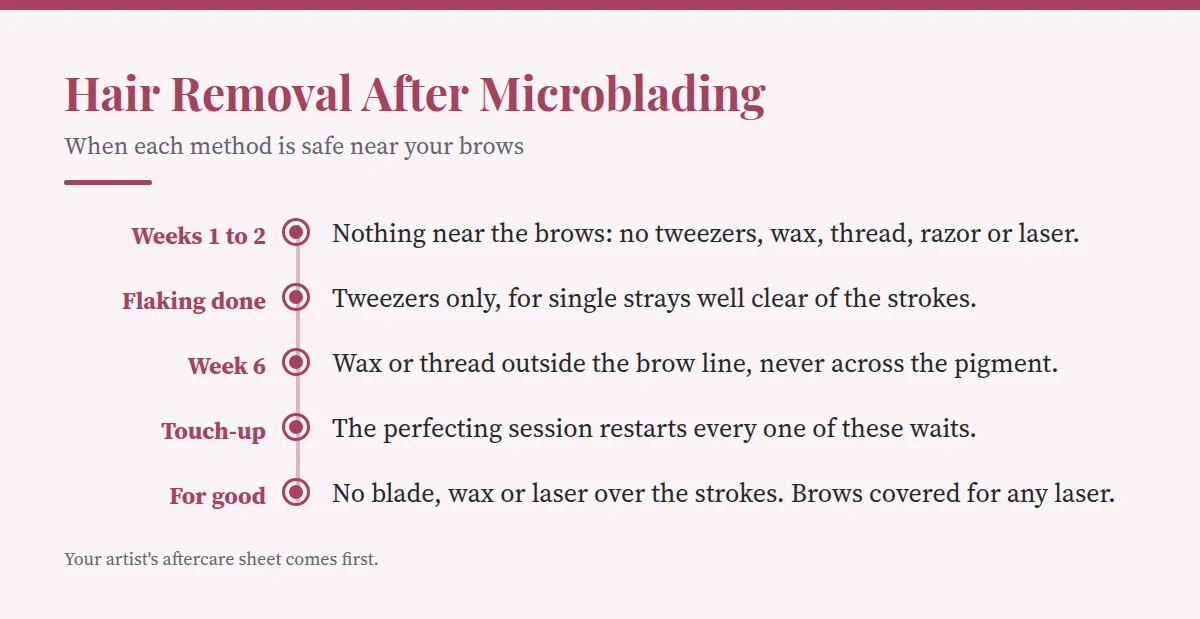
Fresh microblading is a set of fine, shallow cuts packed with pigment. Over the first couple of weeks the strokes darken, form a thin scab and flake, and pigment comes away with any flake that is pulled off before it is ready. Our day by day healing timeline walks through each stage. For hair removal, the calendar looks like this:
- Weeks one and two: nothing. No tweezers, wax, thread, razor, or laser anywhere near the brows. A stray hair is not worth the pigment it could cost you.
- Once the flaking has completely finished: tweezers only, and only well away from the strokes. A single stray sitting clearly apart from the pigment, under the arch or between the brows, is the lowest-risk tidy there is. Leave anything growing inside the shape or along its edge alone until after your touch-up.
- Six weeks: wax and thread, outside the brow line. Marwah and colleagues tell clients not to wax or thread their brows for six weeks after treatment. Six weeks is also about when the perfecting session usually comes due.
- After the touch-up: start the clock again. The perfecting session reopens the skin, so every one of these waits runs from that date, not from your first appointment.
Your artist’s aftercare sheet overrides this calendar wherever the two disagree. Some artists ask for longer, and they have seen your skin.
Tweezers: The Safest Tool, Aimed at the Right Hairs
Tweezing is the hair removal method least likely to harm healed microblading, because it works one follicle at a time and leaves the skin’s surface alone. The risks come down to where you aim and how much you take.
Aim only at hairs that sit clearly outside the mapped shape. The hairs inside it are doing a job. Microblading strokes are drawn to sit among your natural brow hairs, and real hair layered over the pigment is much of what makes the strokes read as hair at conversational distance. Pluck inside the shape and you thin out the texture that sells the effect.
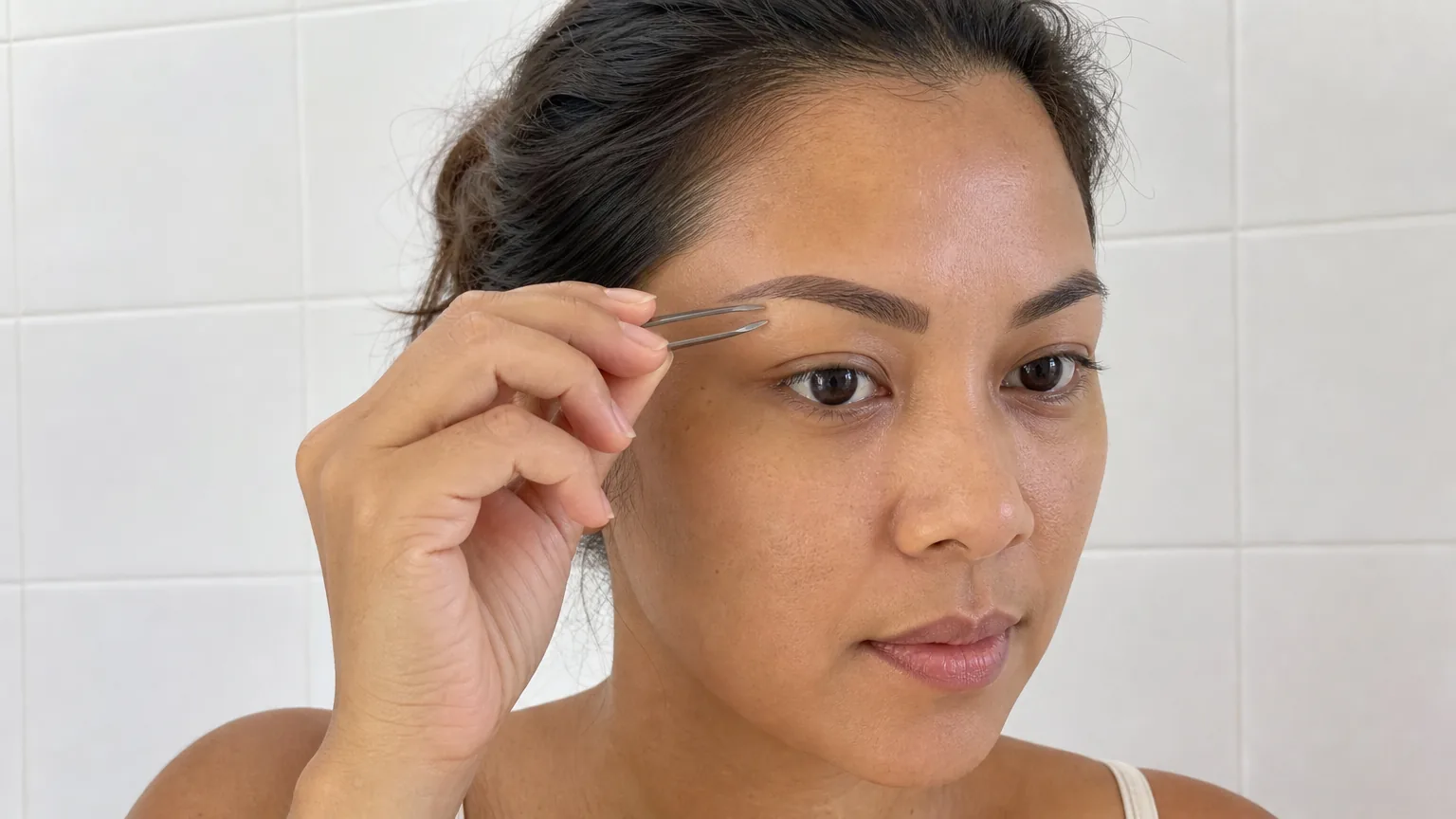
Go easy on quantity, too. In their clinical review of brow and lash loss, Nguyen and colleagues list repetitive pulling and overplucking among the traumatic causes of losing brow hair, and plenty of microblading clients first booked because of brows that were plucked thin years ago. Wipe the tweezer tips with alcohol before you start, because an inflamed follicle is the last thing you want next to fresh pigment.
Waxing: The Method That Waits the Longest
Wax is a quick way to shape a brow and the bluntest tool you can take to a microbladed one. On healing skin it grips the fragile surface over each stroke and lifts it before the skin underneath is ready, which is how brows end up with patchy gaps.
Skin fragility is the reason wax gets singled out elsewhere in medicine, too. The prescribing information for isotretinoin tells patients to avoid wax epilation during treatment and for at least six months afterwards because of the possibility of scarring, and Wu and colleagues describe the skin fragility the drug causes as a particular problem for waxing. If you take isotretinoin, wax is off the table near your brows whatever your microblading dates; our guide to microblading with acne-prone skin covers that wait in detail.
Once you are past six weeks and fully healed, waxing outside the brow line is reasonable: the hairs under the arch or between the brows, with the wax kept clear of the pigment. Ask for that before the spatula comes out, because a busy brow bar works fast and wax spreads. Then keep an eye on the skin afterwards. Over a year of patients seen at one dermatology department for skin problems after salon procedures, Kolalapudi and colleagues found folliculitis after waxing to be the second most common complaint, behind only acne-like breakouts.
Threading: Precise, but It Works Across the Skin
Threading has a loyal following among brow clients, and for good reason. It is quick, precise, and can take out a single hair or a whole row at once. It is also less hands-off than it looks. As Ladizinski and colleagues describe the technique, the threader rolls a twisted loop of thin thread across the skin to trap the hairs, while the skin around the brow is held taut. On healing brows that means friction and stretch over fresh strokes, so threading belongs in the same six-week wait as wax.
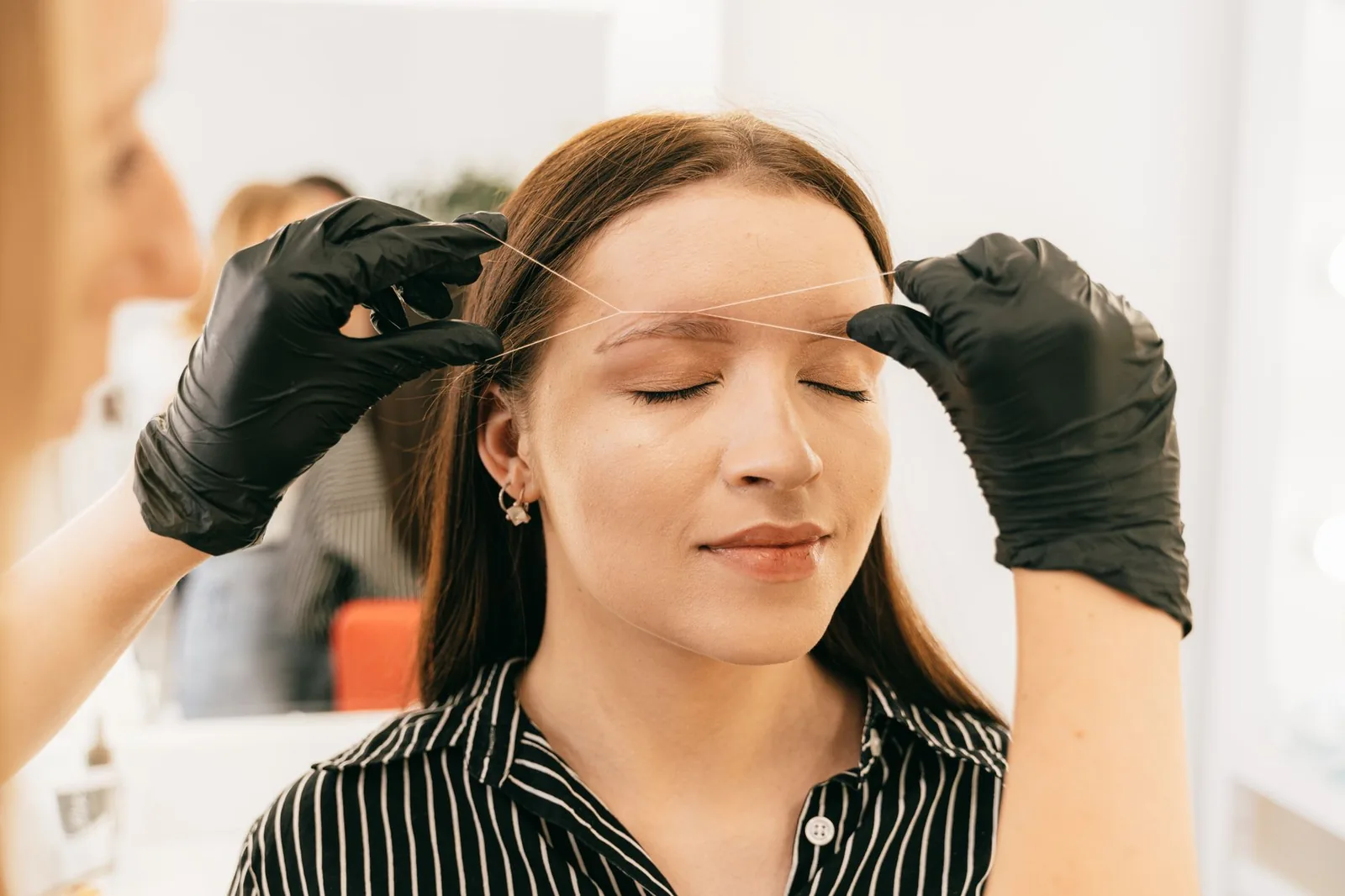
On healed brows, threading outside the shape is a good option, and it is kinder than wax to fragile skin: Wu and colleagues put it forward as the alternative for patients on isotretinoin. Complications are rarely reported, and they mostly come down to technique and hygiene. Ladizinski and colleagues list folliculitis, flat warts, molluscum contagiosum, darkened skin, and vitiligo triggered by the trauma, and they stress disposable threads and properly sterilised tools. A fresh length of thread for every client is the minimum to look for.
Brow bars often sell threading as a bundle with a tint or a henna brow. That is a separate decision with its own risks, and if you have ever had a black henna tattoo, read our piece on henna brows and PPD allergy before you say yes to one.
Dermaplaning and Brow Razors: Keep the Blade Off the Strokes
A brow razor or dermaplaning blade cuts hair at the surface instead of pulling it out, which sounds gentler. The catch is that the blade is an exfoliator as well. It scrapes off dead skin along with the hair, and Marwah and colleagues list exfoliation among the things that fade or change microblading colour. During healing, a blade over the strokes is a blade over open skin.
Once you are healed, a razor is fine for the forehead and for strays well below the arch, as long as you stop short of the pigment. If you book whole-face dermaplaning, ask the esthetician to work around your brows, and put the request in your booking notes rather than raising it on the table. Our article on why microblading fades fast covers how facials and dermaplaning over the brow bone add up over the years.
Laser Hair Removal: Keep It Away From the Brows
Laser hair removal is the one method here that can change your brows for the worse in a single session, and the brows are not the only thing at stake.
It cannot tell hair from ink. A hair removal laser finds its target by pigment, which is why, as the AAD puts it, it works best on light skin with dark hair. The laser types used for hair removal (ruby, alexandrite, diode, and Nd:YAG in Haedersdal and Wulf’s evidence review) overlap with the ones used to remove brow tattoos, as Geisler and colleagues’ review of eyebrow pigment removal shows. The best-documented problem is darkening. Anderson and colleagues reported five cosmetic tattoos that darkened instantly under laser treatment (in two of them, further laser sessions could not clear the darkened ink and it had to be cut out) and showed that ferric oxide, a brown-red iron pigment common in cosmetic inks, blackened in the lab when hit with laser light. More recently, Al-Jasser and Al-Issa described a woman whose pink cosmetic lip tattoo darkened within two days of laser hair removal around her mouth. Hers improved on its own over about two months, but the device was a Q-switched laser, which the authors call an unconventional choice for hair removal, and nothing guarantees darkening will reverse.
It is not done on the brows themselves. The AAD’s list of areas laser hair removal treats includes the face, “especially the upper lip and chin,” and the brows are not on it. Everyone in the treatment room wears protective eyewear, and the ophthalmology literature shows why. Shulman and Bichler, reporting three patients with eye inflammation after laser hair removal of the eyebrow region, concluded that it “may result in anterior uveitis as well as irreversible damage to the iris.” Carrancho Garcia and colleagues described two women whose pupils were left dilated and displaced after diode laser brow epilation, one of them with a cataract as well.
Near the brows, cover and distance do the work. Lasering the strip between the brows or the forehead above them can be done with microblading in place, as long as the person holding the handpiece knows the pigment is there before they plan the treatment. Ask for your brows to be covered, and expect the technician to leave a margin rather than working right up to the strokes. Marwah and colleagues warn that resurfacing lasers and IPL fade pigment even when they are used at a distance from it, so do not treat a home IPL device as the exception; keep it off the brow area too. Our guide to sequencing lasers and other treatments around microblading covers how long to wait after a fresh session.
Permanent cuts both ways. The AAD describes laser hair removal as permanent on most areas of the body, but not on a woman’s face, where hormones bring hair back, so facial results need maintenance sessions. Every top-up near the brows is another round of laser energy beside your pigment. If a few stubborn strays keep returning and you want them gone for good, ask a dermatologist about electrolysis. Kang and colleagues’ literature review notes it is the only hair removal method that is not temporary, and because it treats one follicle at a time with a fine probe and electric current rather than light, it is easier to keep clear of the strokes.
Before Your Appointment: Let the Brows Grow
The hair removal question starts before the first session. Your artist maps the new shape from your natural growth, so the more of it they can see on the day, the more they have to work with. Stop shaping a few weeks before (ask your artist how long they want) and leave the strays to them: Marwah and colleagues note that extra hair is removed as part of preparing the brow, before the strokes go in.

Bring two things up at the consultation. If you are partway through a course of laser hair removal anywhere near the brows, say so; the AAD puts the usual gap between sessions at four to six weeks, and that schedule has to work around your healing. And mention isotretinoin, current or recent. Marwah and colleagues include both ongoing laser or IPL sessions and isotretinoin in the history a practitioner should take before microblading.
Say It at Every Booking
Microbladed brows done well look like a good set of natural brows, which is the whole point. It also means the person waxing, threading, or lasering your face may have no idea there is pigment in the skin unless you tell them. So tell them, every time, and be specific:
- “My brows are microbladed, so please keep wax, thread, and blades outside the pigment.”
- “Please cover my brows before any laser or IPL, and leave a margin around them.”
- “Only the strays outside the shape, please. Leave the hairs inside it.”
- “I am taking isotretinoin,” or “I stopped it recently,” if either is true.
The usual caveats apply here as everywhere in this field. Microblading is semi-permanent, and the strokes you are protecting will fade over one to three years regardless, which is a reason to look after them rather than help them along. Results vary enormously with artist skill and skin type, patch testing should come before any pigment goes in, and microblading itself should only be done by a licensed artist (the FDA notes that the practice of tattooing is regulated locally). If you have eczema, rosacea, or another skin condition around your brows, get a dermatologist’s view before adding any hair removal method to the mix. And for laser, the AAD’s advice is plain: have it done by a board-certified dermatologist or under one’s direct supervision.
Sources
- U.S. Food and Drug Administration on permanent makeup as a tattoo, and the health risks it lists
- American Academy of Dermatology for what to expect from laser hair removal, protective eyewear included
- AAD with the areas lasers treat, and why facial hair removal is not permanent for women
- Marwah, Kerure and Marwah on microblading technique, aftercare, and the six-week waxing and threading rule
- Nguyen, Hu and Tosti for a clinical review of brow and lash loss, overplucking included
- DailyMed with the isotretinoin label’s six-month warning on wax epilation
- Wu, Bhandari and Burkhart on threading as the gentler option for patients on isotretinoin
- Kolalapudi and colleagues for a year of skin problems seen after salon waxing, threading, and laser
- Ladizinski, Ganta and Mathur on how threading works and the complications reported after it
- Haedersdal and Wulf with an evidence review of hair removal lasers and light sources
- Geisler and colleagues for the lasers used to clear eyebrow tattoo pigment
- Anderson and colleagues on cosmetic tattoo inks that turned black under the laser
- Al-Jasser and Al-Issa with a cosmetic lip tattoo that darkened after laser hair removal
- Shulman and Bichler on eye inflammation and iris damage after eyebrow laser hair removal
- Carrancho Garcia and colleagues for lasting pupil damage after diode laser eyebrow epilation
- Kang and colleagues with a literature review of hair removal methods, electrolysis included
Further reading
- The microblading healing timeline, day by day through week six
- Microblading with acne-prone skin: breakouts, the isotretinoin wait, and fading products
- Henna brows, black henna, and PPD allergy
- Why your microblading faded so fast
- How to sequence Botox, fillers, lasers, and facials around microblading