Why Your Microblading Faded So Fast: The Long-Term Retention Playbook
Published on September 5, 2026

You did the aftercare properly. You sat out the two weeks, you went back for the perfecting session, and the healed result was exactly the brow you asked for. Then somewhere around month fourteen the tail of the left one started thinning out, and by month twenty you were penciling again. Your artist quoted one to three years. Marie Claire’s experts put the range at two to five. Neither number matches what you are looking at in the mirror.
The quoted lifespan is not really a property of the pigment. It is a property of your life. Microblading sits in the upper dermis, shallower than a body tattoo by design, which is what lets it fade softly instead of turning into a permanent block of colour. That shallow placement is also what makes it vulnerable to things a shoulder tattoo would shrug off. Everything below concerns the period after healing is complete. If you are still inside the first six weeks, the rules are different and stricter, and they live in our aftercare guide.
The Quoted Range Assumes an Average Life You Might Not Have
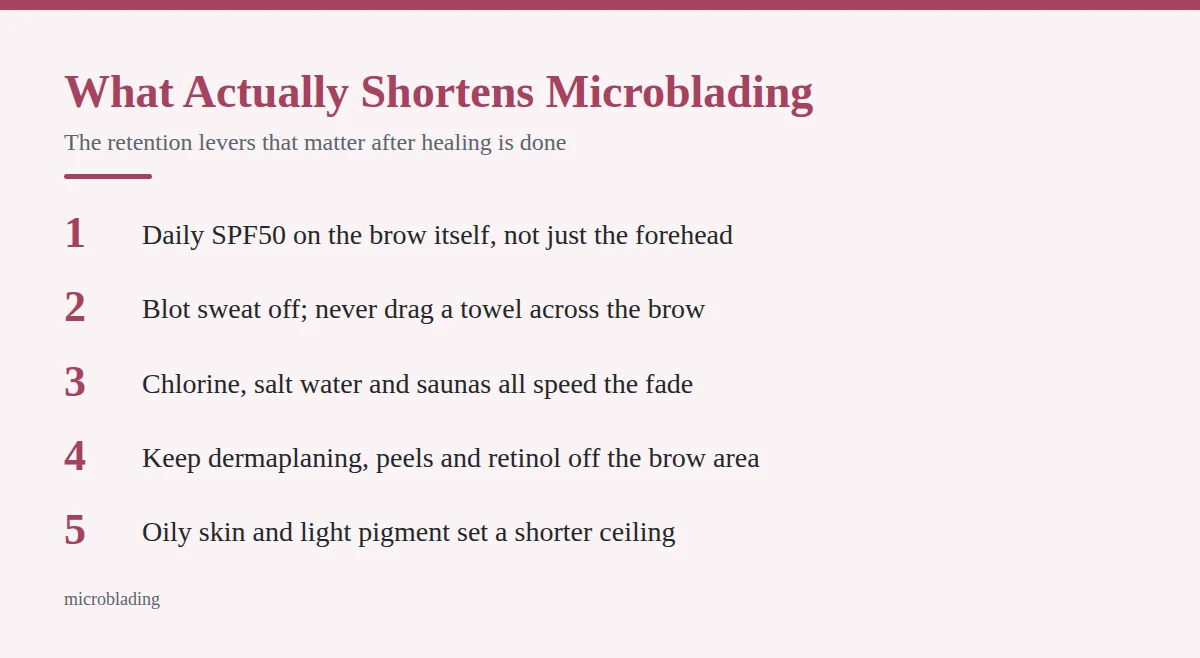
When an artist says “one to three years,” they are describing a median client: normal skin, an office job, moderate sun, a mid-tone pigment laid at a moderate saturation. Shaughnessy Keely Otsuji told Marie Claire that microblading typically softens over two to five years “depending on skin type, lifestyle, and how saturated the microbladed strokes are,” and added that plenty of clients are now finding their results fade faster than expected.
Those three variables do most of the work. You cannot change your skin type, and the saturation was decided the day the blade touched your face. Lifestyle is the one that is still open, and it is the one nobody itemises for you. So here is the itemised version, roughly in order of how much damage each one does.
Cumulative Sun Is the Single Biggest Lever
Ultraviolet light breaks down pigment particles sitting near the skin’s surface, and it does it every single day you go outside, in small increments you never notice. There is no dramatic moment. There is just a brow that is two shades lighter in September than it was in April, every year, forever.
The advice is unglamorous and genuinely effective. Cosmopolitan’s Katie Onyejekwe, writing six years after her own microblading, quoted brow specialist Wallace’s rule directly: keep them protected with a minimum of SPF50, and keep retinoids and exfoliants off the area. Tanning beds count too. Permanent makeup artists interviewed by SaltWire flagged unprotected sun and tanning beds as PMU concerns in exactly the way they are concerns for natural brows.
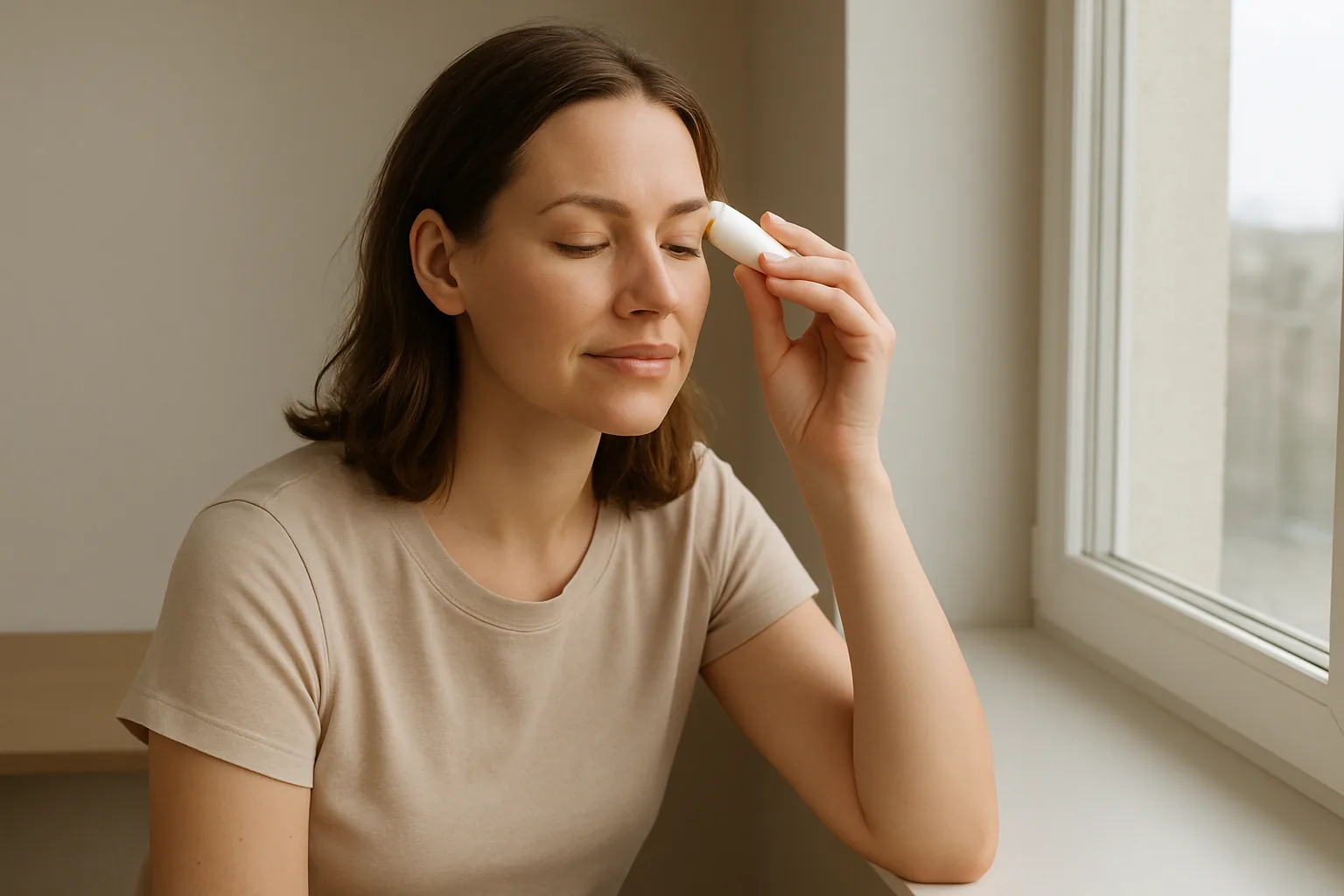
Almost nobody actually does this, and the reason is practical rather than lazy: chemical sunscreen migrates into your eyes and stings, so people instinctively stop the application at the orbital rim, which is precisely where the pigment is. Two fixes work. A mineral stick SPF pressed over the brow with a fingertip stays put and does not run. Or use a tinted mineral SPF as your brow-area product and let it double as light coverage. Either way, the habit that matters is the one that treats your brows as skin that needs sunscreen, not as hair.
UV does not only lighten. It also shifts tone, which is a large part of why aged brows drift toward grey, blue, or a rusty red as the warmer components of the blend degrade first. The chemistry behind that is worth reading if your problem is colour rather than density, and we cover it in our pigment chemistry guide.
Sweat, and Why It Is Really the Towel
Sweat is salty and it arrives from below, and on a five-day-a-week training schedule the brow area is repeatedly wet. Each session then ends with the same reflex: wiping. The wipe is the part that costs you. Salt in solution softens the surface, and dragging a gym towel across a damp brow bone is a low-grade exfoliation you perform two hundred times a year without ever counting it.
You do not need to stop training. You need to stop wiping. Blot the brow instead of dragging across it, use a clean towel rather than the one that has been on the bench, and rinse with plain water afterwards rather than leaving dried salt sitting on the skin overnight. Athletes and anyone in a helmet or headband have the additional problem of friction on top of moisture, and men in particular tend to combine heavy sweating with a daily razor pass near the brow line, which our guide to microblading for men covers in more detail.

Chlorine, Salt Water, Saunas, and Hot Yoga
These four get grouped together in aftercare sheets and then never mentioned again, which leaves regular swimmers assuming the restriction expired with the healing window. It did not. It just softened.
Chlorine is an oxidising agent. It is doing to your brow pigment a mild version of what it does to blonde hair, and a lap swimmer doing four sessions a week is delivering that dose consistently for years. Salt water is less aggressive chemically but usually arrives bundled with a full day of direct sun, so ocean swimming tends to be a sun problem wearing a swimming costume.
Saunas, steam rooms, and hot yoga work differently again. Sustained heat dilates the vessels in the skin, increases circulation through the dermis, and speeds the immune clearance that is slowly carrying your pigment particles away anyway. It also produces sweating without any of the cooling that outdoor exercise gives you.
None of this makes swimming or a sauna habit incompatible with microbladed brows. It makes them a line item in your maintenance budget. If you swim seriously, plan on colour boosts roughly twice as often as quoted, and raise the habit at consultation so pigment and saturation are chosen around it.
The Facial Nobody Connects to the Fading
This is the one that surprises clients most, because it feels like self-care rather than damage. A glycolic peel, a dermaplaning pass, microdermabrasion, or a resurfacing facial all do the same thing: accelerate cell turnover in the upper layers of skin. That is exactly where your pigment lives.
The specific failure is small and repeated. An esthetician working across the face does not stop at the brow bone unless you tell them to, and a dermaplaning blade passing over the brow area every six weeks is an efficient pigment remover. Retinol is the domestic version of the same problem: nightly use is widely reported to roughly halve how long microblading lasts, and most people apply it with a flat palm straight across the forehead and brows.
The fix costs nothing. Put “please work around my brows, I have permanent makeup” in your booking notes rather than mentioning it once you are already on the table, and route your fingertips around the brow when you apply actives. You are not giving up your skincare routine. You are giving up a two-inch strip of your face. The full calendar for peels, lasers, and facials in both directions is in our treatment sequencing guide.
Your Skin Type and Pigment Set the Ceiling
Everything above is a lever you control. Two things you mostly do not control set the maximum the levers are working against.
Skin type is the larger of the two. Oily skin lifts and disperses pigment continuously from below, and the effect is significant enough that Glamour’s reporting suggested oily-skinned clients may need maintenance roughly every six months rather than every year or two. Dry and normal skin holds crisp strokes for the full quoted span. This is not a small difference in degree, it is a different product lifespan, and it is the main reason two people treated on the same afternoon end up in completely different places. Our skin type pairing guide walks through which technique suits which canvas.
Pigment choice matters more than most clients realise. Lighter pigments fade faster, as cosmetic tattooer Caitlin Cartwright put it plainly to Glamour: “Lighter pigments fade faster. Sun exposure without SPF will fade and discolor your brows.” Inorganic pigments generally clear faster than organic ones, which is useful if you want a shorter commitment and frustrating if you were expecting three years. A light, softly saturated brow on oily skin in a sunny climate is the fastest-fading combination there is, and every one of those four factors was decided before you left the studio.
The Levers Compound, They Do Not Add
This is the part that explains the outliers. A client with dry skin, an indoor job, daily SPF, and no exfoliating habit can genuinely be at four or five years with a brow that still reads well. A client with oily skin who swims four times a week, takes a Saturday sauna, has a six-weekly dermaplaning facial, and never once put sunscreen on her brows is not running one lever against the average. She is running five, each one shortening a lifespan the previous one already shortened.
That is why the honest answer to “how long does microblading last” is a range too wide to be useful without knowing the person, and why fixing even two habits usually shows up at the next annual check.
When Fast Fading Genuinely Is Not Your Fault
Not every early fade is a lifestyle problem. Pigment implanted too shallowly sheds with the epidermis within months. Poor-quality or over-diluted pigment fades unevenly regardless of what you do. An artist working too lightly on a client who needed more saturation produces a beautiful two-week photo and a disappointing year. And an unlicensed practitioner working outside health department oversight is a risk to considerably more than your brow shape, since microblading is a regulated procedure for good reason.
If your brows lost most of their pigment inside the first six months despite reasonable habits, that is a conversation with your artist about technique and pigment, not a lecture you deserve about sunscreen.
Whatever you decide next, treat a colour boost as a fresh procedure. Sensitivities develop over time, so a patch test is warranted before new pigment goes in even if the first appointment years ago was uneventful. Anyone with eczema, rosacea, or a history of reacting to pigment should see a dermatologist before booking. Results vary enormously with artist skill and skin type, and microblading is semi-permanent rather than permanent, which cuts both ways: it will fade, and how fast is substantially up to the next two years of your ordinary Tuesdays.
Sources
- Marie Claire on how far microblading has come and what actually decides its lifespan
- Cosmopolitan for the SPF50 rule one writer learned six years too late
- Glamour with why lighter pigments and oily skin shorten the touch-up cycle
- SaltWire covering what permanent makeup artists wish clients knew about sun and tanning beds
- Women’s Health on how skin type governs pigment retention across brow techniques
Further reading
- Microblading aftercare tips: keeping your brows beautiful
- Microblading by skin type: the complete pairing guide
- Microblading pigment chemistry: why brows turn blue, red, or grey
- Botox, fillers, lasers, and facials: sequencing treatments around microblading
- Microblading years later: what brows do at 3, 5, and 7 years out